 One of the fun things about living in a very old house is that every now and then, stashed away in a dark corner, you find a completely fascinating remnant of the past. Such was the case when Bill and Bev Betts found a firemen’s convention booklet from 1902 in their 128-year-old Saratoga County, NY, farmhouse.
The convention was held in Mechanicville, NY, over Labor Day weekend. The commemorative booklet is loaded with pictures and advertisements, not just from Mechanicville, but from neighboring communities as well. Although many of the names ring a bell, none of the industries or businesses mentioned save the struggling Delaware and Hudson Railroad, survived into this century.
When I began reading the text, I found myself laughing out loud. Now, usually when you read one hundred year old material about such a prestigious event as this convention apparently was, you expect complete seriousness. Not so. Whoever penned the text for this booklet had a lively sense of humor. For example, “In the beginning God created the heavens and the earth, and the earth was without form and void, because Mechanicville did not yet appear on the face thereof.”
Now, even the city’s most enthusiastic supporters would have to recognize that the writer’s tongue was firmly planted in his cheek when he wrote that line.
He also discussed discovery of the river on which Mechanicville lies, saying “During the anti-colonial days, a marine tramp by the name of Henry Hudson brought his schooner named the Half Moon to the head of this tail race and to this day they have called it the Hudson River, and the choice part of the surrounding country Halfmoon. The style of Hudson’s vessel left its impress on the nomenclature and size of drinking vessels, yet much used in Mechanicville.”
He was speaking humorously, of course, of the bars and saloons that graced the community back in its formative years, but in spite of the sharp wit, there is a great deal of marvelous local history contained in the booklet, a vivid picture of our fair city one hundred and twenty-two years ago.
The writer talks about the building of canals, and indeed, the Champlain Canal did bisect the village. The growth of railroads is discussed at length, beginning with the incorporation of the Rensselaer and Saratoga Railroad Company on April 14, 1832 which had tracks from Troy to Ballston through Mechanicville.
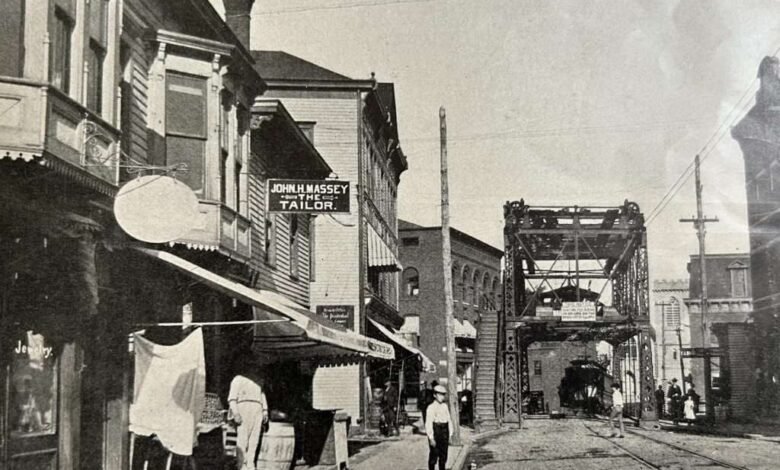
Photos, including the original depot near the canal bridge, the Delaware and Hudson (Union) Depot at Depot Square and the vast freight yards, show the energy these railroads provided our community in 1902.
The many mills that once dominated the city’s landscape, including the Duncan Company paper mill, American Linen Thread, Mechanicville Knitting Mill and the J. B. Orcutt Company are also represented.
Three local brick manufacturers are advertised and their plants pictured, including the Champlain Brick Company, Mechanicville Brick Company and Best Brick Company. Friction matches were also made in Mechanicville for a time, as were razor strops, flutes, fifes, Britannia teapots, whips, bolts and cistern pumps.
The village had its share of hotels, notably Hotel Hawley, Hotel Leland, Hotel Ellsworth, and the Grand Central Hotel. The First National Bank proudly proclaimed capital of $50,000 while the Manufacturers’ National Bank, which touted itself as “an institution which wields a powerful influence in the business affairs of this community” claimed it had deposits of $325,000 and loans outstanding of $320,000.
Within the village proper you could buy beef, pork, lamb, poultry and lard at H.B. Dugan’s Market, and there were numerous stores that variously featured groceries, fresh baked goods, cigars, shirts, collars and cuffs, horse harness, spring beds, ice cream and candy.
There was no shortage of places to eat, and no shortage of drug stores. If you needed to travel, you could hire a horse and buggy at a livery stable on Mabbett Street, or you could have a wagon of your own built to order by Charles H. Burns, the village blacksmith on School Street. Edward LaDoux would paint that wagon up for you, too.
Residents of the village at the turn of the century were justifiably proud of the village’s three modern brick school buildings: the high school on Main Street (on a site now occupied by the Mechanicville Area Community Services Center), School 2 on Chestnut Street and School 3 on Saratoga Avenue. None of these school buildings are with us today.
William C. Tallmadge, who gave the city the lovely park bearing his name, had passed away in August of that year, not long after his 85th birthday. A photo of Mr. Tallmadge seated on the porch of his Mechanicville home is shown, as is a shot of the park taken from the top of the hill.
William H. Van Ness sold pure milk and cream, C.A. Howland had an insurance office on Main Street, C.M. Fort and Son sold “groceries, crockery, glassware and lamps, wallpaper, paints and oils, field and garden seeds, trunks, bags, etc.,” at their store on the corner of Park Avenue and Main Streets.
F. E. Partridge of Third Street was a carpenter and builder, as was W. D. Tweedy of Spring Street. Golden’s Opera House Café was located at 50 Park Avenue, and A. Buchdahl sold clothing, caps and shoes in the Opera House block.
If you picked up your phone and told the operator you’d like to call 26-A, you could order ice from Smith on Saratoga Avenue, and if you needed any staining, painting, glazing, varnishing, kalsomining (whitewashing) or paperhanging done on short notice, P. A. Mawbey was your man.
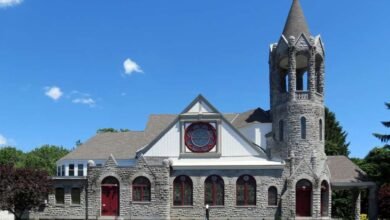
All five of the village’s beautiful churches of that era are pictured, with both interior and exterior views. Although each has been altered a bit, all of them remain to this day except for the Presbyterian Church which was demolished many years ago for a parking lot which now belongs to the CVS Pharmacy.
A number of elegant Victorian homes, street and river scenes, and panoramic views of the village grace the pages. Proud railroaders standing alongside state-of-the-art steam engines, baseball teams, merchants, barbers, and folks on the street – faces of people who forged a thriving community – all are depicted in captured moments of a different time, giving us a vivid and nostalgic glimpse of the Mechanicville that used to be, one hundred and twenty-two short years ago.
Sandy McBride is a native of Mechanicville, and lives in the Town of Halfmoon. Writing has always been her passion, and she has won numerous awards for her poetry. For the past 17 years, she has written feature stories for The Express weekly newspaper and has published four books of feature stories and two poetry collections, and also a children’s historical novel on the Battles of Saratoga entitled Finding Goliath and Fred.
This essay is presented by the Saratoga County History Roundtable and the Saratoga County History Center. Follow them on Twitter and Facebook.
Photo: Park Avenue Lift Bridge, Mechanicville, 1902.