 The morning after a nighttime snowfall evokes feelings of newness and wonder. If the air is calm and the trees still retain their coat of fluffy white, I immediately bundle up and head out to explore. I trudge into the woods looking and listening for signs of life in this alien world.
It is not uncommon for me to follow in the footsteps of others; coyotes, bobcats, foxes, deer, rabbits, and squirrels have already been out and about. I visually follow their tracks, trying to decipher the short vignettes that have been temporarily etched onto the landscape. I stop for a few minutes to listen. Everything is still.
Then I hear soft vocalizations – quiet contact calls – of chickadees and titmice communicating with their flock mates while they search for food. The “yanking” of a white-breasted nuthatch, and the “churrr” of a red-bellied woodpecker seem to break the seal on the library-like quiet, and soon the distant calls of crows and goldfinches flying overhead reach me on the ground.
I start walking again until I reach a small patch of hemlocks from which I can just barely detect a new sound. A thin, high-frequency “tsee” call tumbles from the snowy branches, and I look up to see an impossibly small bird hovering at the end of a needled branch: a golden-crowned kinglet.
Golden-crowned kinglets are ping-pong-ball-sized (and -shaped) songbirds that breed almost exclusively in coniferous forests. In the winter, they occupy a wider variety of habitats, including mixed woodlands, deciduous forests, and even shrub-dominated landscapes.
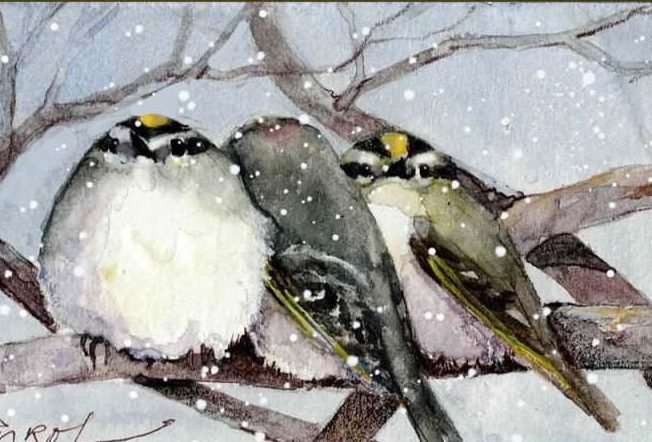
Their small size, quiet vocals, and inconspicuous gray-green plumage make them easy to overlook, but once detected, their bold white, black, and yellow head markings stand out.
For seven months of the year, the golden-crowned kinglet wears the crown of smallest bird in the Northeast, toppled from its throne by the feisty ruby-throated hummingbird in the warm months.
We are often impressed by the hummingbird’s physical and physiological feats – 50 to 80 wing beats per second, 20-hour nonstop flight across the Gulf of Mexico during migration – but those of the kinglet are no less impressive.
Despite their tiny size and correspondingly large surface area to volume ratio (bad for heat loss), they can survive conditions down to negative 40 degrees Fahrenheit. Combined with the fact that these birds retain an invertebrate-based diet during the coldest months, when insects are in short supply, this seems an impossible task.
The question of how these six-gram birds survive such extreme winter conditions caught the attention of Bernd Heinrich a few decades back. Heinrich, a renowned animal physiologist and natural historian, spent several winters investigating the question.
He found that kinglets are very well insulated, and they spend almost every moment of daylight looking for food. Between stomach-content analyses and whacking trees to see what invertebrates fell out, he was able to determine that geometrid caterpillars comprised the bulk of the kinglet’s diet, at least in his part of western Maine.
Heinrich and some of his students also tracked birds at dusk to see what they did at night, and the enterprising researchers found that the tiny birds may conserve energy by huddling together in small groups. Heinrich and his students also found tantalizing evidence that the birds may roost together in miniature snow caves on evergreen branches, thereby benefitting from the snow’s insulating properties.
Heinrich recounts his studies on wintering golden-crowned kinglets in the book Winter World: The Ingenuity of Animal Survival.
A handful of winters ago, I came upon a golden-crowned kinglet hopping on some exposed barnacle and algae-encrusted boulders just below the high-tide line along the coast. The kinglet appeared to be feeding; every so often, it would pluck something from the surface of the rock.
I took some photos to document the behavior, and after the bird had retreated to the trees, I inspected the rocks where it had been feeding. I could see nothing that resembled animal matter, only tiny pieces of frozen algae.
When I looked at my photos later, it did indeed appear that the bird was gleaning tiny flecks of algae from the rock. There is some evidence that golden-crowned kinglets will augment their diet with vegetable matter in the fall and winter, but I think algae would be new.
Regardless of whether the bird was eating algae or some other microscopic food, the experience solidified in my mind that these birds are the kings of winter survival.
Read more about winter survival in New York State.
Loren Merrill is a science writer and photographer with a PhD in ecology. Illustration by Adelaide Murphy Tyrol. The Outside Story is assigned and edited by Northern Woodlands magazine and sponsored by the Wellborn Ecology Fund of New Hampshire Charitable Foundation: nhcf.org.
Source link