 Cobblestone construction is arguably the most unique aspect of the architectural heritage of Western New York: of the 1,054 identified cobblestone structures in North America, 855 (81%) are located within eighty miles of Rochester, with over one hundred each in Wayne, Orleans, Monroe, and Ontario Counties alone.
The manifestation of a unique confluence of glacial processes and skilled masons remaining in the region after its canal building boom, each cobblestone structure — though perhaps easy to overlook in isolation on the modern landscape — is a treasure testifying to the power of craftsmanship.
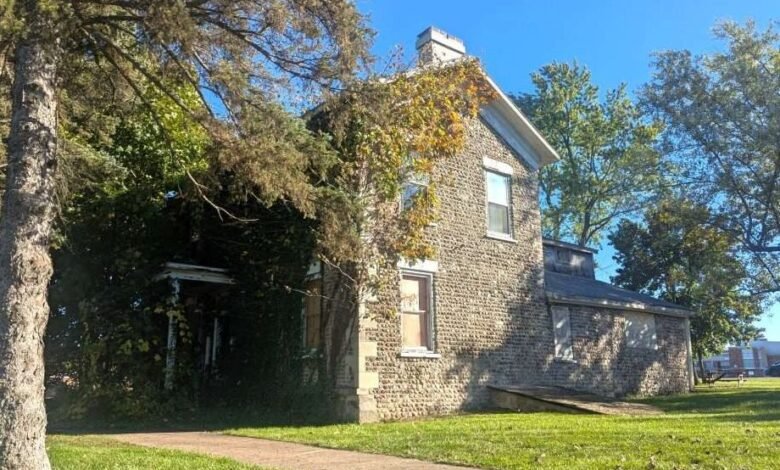
Built by Jacob Hill between approximately 1825 and 1835, the Peirson cobblestone house at 240 West Pearl Street in the Village of Newark, Wayne County, is an early example of cobblestone masonry in the region, valued for both its historical and architectural significance.
The building on the northern fringes of Newark functioned as a farmhouse for a century and a half after its construction ca. 1830, during the earliest period of cobblestone building.
Several generations of the Peirson family owned and occupied the house — or rented it to tenant farmers — for much of that history, from the mid-nineteenth century until the late 1920s. By then, however, Newark’s growth began to encroach on the farmstead.
In 1929, most of the property’s adjoining farmland was sold to serve as the Newark airstrip, even as the house’s remaining grounds were extensively gardened, and once refered to as “a show place of [Newark’s] north side.”
In the 1950s and 1960s, the Newark-Wayne Community Hospital rose in turn on the airstrip land, eventually surrounding the historic house with new institutional development.
In 1947, Joseph Campbell purchased the property and undertook renovations, followed by additional modifications by Drs. Michael McCusker and Walter Muth in the 1970s.
While the interior has been altered over time to accommodate new uses — including use as an ophthalmologist’s office beginning in the late 1970s and 1980s — the exterior retains the original craftsmanship.
The property was later purchased by the hospital itself and reportedly used to house visiting staff, though this use was short-lived.
Today, the Peirson Cobblestone House now sits vacant on the campus of Newark-Wayne Community Hospital, with its landscaping overgrown and the building accumulating pressing maintenance needs — including a leaking roof — that pose serious risks to the integrity of this iconic structure.
Now nearly two hundred years old, it remains one of the Town of Arcadia’s and Village of Newark’s oldest cobblestone buildings. The Landmark Society of Western New York, along with concerned citizens, is exploring ways to preserve this historic resource and prevent its continued deterioration, potential demolition, or even collapse.
The Landmark Society of Western New York has included the Peirson cobblestone house in its 2026 Five to Revive — a list that identifies opportunities for targeted strategic revitalization. The list calls attention to sites across Western New York in need of rehabilitation.
Through this list, the organization hopes to facilitate investment and protect the area’s architectural heritage, by working with owners, developers, investors, and other partners to create connections and reactivate buildings in their communities.
Learn more about the 2026 Five to Revive.
Read more about Historic Preservation in New York State.
Photo of Peirson cobblestone house, ca. 2025 provided by Landmark Society of Western New York.
Source link