 A chronology of cultural interactions between Europe and the United States is a narrative about identity formation. It highlights the transfer of the American artist from a pilgrim to the shrines of European genius to an active participant in redefining the boundaries of art and literature.
Increased transatlantic travel during the 1880s forged close cross-cultural exchanges between the United States and Europe. Many American artists visited European cities for study at their great art institutions, to frequent museums and exhibitions, and copy the Masters.
Young American artists working or studying in Paris would embrace the Impressionist preoccupation with light, color and brushwork. Wealthy American collectors and gallery owners entered the art market as patrons or buyers with an interest in European (French) art to provide private collections at home.
While artists adopted new techniques to depict modern life, they also began developing distinct and independent styles, eventually enabling the transfer of the avant-garde from Montmartre to Manhattan.
The 1880s also experienced the rise of the Arts and Crafts Movement, emphasizing individual skill over industrial mass production. This aesthetic reaction against the horrors of industrialization and urbanization led to the formation of art colonies which served as hubs for stylistic exchange and renewal.
The movement encouraged reform of socio-economic conditions to protect artisanship. There was a utopian undertone in the desire to preserve labor values threatened by mechanization.
It was in one of such colonies, an English village named Broadway, that two American painters found the ideal environment for cultivating their considerable talents. The period marked a transition from a reliance on European models to a more integrated and international artistic dialogue.
Artistic Colonies
During the nineteenth century, art colonies appeared as congregations of creative individuals drawn away from the city to areas of natural beauty, working and living together as a community. These were artistic enclaves that offered mutual support, inspiration from nature, and a retreat from metropolitan life.
Artists escaped urban settings to find fresh motives for creation, a lower cost of living, and new ways of seeing. Moving out to rustic or coastal areas, the exodus coincided with the new trend to leave the studio and paint outdoors (en plein air). Painters brought their canvasses and palettes to “unspoiled” rural places.
In later developments some colonies were turned into mission-driven and formally planned communities with residencies, workshops, and lecture halls. In its original stages, the formation of an artist colony was a spontaneous gathering of like-minded individuals, acting as a group of mutual support.
 They first emerged as village movements, often with a fluctuating population of residents who visited briefly or stayed for just a single summer season (some “colony hoppers” moved from one colony to another, adopting a nomadic lifestyle traditionally associated with the creative artist).
Others settled down permanently in a single village. Jean-François Millet lived at Barbizon (associated with the Barbizon School); Claude Monet resided at Giverny (associated with Impressionism). Most early European art colonies were to be casualties of the First World War. The new world order did not offer much space for such blissful ambitions.
In the later nineteenth and early twentieth centuries, hundreds of young American painters traveled to France, Germany, Denmark, or the Netherlands, to study at academies and join art colonies which were flourishing in these countries. They adopted new techniques and styles, took part in debates about the role of art in society, before returning home and similar artistic communities in the United States.
Starting around 1885, Giverny in the French region of Normandy became a hub for American Impressionists. This picturesque village where Monet lived and worked (and created his famous garden with lily pond and Japanese bridge) became a place of pilgrimage for painters like John Leslie Breck, Theodore Butler, Guy Rose, or Frederick Frieseke.
On the banks of the River Epte, and in the lush country settings surrounding the village, these artists experimented with the new French style of vibrant colors and broken brushwork.
The Broadway Group
At the base of the Cotswold Hills, Worcestershire, some ninety miles northwest of London, lies the village of Broadway. It once had two streams flowing on either side of what is now known as the High Street. The track between streams developed into a curving main street from which the village takes its name.
The Cotswolds became attractive to Londoners and other city dwellers once railways unlocked the countryside. The village’s architecture was an enticing feature. Broadway lies on a belt of limestone that, when quarried, is golden in color. Used as building material, initially for churches and later houses, it created a distinctive “Cotswold architecture.” Broadway’s rural splendor appealed to writers and painters alike.
 A local landmark, the Broadway Tower was the brainchild of England’s greatest landscape designer Lancelot “Capability” Brown, working on behalf of George William, 6th Earl of Coventry, and in cooperation with architect James Wyatt. The latter designed the limestone four-story “Saxon” folly on Broadway Hill in 1798.
From 1822 to 1862, the Tower housed the private Middle Hill Press of Thomas Phillips, a bibliomaniac, and the nation’s most prolific book collector. By the mid-1870s, educator Cormell Price rented the building and invited his friend William Morris for a visit.
The trip inspired the latter to found the Society for the Protection of Ancient Buildings to counter the damage done by Victorian “restorers” to historic properties.
Morris communicated his “discovery” to other artists. Between 1885 and 1889, Broadway grew into a colony of painters, writers, and other artists, known as the “Broadway Group.” Charmed by its peaceful surroundings, these incomers cultivated a withdrawal from the pace of metropolitan life.
Broadway became a bohemian retreat. Amongst key figures were American painters John Singer Sargent and Frank Millet, muralist Edwin Austin Abbey, along with novelist Henry James.
Broadway Rose
John Singer Sargent was a celebrated portrait painter of the Edwardian age. Born in Florence, he spent most of his life in Europe. He spent childhood traveling with his cosmopolitan parents who encouraged him to paint from an early age. His talent was spotted by the French portrait painter and art teacher Carolus-Duran who introduced him to the Parisian art scene.
In 1883, Sargent established a studio at Boulevard Berthier. He spent that year painting the portrait of Madame Virginie Amélie Avegno Gautreau, an eccentric Louisiana-born socialite living in Paris, who was known for her stunning but unconventional appearance. When the portrait was shown at the Paris Salon of 1884, it caused scandal and uproar.
 Critics and members of the public expressed shock by the sitter’s plunging neckline, her “deathly” pale skin, and a jeweled strap slipping off her shoulder that suggested impropriety. Facing criticism and ridicule, Sargent repainted the strap to its upright position but refused to withdraw the work from the show.
After keeping it in his studio for over three decades, Sargent sold the painting to New York’s Metropolitan Museum of Art in January 1916. To protect the sitter’s reputation, he requested the museum to hide Virginie’s identity, leading to the permanent title “Madame X.”
The hostile backlash made him decide to leave Paris and settle in London. Sargent had already met novelist Henry James who was impressed by his work and had introduced him to his London friends.
He settled in the capital in 1886, occupying James McNeill Whistler’s old studio at 13 Tite Street, Chelsea, but commissions did not come forward as his work was regarded too “avant-garde” and “beastly French.” In response, he became co-founder of the New English Art Club.
His stay in the Cotswolds came as a welcome escape. At Broadway, he created a corpus of landscapes, figure studies, and river scenes. He often stayed with Frank Millet and family at Farnham House.
 It was there that he embarked upon his impressionistic painting “Carnation, Lily, Lily, Rose” (its title was lifted from the lyrics of a song), which made a huge impact when displayed at the Royal Academy exhibition in 1887 and then acquired by the Tate Gallery. For the artist it was a singular venture: he painted nothing like it again.
Between 1887 and 1890, Sargent made two trips to America where he enjoyed his first success as a portrait painter. He traveled to New York in September 1887 (only the second time he had crossed the Atlantic) to paint the wife of Henry Gurdon Marquand, banker, art collector and second president of New York’s Metropolitan Museum of Art, at their summer home in Newport, Rhode Island.
He held his first one man show at Boston’s St Botolph Club in 1888, and made influential friends, including the banker Charles Fairchild who would manage his financial affairs. He also befriended the formidable Isabella Stewart Gardner, who was to build up an impressive collection of European art which she installed in a Venetian-styled palace that still bears her name.
Towering Presence
Painter and war correspondent Francis Davis “Frank” Millet was born in Plymouth, Massachusetts, in 1846, the son of a surgeon. He joined his father in the Civil War, became a drummer boy with the United States forces, and later served as a surgical assistant.
He studied literature at Harvard and trained at the Royal Academy of Fine Arts in Antwerp. In 1877/8, he acted as a correspondent on the Russian-Turkish War for several Anglo-American newspapers and was decorated by Russia and Romania for bravery and services to the wounded.
 Having made the move to Broadway, he and his wife Elizabeth “Lily” Merrill first moved into Farnham House which overlooked the village green. The couple made their home at the Swann Inn, later known as Russell House, where they hosted figures like Mark Twain who had been best man at their wedding in Montmartre, Paris, in 1879.
Frank restored the historic Abbot’s Grange as a studio where he created works such as “Between Two Fires,” a painting that is a typical example of the Flemish style he had been taught at Antwerp’s Royal Academy.
Although he lived in Broadway for over two decades (his son John was born there), hosting contemporaries like John Singer Sargent and creating some notable works, he was often in the United States completing commissions.
In 1885, he was elected to full membership in the National Academy of Design, New York, and became its Vice-President. Frank acted as Director of Decorations at the Columbian Exposition in Chicago in 1893.
In 1910, he moved into the G Street home of his friend Major Archibald Butt in Washington DC whilst working in America. Early in 1912 they took a trip together. Butt had been a military aide to Theodore Roosevelt and, at the time, was working for President William Howard Taft.
As his health was declining, Millet took Butt on a tour of Europe to help improve the latter’s physical condition. They visited Naples and Rome, where they had an audience with Pope Pius X, before traveling back to America on board of the Titanic. Millet returned to New York City on a business trip for the American Academy of Arts and Letters.
On the night of April 14, 1912, the ship hit an iceberg in the North Atlantic Ocean. First class passenger Millet was last seen helping women and children into lifeboats. His body was later recovered by the crew of the cable ship MacKay Bennett along with 305 others, and taken to Halifax, Nova Scotia.
He was buried in East Bridgewater, Massachusetts. A memorial fountain and monument honoring Frank Millet and Archibald Butt were dedicated in October 1913 in the President’s Park at the White House.
Read more about art history in New York.
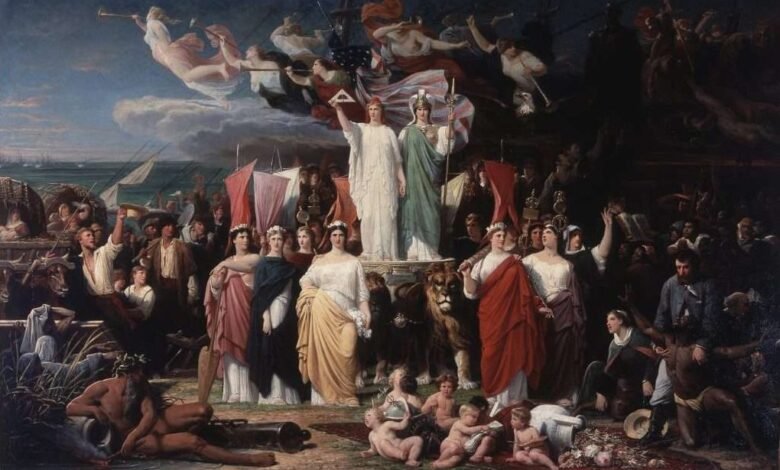
Illustrations, from above: French painter Adolphe Yvon’s “Genius of America,” ca. 1868, (Saint Louis Art Museum); Women art students at the Newlyn Art School in England, from Every Woman’s Encyclopaedia, 1910; the Broadway Tower, ca. 1900 (Houghton, Broadway Pictorial); John Singer Sargent’s “Portrait of Madame X (Madame Pierre Gautreau),” 1884 (Metropolitan Museum of Art); John Singer Sargent’s “Carnation, Lily, Lily, Rose,” 1885 (Tate Britain); and Frank Millet’s “Between Two Fires,” 1892 (Tate Britain).
Source link