 The following articles about a crime on a Hudson River sloop in 1811 were found and transcribed by Hudson River Maritime Museum Contributing Scholar George A. Thompson. They have been lightly edited and annotated by John Warren.
On Saturday afternoon last, a short time before Capt. Griswold sailed from New-York for this village [Newburgh], nine thousand six hundred dollars, in bills, was given him directed to the Bank of Newburgh, and by him put into his trunk in his state room; as soon as the vessel was got under way, the captain discovered the money had been stolen.
Proper inquiries were immediately made of the passengers on board the sloop, from which it appeared that no cause of suspicion attached to them.
 It is supposed the money was taken previous to the vessels leaving the dock in New-York. – Poulson’s American D. Advertiser (Philadelphia, Pa.), November 11, 1811.
March 4, 1812, New York Evening Post
Yesterday [March 3, 1812] took place, at the Sessions, the trial of Charles Willard and William Sherwood, on suspicion of having robbed Edward [sic] Griswold of $9000, money entrusted to his care to be deposited in the Newburgh Bank. After a patient hearing of all the circumstances, the jury brought in a verdict of not guilty; and the accused were acquitted.
Sessions — The people vs. Charles Willard and Wm. Sherwood — Indicted.
The important trial of C. Willard and William Sherwood, who were indicted the last term on suspicion of having robbed Capt. Edward [sic] Griswold of the sum of $9 or 10,000 entrusted to his care by the Directors of the Mechanic Bank in this [New York] City to be deposited in the Bank of Newburgh.
Mr. Fisk on this occasion shewed more than ordinary talents, his solid mind was apparently set to the keenest edge to come at justice in the conviction of the said Sherwood and Willard, for nothing short of conviction would be justice, for so it seemed he had determined in his own mind.
Permit me to digress: for this seems the proper place for remark. what value can be placed upon the invaluable privilege of trial by jury?
Associated with me in the defense was Martin S. Wilkins, Esq…. The Jury took their seats between ten and eleven in the morning, and retired to consider the case about the same hour at night. After 20 or 30 minutes absence, they returned, a verdict of acquittal.
I owe it to Mr. Griswold, as a candid man to state, that his character was well supported as an honest man, though an interested witness in the cause, as were the characters of the accused, (with the exception) that they could not be witnesses.
The money is lost, and the jury say on their oaths that the accused did not take it — common has been the injury, and common be the redress.
From a prejudice existing against Messrs. Sherwood and Willard, while in confinement, it became necessary in my opinion as their Counsel and ally, on whom the business devolved to prepare the cause for trial, to request the public to suspend their opinion as to the guilt or innocence of the accused, until after their trial….
I admitted my clients were accused of a robbery of great magnitude, and I owed it to these gentlemen in particular, who were respectable merchants, and to the public in general, to give this uninterested narrative, that after a full hearing by the court and jury, who merit the highest praise for their great patience and impartiality to declare that Messrs. Sherwood and Willard were acquitted of the charge alleged against them.
For certain reasons I forbear making further comments on the trial at present. [Signed] WM. KETELTAS, Counsel first engaged.
March 11, 1812, Columbian
Advertisement. Having volunteered in behalf of the president and directors of the back at Newburgh…, to assist the company to discover the felon or felons who robbed captain Edmund Griswold [sic], of the sum of $10,000, entrusted to his care, to be deposited in said bank, who made oath he had been robbed of the paper said to contain such sum; nothing would afford me greater pleasure than to detect the felon or felons, and recover said sum for said company, for which I offer a reward of one hundred dollars for the felon or felons to be placed in the hands of justice, and one hundred and fifty dollars to the discoverer of the said sum said to be stolen.
If my clients Charles Willard and William Sherwood are guilty, they have abused the honesty of my heart, and escaped the discernment of the mind’s eye, both of the jury and advocate, and the perseverance of the prosecuting counsel for the people, but the guilty, be they who they may be, cannot escape the all-seeing eye of the searcher of hearts, who was appealed to by both parties under oath, with whom, in the course of his divine providence I leave to punish the perjured, be they whom they may. “Let justice be done if the heavens fall.” [signed] WM. KETELTAS.
May 21, 1812, New-York Evening Post
TO THE PUBLIC. [a card signed by the directors of the Bank of Newburgh acquitting Capt. Griswold of the “uncharitable” and “entirely unfounded” insinuation that he had been the thief who had stolen the bank’s money last November]
July 31, 1817, New-York Evening Post
Thief detected. Several years ago, a packet containing ten thousand dollars in bills and post notes of the Bank of Newburgh, and belonging to the band, was put on board Captain Griswold’s sloop, to be sent up the north river, and was stolen a few minutes after it was received. The bank made great exertions to detect the villain who had taken the money, but without success, till within a few days past.
The cashier lately received a letter from Montreal, informing him that several post-notes of the Bank of Newburgh, to the amount of about twenty-five hundred dollars, endorsed by Griggs Knap, had been offered there under such circumstances as excited suspicion: the notes were described and the person who offered them.
This information, together with the fact of the absence from Newburgh for several weeks of the person described, fixed the suspicion upon Briggs Belknap, who was mate of the sloop at the time of the theft.
He was apprehended, and a package containing $200 of the very bills that were stolen, and which appeared to have lain untouched in the drawer since the time they were missing, were found in his desk.
Upon examination, he was ordered to be committed to the jail at Goshen, where he is lodged for trial. He them made a full confession of his guilt, and acknowledged that he had been to Montreal, and offered the post-notes there, but being suspected, had said he destroyed them. His property, we understand, is sufficient to make good the amount, with interest.
It may be recollected, that suspicions were abroad at the time involving many innocent persons. Two men by the names of Sherwood and Willard were actually indicted for the theft, tried, and with difficulty acquitted; the jury declaring they believed them guilty, but could not feel justified in bringing a verdict to that effect on mere circumstantial testimony.
October 4, 1817, New-York Herald
At a court of Oyer and Terminer, held in the county of Orange, last week, before his honor Judge Spencer, came on several trials for felony.
Briggs Belknap, whose case was some time since stated in the papers, was the first. It may be remembered that this is the man that stole a large quantity of money put on board of a vessel of which he was mate, for the purpose of being sent to a Newburgh bank.
After the most satisfactory evidence of his guilt, the jury brought him in not guilty; because it was more than six years since the theft was committed, and the statute limits the time of commencing a prosecution to three years and one day, but within which time it was impossible to commence this, for it was not found out till after that time had expired that he was the thief. And so the jury said he was not guilty.
October 4, 1817, New York Evening Post
As an act of justice towards capt. Griswold, we republish the following from the Newburgh Gazette, which came to hand this morning.
TO THE PUBLIC. Whereas unfounded and unjust imputations have gone abroad, prejudicial to the character of capt. Edmund [sic] Griswold and that of his family, relative to a sum of money feloniously taken from on board of his sloop, at New York, in the month of November, 1811, and belonging to the back of Newburgh; I, the undersigned, repenting of the crime, and of the injury I have done Capt. Griswold, do hereby declare, that I did take the money from his possession, without his knowledge or consent, and that any suspicions or imputations against his character or any of his family in relation thereto, are entirely malicious, idle, and without the least foundation.
Dated Newburgh, state of New-York, Sept. 19, 1817. [Signed] BRIGGS BELKNAP. Signed and acknowledged to have been done voluntarily in the presence of Leonard Maison.
 August 5, 1817, New Paltz Historic Documents Project
According to the New Paltz Historic Documents Project: On August 5, 1817, Briggs Belknap of Newburgh sold a one-fourth share in the sloop Favorite, an 88-ton Hudson River vessel, to the Bank of Newburgh.
Belknap stated that the share was “for and in consideration and in part payment of the sum of nine thousand six hundred and fifty one dollars, by me justly due and owing to the President Directors and Company of the Bank of Newburgh.”
August 13, 1817, Pittsfield Sun
According to an article in the Pittsfield Sun about a week later on August 13, 1817, Briggs Belknap pled guilty to a charge of theft of the cash and bank notes belonging to the Bank of Newburgh while he was serving as mate on a sloop of Captain Griswold.
In his full confession Briggs admitted destroying most of the notes when he couldn’t redeem them in Montreal. The paper reported, “His property, we understand, is sufficient to make good the amount with interest.”
Further Notes
Read more about transportation history in New York State.
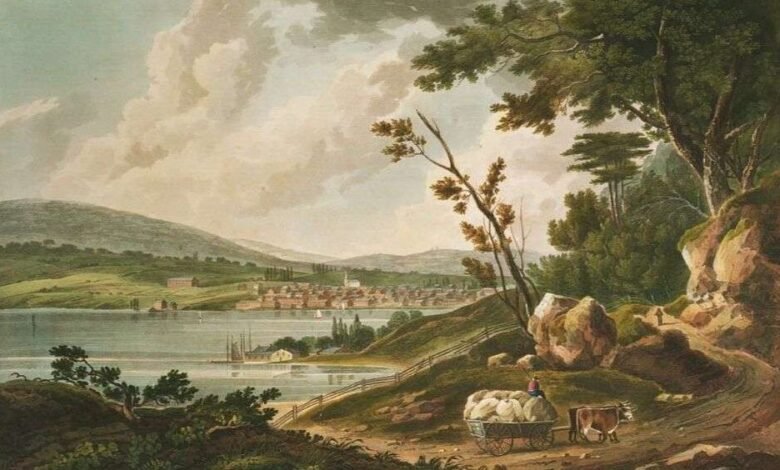
Illustrations, from above: 1820 Hudson River view of Newburgh, NY (New York Public Library); 1839 Bank of Newburgh cashier’s check signed by Aaron Belknap, Agent; and Briggs Belknap’s bill of sale to Bank of Newburgh of sloop Favorite.
Source link