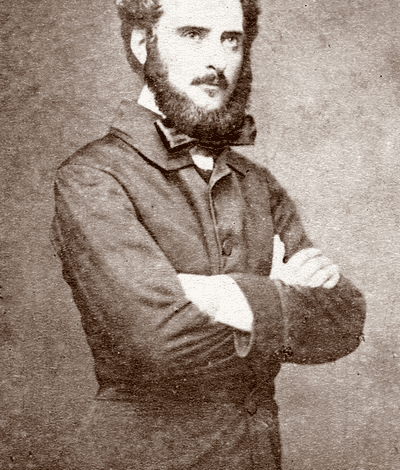
 What follows is an excerpt from The Hunter-Naturalist. Romance of Sporting; or, Wild Scenes and Wild Hunters (ca. 1851) by journalist and explorer Charles Wilkins Webber (1819-1856). In 1855 Webber went to Central America where he joined the filibuster William Walker in Nicaragua to fight in the Filibuster War and was killed in the Second Battle of Rivas on April 11, 1856.
A summer’s journey of sporting adventure towards the North, dating at a much later period in my life than those previously given as personal, included a sojourn amongst that linked and wonderful cluster of Lakes, extending from Hamilton County, in the west of New York, north to Lake Champlain and the St. Lawrence. Something of the “Wild Scenes” and characteristic incidents amidst the haughty solitudes of those rugged hemlock-bristled Adirondacks, and their chaste, cold, glistening Lakes, I must give in a fragmentary way.
I had reached Lake Pleasant in Hamilton county, the semi-civilized outpost of the wilderness interior of “Sporting Grounds,” through the ordinary tribulations of jolting, fatigue, mud, rain, etc., in company with an English friend, a placid “son of the angle” [an angler] in the strict Waltonian sense, but altogether an unaccustomed hunter of wilderness game. [The writer refers to Izaak Walton (ca. 1594–1683) an English writer and biographer best known for The Compleat Angler].
Lake Pleasant, upon the outlet end of which we were temporarily located in a rude board hovel, dignified as “mine inn!”- was overlooked at the opposite by an abrupt mountain-one of the Adirondacks – named from the Indian name, the Speclater [sic, Speculator Mountain just south of the village of Speculator.]
The inlet came in at its foot, and from the steep top, a bird’s-eye view could be obtained of the whole scene of our future operations. After a night’s rest, we made a day of it to clamber the huge rocky sides of this ancient sentinel that from its bald crest we should look forth, that our eyes might be “made aware.”
I wanted to convey some idea of what we saw, but I find that though very nice in theory the practice is difficult. I could only think, as we ascended, in the words of one who spake of old — “Get thee up into the top of Pisgah, and lift thine eyes westward, and northward, and southward, and eastward, behold it with thine own eyes!”
And, verily, when we reached the top of Mount Speclater did we lift our eyes and behold the promised land of sportsmen – the Canaan, not of milk and honey, by a long jump – but of the ferxae naturae [a Latin phrase that translates to “wild by nature”] — ” a whole yearth full ‘er God-a-mighty’s wild varmints!” as a sublimity-struck Connecticut Pedlar ejaculated from the same point of view! [The Connecticut Pedlar was a popular song in 1850.]
Of a truth it was a wonderful sight-looking down at your feet, then off to the South, and then to the North-west, upon this wild chaos of savage-looking hills, lit up by the scattered shine of thirty-six Lakes, which, within the space of about the same number of miles in length, look like bright patches which had fallen in benediction out of a summer’s sky into these sullen glooms!
There they go, far away beneath us – those younger ranks of pine-haired Titans [evergreens], that make the blue line of the Adirondack. See them stretch their misty arms to one another, rank upon rank, to form these cordons of impregnable defense about those shadowy basins, up from which the silver sheen of many a grotesque form of Lake is thrown into our dazzled eyes.
What a sight is this, within twenty-four hours of New York, with its smoke, and din, and crush! Hurrah! to think that these bright sheets are gleaming down through their still blue depths with shoals of the magnificent salmon trout, with their dark marbled backs and lustrous mottled sides, and that every silver thread of river, rivulet and inlet binding them together, glitters upon its ripples or within its shaded pools to the arrowy leap of that crimson flecked keystrel [kestrel] of the streams, the brook trout!
Hurrah! hurrah! to think, too, that these unbroken forests which still wear the solemn look of Earth’s Primeval births, yet shelter within their difficult fastnesses, her earliest children. That the huge moose which came before the red man, yet rouses the sluggish echoes with its hoarse, bellowings.
That the red deer [sic, whitetail deer] whistles and snorts to the boding howl of the tireless gray wolf; and the brown [sic, black] bear, like a clumsy boxer, cuffs the screaming panther away from its newly slain feast!
 The Indian is gone, but yet his ancient foes and victims have flourished apace, and may usurp their inheritance. Hurrah! hurrah! [Textile industrialist Sir Richard] Arkwright and [steamboat inventor Robert] Fulton have not yet conquered the free earth of God in this direction — and bound all its limbs in chains!
“‘The undevout astronomer is mad” – and the devout sportsman may be forgiven, if at such a sight he, too, grow mad and should fall to capering, and become something of a heathen in his glee, shouting as I did. “Take my cap, Jupiter, and thank thee!” Against such uncanonical sins I hereby formally warn all other faithful sons of Nimrod, who may be “taken aback” under similar circumstances.
As to the propriety of capering and throwing up one’s cap on the top of a mountain, I must in meekness confess to its being “highly improper” – “unworthy the dignity,” etc. – but bless our soul, who could help it? Not any genuine sportsman, I am sure, whether he be ” Venator,” “Piscator,”
or Anceps!” — or all combined as – “I flatter myself!” ahem!
No, it was not in human nature – or more inclusively, sportsman’s nature – to look down upon a scene so gloriously fresh-so impregnably savage-hemmed in with its blue topped barriers forever! – without feeling rich-rich as the discoverer of some new gold-bearing island of the tropic sea of dreams richer far than one of England’s proud lords when he waved his hand towards his fenced and great domain; for this, too, was mine – was ours – was all mankind’s -was GOD’s, as the executor for ALL!
And what if I were guilty of some saltant [dancing, leaping, or jumping] absurdities? There were no game law iniquities upon my shoulders to
weigh down my heels! – all this was free, and the fatness thereof was mine for the winning – mine to be struggled for manfully with my brother -mine to be pouched, carried off and eaten, if my right hand retained its cunning!
Even my placid friend, Piscator, felt within him the movings of a mild exultation, as he stretched forth his hands above it in calm blessing, and peacefully smiled!
Here and there the white mist – clouds lay along the hillsides above them – seeming to form high up against the purpled green the erial [barren or uncultivated] double of the lakes – and there, no doubt, the swift-winged swallows – though we couldn’t see them – dived through the fleecy waves like brook-trout, and the fish-hawk swooped like the ravenous salmon – if they didn’t at them below!
Of this we had much more palpable evidence, for we saw many of them rise, beating their wings with exulting screams as they went circling up and up, bearing a three to a five pounder in their talons. Fat pickings for fish-hawks, any how, in these thirty odd lakes!
How I envied the rascals, and wished to hear the war-cry of a bald eagle, and see him come down from the clouds above, hurled swiftly, like the bolt he once bore, upon resistless wings, to strike the gluttons and make them drop their struggling prey, and then to see the conquering robber pause and dive with a roar of plumes down the still air and snatch the glistening spoil before it reached the wave again.
These are the quick, fierce battles of the air-kings that we sometimes see from such a perch. But let us count our riches over, and name their names and places that we may know them.
Sheer down from our pinnacle on the northern side lies Lake Pleasant – a great white opal, with an emerald in the center. This is “the captain jewel of the carcanet,” and old earth wears it proudly for its beauty, and its name is most happily named.
Its shape is somewhat irregular, and its length is four miles, with an average breadth of two miles, and a depth of sixty feet. At the opposite extremity is the narrow but deep outlet which forms the Sockendog River [Sacandaga River], after passing through Cungamunck Bay [Kunjamuk Bay], a few miles farther on, and then strikes off to the north-east, a bold and boisterous mountain stream, clattering among the hills until it looses itself in the great Hudson, as its western branch.
The shores of Lake Pleasant have quite a cultivated aspect -this is of course comparative. A number of beautiful grazing farms are opened to view around its rolling shores down to the water’s edge. They are very rudely cultivated yet, but they might be made surpassingly lovely some day.
At the N.W. extremity of Lake Pleasant is the inlet of Round Lake [now Sacandaga Lake], which is about half a mile in length. Round Lake! Gloomy, wild and picturesque Round Lake! twin sister of Lake Pleasant, “but grander and more rude than she!” – rimmed, like a Titan’s brimming drinking cup, with low rocks, all around and above them the unbroken forest slanting up to blue-topped hills. How deep, austere and solemn its repose.
What a shadow beside the sunny loveliness of its contrasted sister! It is three miles both ways, and deeper than Lake Pleasant. There is no sign of cultivation upon its savage shores except at the outlet. It has several inlets, which go glimmering faintly through the narrow valleys towards the north-west.
They connect it still with smaller lakes, Echo Lake, Lake Sound, and —O! euphonious accord! — Mud Lake!
When a few miles to the west another chain commences with Long Lake, which is two miles and a half in length by a half in width. This connects with Fly Lake, which is smaller still, and this with Falls Lake, about the same size, which outlets into Piseco, eleven miles west.
This is a famous lake, and is about seven miles long and twelve wide. Through its outlet, West River [the former name of the West Branch of the Sacandaga River], it is one of the feeders of Sockendog River, which forms the west branch of the Hudson.
This, too, is a lovely lake, partaking of many of the features of Lake Pleasant. There is some rude presence of civilization on the north end and eastern side, where a few farms and a small village are to be seen along the smoothly undulating shore. The country opens level to the south-east, but on the north-west the Panther mountain beatles over it protectingly stern.
This lake has been made renowned among sportsmen by the feats of the noted Piseco Club – a fraternal band who went thither once a year upon a devout pilgrimage to offer up a sacrificial hecatomb [a great public sacrifice] of fish bones and buck’s horns to the manes of their hirsute progenitor, Ham!
After very nearly exhausting its waters and shores, they have deserted them, and are now threatening some one of the wilder lakes we see towards the north-west.
Here, when we talk of exhausting Piseco, we must be understood as when talking of the progress of civilization – in a comparative sense – for be it understood – these six devout pilgrims regarded one hundred pounds a day as the small expression of their fervid religious zeal; and the beautiful lake fell into discredit with them so soon as it refused to render up this slight diurnal tribute.
Sportsmen of less zeal still find it a charming resort.
Now look away to the north-west, and you can count along the line of vision, until it is lost in the dim serrated line of the Blue Adirondack, twenty-five wild, lovely lakes, upon whose virgin solitudes no Piseco Club has ever intruded with its exhausting zeal. Look closely now, and you will be able to trace the threads of three of the finest trout streams in America. They form the eastern branch of the Hudson!
Here we are perched above and in the center of the head springs of that majestic river, and can almost trace even the attenuated rills to their junction, and we can see, too, in the blue mountains, the dividing ridge between its waters and the clear, gelid flood of the St. Lawrence! A glorious perch, is it not?
First: six miles N.W. we can see Jessup’s River. This is the nearest stream abounding with speckled trout, and where sport at this season is sure to be abundant. To “the Bridge” and to “the Indian Clearing” [at Indian Lake] everybody must go first “to feel the joy that anglers feel.”
This last place has been rendered immortal by the extraordinary feat of our friend [William T.] Porter, of the Spirit of the Times [a popular sporting newspaper].
We do not venture to give the number of pounds within a given time – he is “tall” enough and his shoulders are broad enough to bear the responsibility – but we can bear witness, from our high and responsible position, in the presence of all these solemn-looking hills and lakes, that our “experience” at the Indian Clearing entirely bears him out in the assertion of prodigies to be wrought there.
Then comes Whittaker Lake – thereby hangs a tale! Then comes the two Dug Mountain Lakes and Mason Lake – these are all small.
Now comes Louis Lake [now Lewey Lake] – the next most famous to Piseco, and affording now better fishing and hunting. It is twelve miles from the Speclater, and is the favorite resort of those who come for a short stay and ready sport.
This is one of the most beautiful of the lakes-its outlet forms a junction with Jessup’s River in a few miles, and is thence called Indian River to its junction with the east branch of the Hudson.
But I have not space for more particular enumeration. I must pass to the curious Trinity of the Cedar Lakes, which empty, too, into the Hudson by Moose River —better fishing even than the Jessup’s River-and here we are at Raccquett’s Lake [Raquette Lake], which is in this direction almost the ultima thule (Latin for “the furthest place“] and El Dorado of the sportsman combined.
It is fourteen by seven miles, average, broken into two great basins, connected by a narrow strait. It is the largest and most savagely picturesque of the lakes, and most abounding in game of every sort.
Trout of both kinds are so abundant in the great basins and the numerous inlets, that the sport soon becomes fatiguing. It has twenty-four islands, of from one hundred acres to ten feet. On the west side is the inlet of a singular chain of small lakes, eight in number, all of which abound in both varieties of trout, and the accompanying fish, suckers, chubs, shiners, blue cats, sun perch, etc.
This remarkable chain extends about fourteen miles north and east of the lakes, is deep, clear and ice cold. On the east side of Racket Lake is the inlet of Blue Mountain Lake, which is cold – almost to freezing point – and like a solid crystal set upon a snowbank of blanched sand.
You can see, as you hang suspended in mid-air here in your boat, the shoals of trout go by in twenty feet water! Think of that! Then comes Long Lake again – this time in earnest — for it is twenty miles long, with an outlet towards Lake Champlain.
Here is the difficult paradise of sportsmen; and from Louis Lake, north, the moose becomes more abundant, with its attendant train of smaller game, and the distance, all told, from our perch on Speclater Mountain to Long Lake, is only sixty miles!
These are the principal points of attraction within the range of our utmost vision which I have here noted; though now we can perceive that even yet there are more than thirty-six lakes, the names and distances of which I have not space to notice in this bird’s-eye view.
But verily, this view of this our exceeding riches, in a land so rude and unpromising in the mouth of fame, and it may be together with the rareness of the air, has sharpened our appetite for testing again the flavor of the good things therein contained.
Yea, our placid friend, Piscator, stroketh his stomach as his anticipative eyes are turned towards yonder humble looking house. Let us descend.
What have we here, our tidy hostess? Fresh green peas – a salmon trout – a delicate steak of venison – strawberries, currants, cream! O, ye gods on high Olympus! Shade of Epicurus! Let us fall to!
The blessing of Piscator was somewhat curiously commentated – “Thank thee for thy manifold mercies, good Lord: Amen. Verily a good wife is a jewel unto her husband!”
Amen! we responded.
This essay was transcribed and annotated by John Warren.
Illustrations, from above: Charles Wilkins Webber; and David H. Burr’s map of Hamilton County, NY, 1839 (see a larger version here).
Source link