 On July 22, 1920, with his wife, daughter, and two sons at his bedside, railroad tycoon and financier William Kissam “Willie” Vanderbilt I, grandson of the legendary Commodore Cornelius Vanderbilt, died in Paris at the age of 70. His widow soon set out to make a new life for herself. For the third time.
Anne Harriman Sands Rutherfurd Vanderbilt (1861 – 1940) had a knack for choosing husbands and an independent, public-minded spirit – in the words of author Alfred Allan Lewis, “a dutiful Victorian daughter, who, through successive widowhoods, married better and better.” But a simple gold digger she was not.
Born in 1861 to banker Oliver Harriman and his wife, Laura Low, the daughter of a successful dry goods merchant, Anne grew up on West 25th Street until her family decamped uptown in 1875 to ultra-fashionable West 57th, near Fifth Avenue and the Whitneys, Roosevelts, and Rothschilds.
At her mother’s urging, at 19, she married 24-year-old sportsman Samuel Stevens Sands Jr., from the eponymous Sands Point on the North Shore of Long Island, in the process spurning the romantic hopes of Teddy Roosevelt’s brother Elliott. The young couple moved to Garden City, then part of Queens, near Sam’s adored Meadow Brook Hunt Club.
In March 1889, calamity struck when Sam died at 33 – thrown from his horse during the club’s first hunt of the season. Anne was left with two sons under age 5. Wrote The New York Times, “Having always been counted a singularly fearless horseman, this fatal result from what was almost his first mishap in the hunting field is as astonishing as it is sad.”
Modestly provided for thanks to the fortunes of two wealthy families, Anne, now 27, was nonetheless impelled to seek a future life and greater security. She soon moved to London and set to courting Lewis Morris “Lewy” Rutherfurd Jr., from a wealthy landowner family descended from both Peter Stuvvesant and Declaration of Independence signer Lewis Morris.
In June 1890, barely 15 months after Sam’s death and far from the censoriousness of Gilded Age New York, Anne and the 31-year-old Lewy were married in the venerable St. George’s Hanover Square church. The couple would have two daughters and spend barely a decade together before Lewy’s 1901 death in Switzerland from tuberculosis.
Now Anne – albeit decidedly wealthier than in 1889 – was 39, twice-widowed, with four children under the age of 16. Still she persevered.
 Living in Paris, the tall and still striking Anne drew the attention of an even more opulent catch than a Sands or a Rutherfurd: Willie Vanderbilt, scion of America’s wealthiest family. Willie’s grandfather, the Commodore, had made his fortune first in steamships and then in railroads.
At 19, Willie was put to work as a clerk for the treasurer of the New York Central Railroad. He spent his life flitting back and forth to Europe living, in the words of his Times obituary, “a life of culture and leisure, although it was mixed with hard work and with the management of affairs.”
In 1875, Willie married the definitive social climber, Alva Smith of Mobile, Alabama, whose forceful entry into New York society, and engineering of her daughter Consuelo’s marriage to the Duke of Marlborough, provided inspiration for the character of Bertha Russell in HBO’s The Gilded Age.
Willie and Alva divorced in 1895 – she soon marrying banker Oliver Hazard Perry Belmont and embarking on a commitment to women’s suffrage; he dedicating himself to yachting, thoroughbreds, and the nascent sport of automobile racing – all the while helping drive forward the colossus New York Central.
In 1903, Anne and Willie were married, uniting two great railroad names (Anne’s first cousin was Union Pacific tycoon Edward Henry “E.H.” Harriman.). This time, Anne had 17 years with a husband before Willie’s death in Paris at age 70 – what was then viewed as old age.
He left an estate valued at $54 million; his obituary mentioned the 27 directorships he held, ranging from the giant New York Central to the tiny Pittsburgh, McKeesport & Youghiogheny Railroad Company.
During and after her Vanderbilt marriage, Anne led a life of consequence, devoting herself to those less fortunate and providing health and humanitarian aid in war-scarred Europe. In 1903, along with Anne Morgan and Elizabeth Marbury, she helped organize the Colony Club, one of New York’s first women’s social clubs.
She convinced Willie to underwrite the founding of a tuberculosis clinic at what’s now New York Presbyterian Hospital, and started the Big Sisters organization to provide mentorship and guidance to young girls caught up in the law-enforcement system.
As World War I descended on Europe, she set up a fund to supply and operate 100 motorized battlefield ambulances. She toured front-line relief services, raised money to aid wounded soldiers, and by the time the U.S. entered the war, had assumed a status, in Alfred Lewis’s words, as “the commanding general of women [aid] volunteers.” In 1919, she was made a Knight of the French Legion of Honor.
After Willie died, Anne had little use for his Fifth Avenue mansion, viewing it as redolent of Alva’s imprint. Anne sold it along with a 125-acre country estate on Long Island.
With a group of lady friends, she targeted what Alan Lewis in his 2000 book, Ladies and Not-So-Gentle Women, termed an “unfashionable, somewhat disreputable neighborhood on the edge of the East River” for her own home, leading the creation of what was known as the “Amazon Enclave” – “the only cluster of homes in New York built largely by and for women,” away from “the overblown grandeur of the mansions of their husbands and fathers.”
In 1921, Anne bought the former home of California Gold Rush shipping merchant Effingham B. Sutton – at One Sutton Place, on the northeast corner of 57th Street – for $50,000. Anne, Elizabeth Marbury and Anne Morgan each hired architect Mott B. Schmidt, known for his American Georgian Classical style.
 For a further $75,000, Mott transformed Sutton’s former home into a thirteen-room, 7,000-square -foot townhouse with terraced gardens overlooking the river. Wrote the Times in 1929, “those who doubted the wisdom of Mrs. Vanderbilt’s move have found a convincing answer to their conjectures as to the ultimate success of the Sutton Place movement.”
Anne Vanderbilt outlived three husbands and three of her four children, dying in 1940 at the age of 79. Sutton Place remains the choicest of Manhattan neighborhoods. One Sutton Place was later owned by members of the Heinz family, and in 2019 was sold for $13 million to Andrew Bolton, a curator of The Met’s Costume Institute, and his partner, designer Thom Browne.
In 2023, Friends of the Upper East Side Historic Districts, one of New York’s premiere preservation organizations, honored Bolton and Browne with its Ambassador to the Upper East Side Award, saying they “renovated with deep consideration” for the provenance of One Sutton Place, updating it “with great respect and tremendous design sense, creating an exceptional tribute to the history and aesthetic of this important building.”
While Anne had no direct descendants, her consequential life as an independent women still impresses a century later, and her home and the neighborhood she helped create form a lasting legacy.
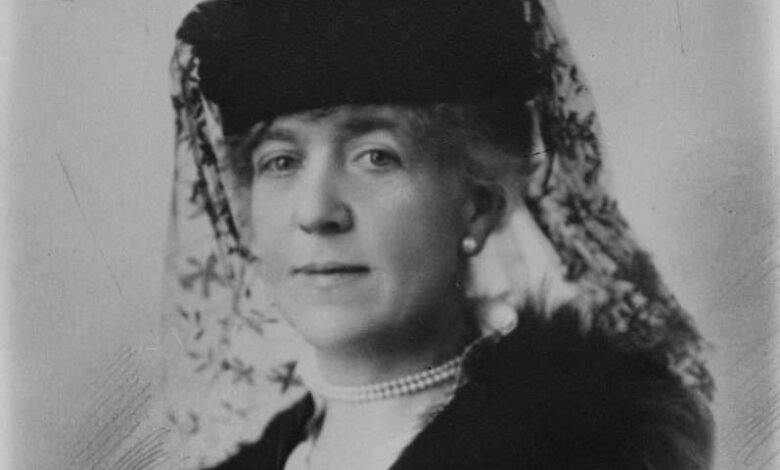
Illustrations, from above: Anne Harriman Sands Rutherfurd, wife of William Kissam Vanderbilt ca. 1915; William “Willie” Kissam Vanderbilt; and One Sutton Place, ca. 1930.
Source link