
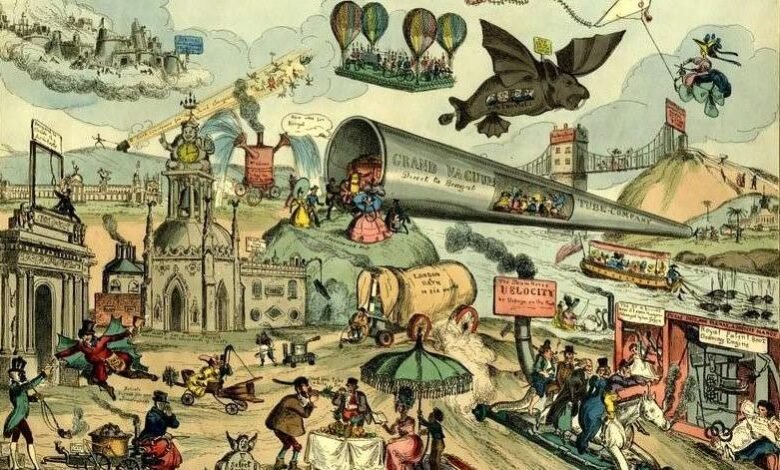
 In 1903, Ashkenazi Jews in Ukraine suffered systemic discrimination and severe poverty. Brutally enforcing residency laws, officers conducted nighttime raids and expelled those who lacked proper paperwork. A wave of (state-sanctioned) antisemitic attacks throughout the Russian Empire caused panic and displacement.
This persecution preceded the terrifying pogrom in Kyiv (Kiev) in October 1905. By that time, the Dibner family, like many fellow Jews, had fled from repression to New York City and settled in the Lower East Side of Manhattan.
Stuyvesant High School
Born in Lysianka, near Kyiv, Bern Dibner (1897-1988) was the youngest of eight children. He was seven years old on arrival in Manhattan.
That same year Stuyvesant High School opened its doors in the East Village, Manhattan’s first “manual training” school for boys. Once set up at its permanent location at 345 East 15th Street (where it stayed until 1992), it was New York’s first high school to focus on the sciences.
Many sons of first-generation immigrants were taught at the Stuyvesant which offered them a gateway of opportunity to overcome language barriers, qualify, and make their way into society.
 Bern Dibner was one of those students, before continuing his schooling at the Hebrew Technical Institute.
Born in Manchester in December 1854, Henry Marcus Leipziger was an educator whose family (of German origin) had emigrated to America in his childhood.
Having studied at City University and Columbia, he founded the Hebrew Technical Institute in January 1884 and acted as its director until 1891.
The school aimed at providing vocational education for Jewish immigrants. Starting at 206 East Broadway, and after several relocations, the school finally moved to premises at 34/6 Stuyvesant Street.
There is some irony in the fact that Peter Stuyvesant’s name is associated with two institutions that helped Jewish integration.
In 1654, the Governor had tried to prevent access to a group of Sephardic refugees into New Amsterdam after their escape from Recife following the Portuguese reconquest of Dutch Brazil (Nieuw Holland).
This marked the end of a brief 24-year period from 1630 to 1654 of religious freedom under Dutch rule, during which the first synagogue in the Americas, Kahal Zur Israel, was established in Brazil.
Stuyvesant was vetoed by the directors of the Dutch West India Company who allowed the group to settle. It became New York City’s first permanent Jewish congregation.
Electrician & Scholar
 After working as an electrician and being injured, he used a small settlement to continue his studies. He matriculated at the Polytechnic Institute of Brooklyn, graduating in 1921 with a cum laude degree in electrical engineering.
Dibner started his career at the Adirondack Power & Light Company, a major utility with operations in Amsterdam, NY, featuring large infrastructure projects.
In 1923, the Electric Bond & Share Company employed him for an assignment to unify Cuba’s system on a single grid. He developed and patented a connector to link previously incompatible transmission lines.
A year later he set up a partnership with his brother-in-law, naming it Burndy (“Bern D.”) Company with a small office at Fifth Avenue and 43rd Street. Business took off rapidly; the Burndy Corporation was eventually listed on the New York Stock Exchange.
Financially secure, Dibner retired from active management to pursue scholarly interests. Reading a chapter on Leonardo da Vinci in Stuart Chase’s Men and Machines (1929), he became intrigued by this extraordinary dual talent of creator and engineer.
In 1930 he enrolled at the University of Zurich where he studied history with a focus on Renaissance culture and technology.
Why Zurich? The University had been the intellectual home of Jacob Burckhardt (1818-1897), the greatest Renaissance scholar of his time and the legacy endured. Dibner received the spark.
The History of Science discipline had manifested itself during the late nineteenth century by charting the modern world’s rise as driven by technology.
The word “scientist” has an equally brief history. In 1834, Cambridge academic William Whewell put the word into print when reviewing Mary Somerville’s study On the Connexion of the Physical Sciences.
He argued that the unity of science, and hence knowledge of the material world, had fragmented with the splintering of research into specialisms. He proposed the introduction of the word “scientist” (an analogue to “artist”) to bring back linguistic cohesion into scholarship.
In Britain, academics resisted the idea and stuck to the (gendered) term “man of science.”
Whilst the British debate endured into the twentieth century, in America the term “scientist” was adopted much quicker. By the 1870s it was in routine use.
In fact, the word was so common that many linguists assumed it to be an Americanism. Proof to purists that the term was illegitimate.
Collector & Legacy
Bern’s passionate curiosity led to a love for manuscripts and rare books as physical records of scientific progression. Over the years he assembled what became the pre-eminent American collection of materials on the history of science.
Available to scholars and bibliophiles, the volumes were stored in dedicated rooms at the Burndy Corporation’s headquarters in Norwalk, Connecticut, and later in the specially designed Burndy Library.
 In 1955, Dibner selected two hundred titles to highlight achievements in technology, biology, and medicine. That year he published Heralds of Science, a catalogue of “epochal books and pamphlets… in the Burndy Library that were instrumental in establishing our age of science.”
The book celebrated the 500th anniversary of the invention of printing from moveable type by Johannes Gutenberg.
Although aimed at a wide audience of non-historians, the scholarship that went into annotating his selection of titles showed the depth of Dibner’s historical knowledge. In his introduction he admitted that his choice was, inevitably, arbitrary.
In the following years, Dibner donated parts of the collection to various institutions, gradually dissolving the Burndy Library.
A considerable number of books went to the Smithsonian where a wing was named for him, while another part moved to the Huntington Library, California.
Dibner also supported his alma mater, the Polytechnic Institute of Brooklyn, which in turn created the Bern Dibner Library of Science and Technology, serving today as a resource for New York University’s Tandon School of Engineering.
Manuscripts & Incunabula
The Smithsonian was the main beneficiary of Dibner’s generosity, receiving some ten thousand rare books and manuscripts in 1974, including most of the Heralds of Science, except for those already held at the institution.
The gift contained an astonishing 320 incunabula (documents produced with movable type at the transition from manuscript to printed book), including such landmarks as Pliny’s Historia naturalis (Venice 1469), considered the first printed science book; De re militari (Verona 1472) by Valturius, the first printed book to contain scientific illustrations; and Aristotle’s Organon, (Venice 1495/8), the first edition of his complete works in Greek.
Dibner stressed the importance of manuscripts as research tools in addition to printed literature. Whether hand-copied texts of ancient learning, letters exchanged between scientists, or lecture notes, they all contribute to the scope of scholarly research.
He assembled a diversity of documents associated with Isaac Newton, Galileo Galilei, Benjamin Franklin, Alessandro Volta, or Wilhelm Conrad Röntgen.
As a collector, he literally “hunted” for materials. By acquiring the collection of Czech engineer Armin Weiner, he secured Alfred Einstein’s handwritten summary of the Theory of Relativity.
He also bought the library of Vito Volterra, the outstanding Italian mathematician, physicist, and Mussolini-opponent. His interest went beyond just manuscripts or books: in 1965 he added a hundred early light bulbs to his monumental collection.
Although a prominent entrepreneur and intellectual, the past came back to haunt him. In the post-war period, the American Jewish community and other minorities faced discrimination in higher education.
In 1948 Brandeis University at Waltham, Massachusetts, was founded as a non-sectarian research university, welcoming students of all backgrounds and beliefs.
Named for Louis Dembitz Brandeis, the first Jewish justice of the Supreme Court, the institution focused on undergraduate education, while building a pioneering research enterprise.
Dibner took a personal interest in the formation of its library and became a major contributor. Donations included materials related to the work of Leonardo da Vinci as well as 150 documents chronicling scientific discoveries over the centuries.
 Among these rare texts was a 1613 edition of Istoria e dimostrazioni intorno alle macchie solari, Galileo Galilei’s treatise on sunspots published in Rome which includes forty-four full-page illustrations and a fine portrait of the author by Assisi-born engraver Francesco Villamena.
Two Cultures
The traumatized child who had fled with his Jewish parents from Kyiv to Manhattan facing a foreign language and an alien socio-cultural environment, made his way up the economic ladder from a simple electrician to the founder of a major company actively involved in building New York City’s modern infrastructure.
Inspired by Leonardo da Vinci and Renaissance ideals, he also pushed forward a debate about the balance – or lack thereof – between the humanities and sciences (what physicist and novelist C.P. Snow would name the dichotomy of “Two Cultures”).
Intellectual life divided into two hostile camps, humanities versus sciences, prevents effective action on global problems and issues. The discussion today is more urgent than it has ever been.
Having started his life in an underprivileged and marginalized segment of Manhattan’s population, Dibner would eventually outsmart the nation’s “best and brightest.”
He considered his career a “gift to the nation” which had granted him education and opportunity. This is what should direct our reflections on immigration, but the reality is different.
In December 2025 antisemitic slurs and symbols as well as racist graffiti targeting other minorities were found in a study room at Brooklyn’s Dibner Library. The concrete walls of division are re-erected under our eyes.
Read more about the history of science in New York State.
Illustrations from above: “March of Intellect” print by William Heath,” ca. 1828 (British Museum); Undated portrait of Bern Dibner (NYU Libraries); Logo of the Polytechnic Institute of Brooklyn; Dibner’s Heralds of Science, 1955; and Francesco Villamena’s portrait of Galileo Galilei, 1613.
Source link