 Just who was Captain Bernard Romans, the man who captured of Fort George in 1775? Where was he from, and how did he end up at Lake George?
Bernard Romans, (ca.1720-1783) was a surveyor, cartographer, naturalist, engineer, and soldier. His surveys and mapping of the Alabama coastline along with Eastern and Western Florida provided the first look at the land and the flora and fauna that the British had acquired at the end of the French and Indian War in 1763.
 He published the results of this work in A Concise Natural History of East and West Florida which proved so popular, that John Hancock bought two copies and Henry Knox bought fifty for his bookstore.
Romans was born in Holland in 1720, and as a young man went first to England to study mathematics, botany, and engineering.
In 1757 he came to the Americas, first as the commander of the sloop Mary operating out of the Caribbean. After several trading voyages, the Mary sank off Key Biscayne, Florida, virtually bankrupting Romans. He then acquired the post of Deputy Surveyor of Georgia, which enabled him to accept private commissions for land the English were granting in East Florida to populate the region.
He conducted several notable expeditions from 1768 to 1772, including an arduous cross-country trek after his boats were destroyed in a storm. He made an overland journey from Tampa Bay to St. Augustine, over what he described as the Tract of Ferdinando Soto. After outfitting another ship, sailed to Pensacola charting harbors, depth soundings, and sources of fresh water.
He was then hired to survey West Florida including the lands of the Choctaws and Chickasaws. These final surveys led to the completion of his book.
Romans, who had become pro-American in his politics, traveled to Boston promoting his work, and was there for the Boston Tea Party.
He remained in New England, and in April of 1775, he was appointed a Captain in the Connecticut militia by the Connecticut Committee of Safety to take Fort Ticonderoga. However, Benedict Arnold and the force of Vermont militia known as the Green Mountain Boys, commanded by Ethan Allen, beat him to it.
Having been tasked with the taking of other British installations, Romans turned to Fort George at the head of Lake George (which had replaced Fort William Henry after that fort was destroyed by the French in the 1750s).
 Romans proceeded to the head of the lake and took possession of what was left of Fort George and its caretaker, 65-year-old self-described “pensioner” Captain John Nordberg, whom he sent to Connecticut as a prisoner of war.
B.F. De Costa, in his A Narrative of Events at Lake George (1868), states “Romans felt the capture of an abandoned fort was not a thing to boast of and gave no publicity to this event.”
He moved to Ticonderoga for a short time and participated in the Invasion of Quebec.
He was then appointed by George Washington to improve defensive works on the Hudson River but resigned his commission on June 1, 1778, to work on a two-volume history of the oppression of the Netherlands by the British.
In 1780, he joined the Southern Campaign and was captured by the British at sea en route to South Carolina. He was imprisoned in Jamaica until the end of the war and died at sea on his return voyage home. The cause of his death is unknown.
Related to the capture of Fort George, DeCosta also makes note of the claim of Daniel Parks to have taken the key to Fort George:
“Daniel Parks may have followed in the train of Captain Romans, and may have also been a member of the garrison, when it was soon after found necessary to maintain a small force at this point… the fort had neither garrison nor commander.”
Also, the petition of Captain Nordberg to the Provincial Congress seeking his release states “the 12 of May last Mr. Romans came and took possession of Fort George.” No mention of anyone else is recorded; therefore, the observation can be made that the account of Parks is a tale and nothing more.
Queensbury Town Historian John Berry is Chair of the Warren County Commission for the 250th Anniversary of the American Revolution and Treasurer of the Warren County Historical Society.
A version of this essay first appeared in the Commission’s newsletter. You can subscribe to the newsletter here.
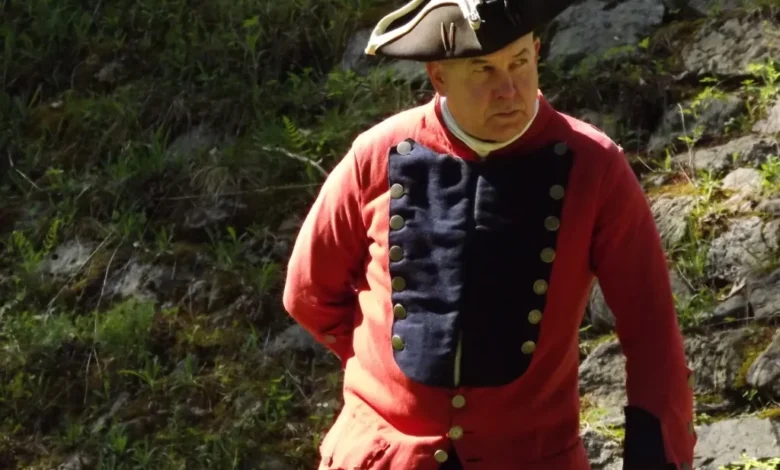
Illustrations, from above: The remains of 1759 Fort George at the head of Lake George; title page of Bernard Romans, A concise natural history of East and West Florida, 1776; and Captain John Nordberg, as portrayed in 2025 by Andrew Menzie, Fort William Henry Director of Historical Interpretation.
Source link