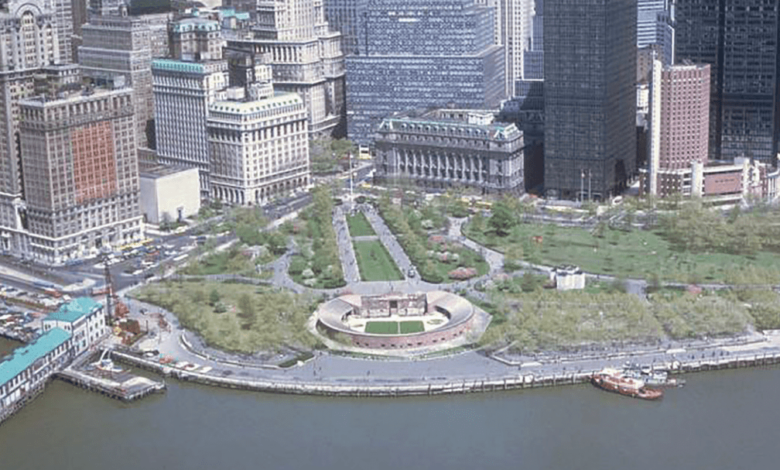
 Located at the southern tip of Manhattan Island, Castle Clinton stands where New York City began and represents not only the city’s growth, but the growth of a nation.
Initially intended to prevent a British invasion in 1812, the fortification has transformed over the years to welcome theatergoers, immigrants, sightseers, and now, millions of visitors to New York Harbor.
Castle Clinton was one of four fortifications built within the New York Harbor to protect the city from British invasion, originally known as the Southwest Battery.
The other three forts were Castle Williams on Governor’s Island, Fort Wood on Bedloe’s Island (known today as Liberty Island), and Fort Gibson on Ellis Island. Others were built at the Narrows, Sandy Hook, and along the Long Island approaches to the city.
 Designed by Lt. Col. Jonathan Williams, it was constructed on the rocks about 200 feet off the tip of Manhattan between 1808 and 1811 as a single-tiered, open casemated structure, almost circular in plan (about 26,000 square feet in area) and made of sandstone blocks.
On March 27, 1812, General Joseph Bloomfield was appointed to the command of all the fortifications in the city of New York and the harbor. He established his headquarters at Castle Clinton. The fortification was fully armed with 28 cannons, each with the ability to fire a 32-pound ball a distance of 1.5 miles.
The four forts in the harbor kept the British Navy at bay, and soldiers at Castle Clinton never had occasion to fire upon the enemy. The Southwest Battery was renamed Castle Clinton after the war in honor of Governor DeWitt Clinton. In 1823, the fort was deeded to the city of New York.
The following summer a new restaurant and entertainment center opened at the site, renamed Castle Garden. A roof was added in the 1840s, and Castle Garden served as an opera house and theater until 1854.
Many new inventions were demonstrated there, including the Morse telegraph, Colt revolving rifles, steam-powered fire engines, underwater electronic explosives, and the “centrifugal railway” or roller coaster.
 The island on which Castle Clinton was built was joined to Manhattan with landfill in 1848 becoming part of what is now Battery Park.
On August 3, 1855, Castle Garden opened as an immigrant landing depot, managed by the State of New York. Castle Garden was the first official immigrant processing center in New York.
During the next 34 years, over 8 million people entered the United States through Castle Garden. Two out of every three immigrants to the United States during this period passed through the Castle Garden. It closed on April 18, 1890.
With the federal government taking control of immigration and the opening of Ellis Island, Castle Garden’s time as an immigration center ended.
 The building was remodeled once again and reopened as the New York City Aquarium on December 10, 1896. The exotic fish and Beluga whale made the aquarium one of the city’s most popular attractions. More than 30,000 visitors visited the aquarium on opening day, and it averaged over 5,000 people per day. The New York City Aquarium moved in 1941.
Saved from demolition in 1946, Castle Clinton was restored to its original design by the National Park Service. The site reopened in 1975 as Castle Clinton National Monument.
Read more stories about New York City.
This essay was drawn from the National Park Service’s “Foundation Document: Castle Clinton National Monument,” 2018.
Illustrations, from above: Battery Park and Castle Clinton from Above, ca. 2018; the new Castle Garden, 1849; Castle Garden after being filled and connected to Battery Park, 1869; New York City Aquarium, ca. 1920s.
Source link