 According to Webster’s American Dictionary, “critical mass” is the time when a turning point is reached in a series of events leading to a major action. Scientifically, the term is used when sufficient size of matter leads to a chain reaction, as in a nuclear reactor.
Thus, “critical mass” can help explain the American Revolution.
Typically, historians cite 1763 as the beginning of the American Revolution although a case can be made that major unrest occurred in the 1740s in the Carolinas with the Regulator Movement (1766-1771), whereby colonists residing along the frontier openly revolted against colonial governments located on the East coast and acted indifferently toward crises in the western parts of those colonies. Out of sight, out of mind.
 The Treaty of Paris of 1763 ended the French and Indian War (1754-1763). But it’s impact on the American colonies as well as on Great Britain continued. The mother country faced an enormous debt brought about primarily by underwriting the cost of the war against New France in order to preserve and protect her colonies in America.
In an attempt to pacify their Native American allies, the British took two major steps: the Proclamation Line of 1763 forbade colonists from crossing the Appalachian mountains for settlement in order to prevent additional incursions against their Indian allies; and the placement of thousands of British soldiers along the line to insure the peace. Both actions angered the colonists.
Furthermore, Parliament began imposing new taxes, beginning with the Stamp Act in 1765 to pay for both steps, further alienating the white settlers.
 Compounding the problem was the outbreak of Pontiac’s Rebellion (1763-1766) and the anti-Indian violence in Pennsylvania led by the Paxton Boys, vigilante group of Scots-Irish frontiersmen from Lancaster County who murdered 20 peaceful Conestoga Indians during that conflict.
Tensions remained high until the repeal of the Stamp Act in 1767 but with the added insult of the Declaratory Act that proclaimed the supremacy of Parliament “in all cases whatsoever.”
The Townshend Acts (1766 and 1767) followed with the imposition of additional taxes particularly the one on tea, the popular beverage in both Britain and America. The Boston Massacre didn’t help cool things down, and the Gaspee Affair in 1772, wherein Rhode Islanders burned a British ship to the waterline, further inflamed the overall situation.
Finally, the Boston Tea Party crossed the line when private property, East India Company tea worth more than 9,000 British pounds, was dumped into the harbor. It was quickly followed by the New York Tea Party.
 In retribution, Parliament passed the Intolerable or Coercive Acts (1774) closing down the port of Boston, the lifeline for Massachusetts, and repealed their 1691 Charter, among other punishments until the destroyed tea was paid for by the citizens of Boston, which never happened.
Despite these series of major events, there was little talk of independence from Great Britain throughout the decade. It was “the rights of Englishmen” and “no taxation without representation” that rang out.
Even after Lexington and Concord in April of 1775 and Bunker Hill in June, the moderates remained in control in the First Continental Congress.
Radicals like Samuel Adams, his cousin John, and Richard Henry Lee were held in check by moderates like John Dickinson, John Jay, and Peyton Randolph. Still, critical mass had not been reached.
Two publications turned the tide in favor of independence. First and foremost was the publication of Common Sense in January 1776, written by the transplanted Englishman Thomas Paine, who arrived in Philadelphia carrying a recommendation from Benjamin Franklin shortly before.
 The pamphlet took the gloves off and attacked in no uncertain terms. While heretofore it was Parliament and then the Ministry that were identified as the oppressors, the King had been viewed as the “father protector.”
Not anymore wrote Paine, whose essay had a print run of more than 150,000 copies and was read or heard by perhaps most men throughout the 13 colonies – a runaway best seller.
Adding fuel to the fire was the revelation in May of 1776 that the British had signed a series of treaties that would bring some 30,000 Hessian mercenaries to the colonies to help the British Army put down the rebellion which George III had earlier declared the previous August.
The die was cast. The King became the chief protagonist against his American colonists.
These two events that occurred before the passage of the Declaration of Independence in July by the Second Continental Congress were codified in the document itself along with many other causes that contributed to independence.
 Finally, the critical mass had been reached. The United States and Britain were at war.
We often hear today that Congress has abrogated its constitutional authority in favor of the Chief Executive. And that the Supreme Court similarly bends before the president as never before.
The people are frustrated. But perhaps the critical mass has not yet been reached. Look how long it took to even declare independence from the British.
And look what followed: Eight years of war in which 25,000 American perished. Yet in 1783, American independence was finally achieved.
Read more about the American Revolution in New York.
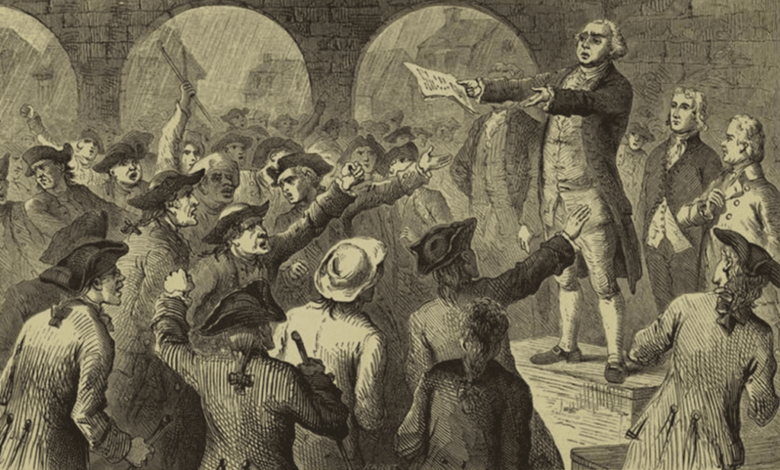
Illustrations, from above: Sons of Liberty meet across the American Colonies to discuss resistance to parliamentary overreach shown in “Agitation against tea ships, New York City, 1773” (NYPL); 1841 lithograph depicting the Paxton Boys’ massacre of the Conestoga at Lancaster, Pennsylvania, in December 1763 during Pontiac’s Wa; map of the Proclamation Line of 1763; “The able doctor, or America swallowing the bitter draught” (NYPL); Original Cover to Thomas Paine’s Common Sense, 1776; and “The Declaration of Independence,” lithograph by Napoleaon Sarony after John Trumbull, 1843-1853.
Source link