 In January 1776, American Revolutionaries disarmed and arrested those accused of Loyalist sympathies in Johnstown, NY. Some would remain under watchful parole. Others were brought to Albany or sent out of the Province of New York for imprisonment, far from home and family.
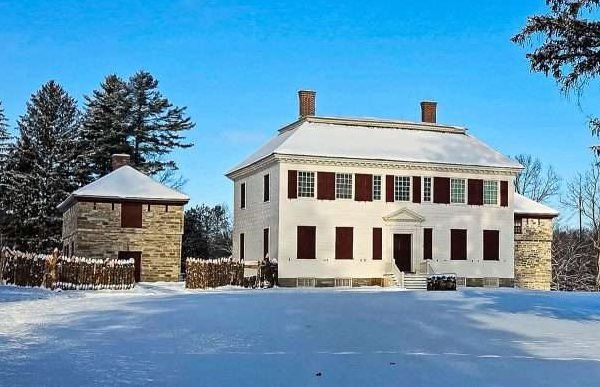
Concerned by the number of Loyalists in New York being arrested, exiled, or even killed, Sir John Johnson directed the building of stockades to fortify Johnson Hall against attack. The replica stockades standing there now were constructed by hand using 18th century building techniques.
The Johnsons, Opponents of the American Revolution
Sir John Johnson (1741 – 1830) succeeded his father Sir William Johnson as British Superintendent of Indian Affairs, raised the King’s Royal Regiment of New York, and fought for the British, eventually fleeing to Canada.
On January 20, 1776, Major General Philip Schuyler, with a force of Continental troops and the Tryon County militia numbering around 3,000, disarmed Johnson and about 300 of his Loyalist supporters; Schuyler paroled Johnson.
Hearing in May 1776 of another force being sent to arrest him, Johnson decided to flee with his family and supporters to Canada. He led about 170 of his tenants and allies among the Iroquois Confederacy to Montreal, Quebec.
Johnson and his followers formed the core of the King’s Royal Regiment of New York, a Loyalist regiment which saw substantial action against American forces from New York under his command throughout the revolutionary war, including at the Siege of Fort Stanwix, in the Saratoga Campaign, at the Battle of Oriskany, Carleton’s Raid in 1778, and the bloody raid on the Schoharie Valley in 1780.
Along with American Indian allies and fellow provincial regiments, such as Walter Butler’s Rangers, the regiment fought a series of low-level raiding campaigns, through the Mohawk Valley.
Sir John’s loyalty to King George III cost him his home in Johnstown and extensive property in the Mohawk Valley, all of which was confiscated after the war by the State of New York.
Guy Johnson (ca. 1740 – 1788) took over his uncle Sir William Johnson’s role as Superintendent of Indian Affairs, moved to Canada with other Loyalists, and led joint British and Mohawk attacks on New York.
These attacks included massacres at Wyoming and Cherry valleys, also known as the “Burning of the Valleys,” during which more than 300 people were murdered. Accused of falsifying reports, Guy Johnson went to London to defend himself after the war and died there in 1788.
The state confiscated all of the Johnson property in 1779 because of the family’s support for the British cause. Johnson Hall suffered vandalism at the hands of Continental soldiers quartered there but the house and estate were subsequently sold to Silas Talbot, a naval officer and hero of the Revolution.
Although most of the fighting during the American Revolution occurred elsewhere, Johnstown did see some fighting late in the war. With area residents not knowing of Cornwallis’ defeat and surrender at the Battle of Yorktown in Virginia, about 1,400 soldiers fought at the Battle of Johnstown, one of the last battles of the Revolution, on October 25, 1781.
The Continental forces, led by Col. Marinus Willett of Fort Johnstown, ultimately put the British to flight after they had burned large tracts of land in the Mohawk Valley. Fort Johnstown formed by fortifying the 1773 stone jail with palisades and towers to defend against British/Loyalist raids, serving as a key defense point for the area
After the war, Johnstown became part of Montgomery County when Tryon County was renamed to honor the Continental General Richard Montgomery, who died at the 1775 Invasion of Quebec. It is now located in Fulton County, NY.
Upcoming Event
In commemoration of the 250th anniversary of the American Revolution, Johnson Hall State Historic Site will host a special reenactment of the first raid on the Johnson family home and the community of Johnstown. This event is free and open to all. No registration required.
On Saturday, January 17, 2026 visitors to Johnson Hall can learn about the weaponry seized from the Hall and the experiences of those enemies of the Revolution.
Patrons will experience living history interpretations including a reenactment of the disarming and arrests, weapons firing demonstrations, live hearth cooking, and an opportunity to explore Johnson Hall against the backdrop of the tumultuous opening days of the year 1776.
Visitors can also explore replica stockade fortifications constructed to resemble ones used to defend Johnson Hall in 1775 and 1776. These stockaded walls of vertical logs were a common defensive structure in North American warfare during the 18th century.
Saturday, January 17, 2026 Event Schedule
- 10:30am to 12:00pm: Recreation of the disarming and arrests in Johnstown
- 12:30pm to 2:30pm: Ongoing living history interpretations
This event is part of a series commemorating the 250th anniversary of the American Revolution at Johnson Hall State Historic Site. On May 16 and 17, 2026, the site will recreate the May 1776 confiscation of Johnson Hall by the 3rd New Jersey Regiment during a two-day reenactment.
Johnson Hall is located at 139 Hall Avenue in Johnstown, NY. As the home of Sir William Johnson and Molly Brant, it served as a seat of trade and diplomacy on the borderlands of the Six Nations of the Haudenosaunee and British colonial holdings in North America.
The Hall is open for guided tours Wednesday through Sunday from mid-May through mid-October. For questions and further information, call (518) 762-8712, or visit the site’s website.
Illustrations, from above: Johnson Hall in Winter, and replica stockade fortifications surround Johnson Hall State Historic Site (Courtesy State Parks).
Source link