 Modern international law prohibits a neutral nation from supplying arms, ammunition, or equipment to any warring party, either directly or indirectly.
Eighteenth-century Dutch legal minds argued the opposite case. They stuck to the principle of “free ships make free goods,” dictating that a vessel under a neutral flag cannot be captured or confiscated.
Neutrality was driven by self-interest, a desire to achieve economic advantage without being involved in hostilities.
Beginning in September 1775, the British set up a blockade of the American Atlantic coast to isolate the Colonies. The Dutch Caribbean island of St Eustatius (“Statia”) became a hub for supplies to the Continental Army during the American Revolution.
The rebels got their muskets, pistols, and gunpowder through this free port where everything was traded, from food and goods to slaves or weapons. The Dutch Republic officially remained neutral but allowed its merchants to profit from the conflict. Sanction busting is a lucrative venture that has a long history.
Born Out of War
The Dutch Republic was born out of war. Lasting from 1568 to 1648 (known as the Eighty Years’ War), the repressive Catholic Habsburg regime of Philip II was overturned by the rebellious Protestant provinces of the Low Countries, leading to a separation of the north from the Spanish controlled Southern Netherlands and the formation of an independent federal state. Formally recognized as the Dutch Republic in the Peace Treaty of Westphalia (1648), it gained significant financial power, and a long-lasting reputation of military might.
The Spanish sacking of the cosmopolitan port city of Antwerp in 1585, brought about a mass migration of Protestant Flemish citizens to the north, causing a shift in the balance of power within the Low Countries. By integrating Flemish experience, the Netherlands built an unrivaled center of commercial and artistic activity. The spirit of Antwerp was revived and continued in Amsterdam, Leiden, Haarlem, and elsewhere.
Under the Treaty of Nonsuch in 1585, Queen Elizabeth decided to intervene in this war. She sent Robert Dudley, Earl of Leicester, with some 5,000 troops to aid the Dutch. For years to come, English troops stationed in the Netherlands saw new weapons and innovative fighting tactics being introduced.
Within the military domain a body of skills was acquired that would become a significant economic factor in the nation’s rapid development. After the outbreak in 1618 of the deadly Thirty Years’ War, Amsterdam became a staple market for the supply of arms.
 English soldier and translator Henry Hexham compiled the first detailed Anglo-Dutch dictionary. He incorporated many military terms derived directly from his Dutch experience (he also authored books on war strategy).
Published in 1648 at Rotterdam, Het groot Woorden-boeck… A large Netherdutch and English dictionarie, introduced a new jargon into English that included such words as beleaguer, blunderbuss, booty, knapsack, plunder, quartermaster, tattoo, and many others.
British authorities invited Dutch engineers to cross the Channel and aid England’s strategic reorganization. Born in 1620 in Terneuzen (Torneus), Bernard de Gomme served under Prince Rupert, grandson of James I, and became his chief engineer.
After the Royalist defeat to the Parliamentarians in the Civil War, he returned home. During the Restoration, he took charge of the King Charles II’s castles and fortifications. After the daring raid on the Medway during the Second Anglo-Dutch War in 1667, De Gomme designed and rebuilt the defense systems of Sheerness. An infrastructure destroyed by Dutch naval power was restored by the skills of a Dutch engineer.
The arms industry flourished. Muskets, pistols, and cannons were produced in Amsterdam, Utrecht, Rotterdam, and Maastricht. Activity along the River Maas (Meuse) stretched from Liège to Namur in the Southern Netherlands. Arms produced in that region were also labeled as Dutch made. In politics, the concept emerged of a “fiscal-military system,” that would enable countries to fight lengthy and costly wars.
Amsterdam functioned as an international hotspot where quantities of arms were sold to both allied and hostile regimes by facilitating financial transactions, loans, and long-term contracts. Battlefield demands, technological innovation and government intervention became intertwined.
Entrepreneurs such as Louis [Lodewijk] de Geer (born in Liège in 1587) and the brothers Elias and Jacob Trip who traded in cannons and muskets were amongst Amsterdam’s wealthiest citizens. Rembrandt painted Jacob’s portrait.
The American Revolutionary War opened up the potential for an enormous new market. The British authorities bought Dutch armaments to supplement their own production.
 Recruiting 31,000 “Hessian” (German-speaking) mercenaries, George III armed them with Dutch muskets. When these troops under command of General John Burgoyne surrendered at Saratoga in 1777, an estimated 1,200 captured muskets would strengthen the firepower of the Massachusetts militia.
That same year, Benjamin Franklin’s agents bought 2,000 muskets, many of them with Amsterdam labels on the lock plates. Until the late eighteenth century, the Dutch Republic was better known for selling weapons than making cheese or growing tulips.
First Salute
The “Brown Bess” was the standard British infantry musket and the most common firearm for both sides in the American Revolution. The “Charleville” was the superior French musket that became a much-used weapon by Continental Army. Named after the Arsenal at Charleville in the French Ardennes, it was lighter and more precise than its British counterpart supplying American soldiers with plenty of firepower in battle.
Dutch muskets may have lacked the reputation of these British or French arms, but they were widely available and employed in every battle of the Revolution. Since the ending in 1763 of the Seven Years’ War (the French and Indian War in America), Europe was awash with surplus armaments.
Using parts recovered from conflict areas, Dutch dealers shipped reassembled weapons to America before and during the French and Indian War and early in the Revolutionary War. The rebel militia were ingenious too. Using locks and parts scavenged from old hardware, muskets were recycled and paired with American beech, chestnut, or maple.
Dutch arms were in use from the start of war. The first shot in the “Battle of Bunker Hill” on June 17, 1775, was fired with a Dutch-made flintlock musket by private John Simpson of the First New Hampshire Regiment.
 When on November 16, 1776, the merchant vessel turned warship Andrew Doria sailed into the harbor of St. Eustatius, Governor and merchant Johannes de Graaff at “Fort Oranje” (built by the Dutch West India Company in 1636) ordered his men to return its nine-shot salute.
It marked the first official recognition of the American flag by a foreign power. This “betrayal” infuriated the British who regarded the island as an enabler of rebellion.
Fury about this act of recognition and a determination to stop the illicit arms trade, prompted Britain to declare the Fourth Anglo-Dutch War in late 1780 after the Dutch had joined the League of Armed Neutrality, an alliance of nations (Russia, Denmark, Norway, Sweden, Prussia, Portugal, and the Ottoman Empire) intent on protecting free shipping against Britain’s aggressive maritime policy.
This naval war would eventually turn out to be disastrous for Dutch trade, heralding the decline of the once powerful Republic.
In February 1781, a British fleet under Admiral George Brydges Rodney invaded the island, ruthlessly plundering the vast material and financial wealth of the “golden rock” (Rodney had extensive gambling debts to pay off) and cutting its supply routes.
He also apprehended fifty-seven British merchants in the locality who were trading with American rebels. At the same time, retributive action distracted him from his defensive mission, allowing the French Navy to reach Virginia which contributed to George Washington’s decisive victory at the siege of Yorktown.
Masters of War
Jan Verbruggen was born in 1712 in the port city of Enkhuizen, where he grew up. He trained as an architect before his appointment in 1746 as master founder for the Admiralty of West Friesland. He introduced the latest technique for boring a cannon from solid castings which, developed in Switzerland by Johann [Jean] Maritz, was in operation at the French Royal Foundry in Douai.
In the early 1750s Verbruggen was called to The Hague with the task of reviving the city’s state-owned foundry after years of neglect. Aided by his son Pieter, a law graduate, he employed John Siegler who had worked at Douai’s Arsenal for fifteen years.
The attempt to radically remodel the foundry led to a decade of controversy with his employers and the accusation that the guns he produced were unreliable. In the end father and son Verbruggen decided to quit, move to London, and take up an offer of work at the Royal Arsenal at Woolwich.
On January 12, 1770, they were appointed master founders, facing a task of monumental proportions. The foundry was in ruins. Its buildings had to be restored, new furnaces built and machinery replaced, requiring huge expenditure by the Board of Ordnance.
 By early 1773, the Royal Brass Foundry had been revamped. The advanced tool techniques (including the first use in England of a horizontal boring machine) proposed by the Verbruggen duo were introduced to the foundry. The first cannons made by them passed proof tests in April 1774.
Producing cannons, guns and mortars, the foundry provided high-quality ordnance for the army. In early 1775, the slow production schedule for casting arms was broken by emergency orders to rapidly supply British forces engaged in the American War of Independence.
During the Seven Years’ War, the Prussian Army had introduced a light cannon that could be mounted on a carriage, or even carried by soldiers in case of emergency. During the 1770s, the British Board of Ordnance insisted that this type of weapon would suit military action in the rugged terrain of North America.
By early 1776, with hostilities well underway, the Board ordered a weapon designed for “American service.” The first twenty pieces were handed to General John Burgoyne’s Army during the campaigns of 1776/7 in Canada and Northern New York. Verbruggen’s mass production (a first in military history) of the “light 3-pound gun” would change the nature of warfare.
Nicknamed “grasshoppers,” they supported fast-moving infantry units. Some three quarters of all those produced between 1775 and 1782 were shipped from Woolwich to British forces in the Colonies and Canada.
Used throughout the war, these light guns were often captured and used by American forces. They were “trophy” cannons, symbols of victories in iconic battles at Saratoga or Cowpens.
Merchants & Engineers
Jan Verbruggen was also a painter of seascapes and coastal scenery. As a youngster he had been apprenticed to the studio of Jan van Call the Younger at The Hague. Although his career took a different direction, he did apply his drawing skills for technological purposes.
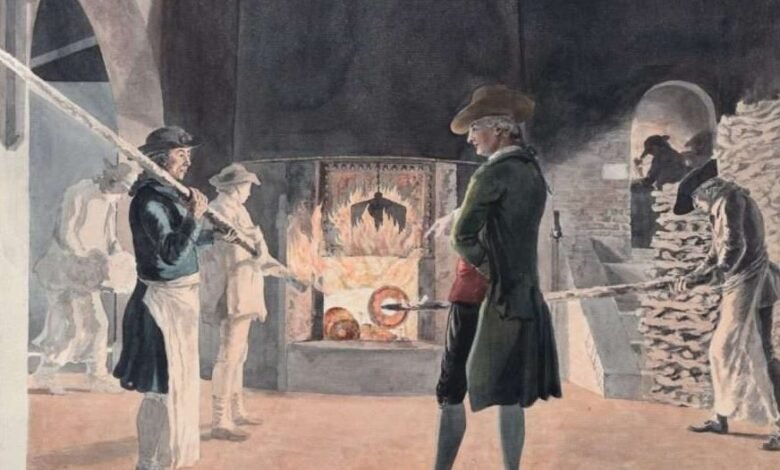
 Between 1774 and 1778, he produced fifty images of the horizontal boring machinery (or “lathe”) that had been installed at the Woolwich Arsenal. Known as the “Foundry Drawings,” they are unique pictorial records of eighteenth-century industrial operations.
In 1991, these images inspired Carel de Beer (Professor of Mechanical Engineering at the University of Eindhoven) to edit a study on The Art of Gunfounding.
Jan Verbruggen died in London on October 27, 1781, and was buried at London’s Dutch Church, Austin Friars. His three-story brick house still stands at the Woolwich Arsenal; his guns are on display in military collections in Europe and North America.
Pieter Verbruggen continued the Woolwich project until his death in 1786. Under his leadership the foundry reached its apogee, finishing a total of 237 guns in 1782. With the ending of the American War the foundry declined.
In the early colonial period, Dutch settlers had developed a network of firearm suppliers and their aptitude to deal in guns and ammunition continued up through the American Revolution. The government may have claimed neutrality, but Dutch merchants and smugglers made vast profits by delivering weapons to both parties in the conflict.
Dutch engineers continued a long-standing tradition of working in the service of the British Crown. They were actively engaged in designing improved weaponry for British troops fighting in the Revolutionary War.
It was, on the other hand, Delft-born Dutch engineer Barent [Bernard] Romans who in 1775 designed and started the construction of fortifications at West Point.
In the end, Dutch political and financial support would swing behind the rebel cause. The Republic recognized the United States in 1782, becoming the second European nation (after France) to do so.
Read more about New York Military History.
Illustrations, from above: Jan Verbruggen’s “Foundry Drawings,” no. 35 (with himself in the foreground); Henry Hexham, Het groot Woorden-boeck… A large Netherdutch and English dictionarie, composed out of the best Netherdutch authors (Rotterdam: Gedruckt by Arnout Leers, 1648); An eighteenth-century Dutch musket; First Salute plaque unveiled on November 16, 2001, at Fort Oranje; James Fittler, “The Royal Brass Foundry at Woolwich,” engraving (Jan Verbruggen’s house is on the left), 1779 from Sandby’s Views, 1781; Jan Verbruggen, “VOC yacht approaching the East Indiaman De Vrientschap,” 1766 (Archive of Semeijns de Vries van Doesburgh).
Source link