 The United States Patent Commission was created on April 10, 1790, to establish a formal method for submitting and indexing patents. Its first three members were Secretary of State Thomas Jefferson, Secretary of War Henry Knox, and Attorney General Edmund Randolph.
As only three people made up the early patent office, the first applications were not closely examined. An inventor simply submitted a written description, a working model, and a $30 fee (equivalent to about $1,000 today).
For over 25 years, the patents were stored in a building known as Blodgett’s Hotel, also the site of the General Post Office. A bizarre series of incidents at the hotel would irreparably damage a part of American history.
That December was a particularly cold one in Washington D. C., so Patent Office employees had a large pile of wood stored in the basement to warm the building. Unfortunately, they also had a habit of storing ashes in the cellar hallway despite being warned against that dangerous practice.
In the early morning of December 15, 1836, these ashes are believed to have set the wood on fire and the cellar quickly became engulfed in flames. The alarm was sounded, but the fire pumper was frozen from the cold, and the hoses in poor condition. A bucket brigade was formed, but too late. All of the patents and models were destroyed.
The Patent Office attempted to reconstruct the lost patents using private collections and the inventors themselves, about 10,000 were lost, with only about 3,000 recovered. These were given an “X” designation to distinguish them from patents issued after 1836 and are commonly called the “X-patents.”
The 1836 fire was devastating to the early patent record of Saratoga County, NY. Of the 54 X-patents issued there, 34 were destroyed by the fire, including 22 out of the first 25. Four additional patents contain the drawings only, while in two others the drawings have been lost.
The county’s first patent was one of those that could not be replaced, issued on April 2, 1810 to Jonathan Minor of Saratoga Springs for a water wheel. Others destroyed by the fire include Daniel Newell’s “Machine for Shaving and Dressing Shingles” (Saratoga, 7/26/1810), John Bryan’s “Manufacturing Hats” (Saratoga, 8/26/1815), Eliakim Cory’s “Stove” (Milton, 5/30/1816), and John Gue’s “Machinery for Windmills” (Waterford, 12/31/1822).
The most X-patents, 19, come from the Town of Waterford, while Saratoga Springs comes in second with 10. Surprisingly, the Town of Galway is third with nine patents, all of which were submitted before 1830. None of Galway’s patents survived the Patent Office fire.
The Town of Milton had four X-patents, of which one survived – Oliver Davidson’s “Door Spring,” issued on March 30, 1835. The towns of Wilton and Stillwater each have two, while the towns of Greenfield, Malta, Moreau, Clifton Park, Northumberland, Corinth, Charlton, and the Village of Schuylerville each have one.
A few of those that survived intact are James McGregor’s “Planing Machine” (Wilton, 8/28/1833), George Tibbets’ “Water Cistern” (Jamesville, 12/30/1833), Valentine Brown’s “Canal Lock Indicator” (Clifton Park, 5/14/1836), and Isaac Norton’s “Thrashing Machine” (Schuylerville, 1/6/1831).
One of the so-called “fractional” patents exists – Samuel Allen’s “Thrashing Machine” (Saratoga, 4/3/1835). Fractional patents arose when some of the original X-patents were left out of the sequence, and so to keep them in chronological order, newly-discovered patents were inserted between patent numbers. Therefore, Allen’s patent became number X8737½.
The loss of X-patents is particularly impactful for those of historic nature. John F. Rogers of Waterford was a pioneer in creating new firefighting apparatus and had submitted two patents that were both lost. One was a “Forcing and Suction Pump” dated February 27, 1833, and the other was for an improved “Forcing Pump” dated March 30, 1836.
Despite the fact that Joel Farnam was one of Stillwater’s greatest inventors with five patents, for some reason he did not provide the Patent Office with another copy of his own forcing pump. The only X-patents of Moreau, Charlton, Corinth, Northumberland, and Malta have also never been recovered.
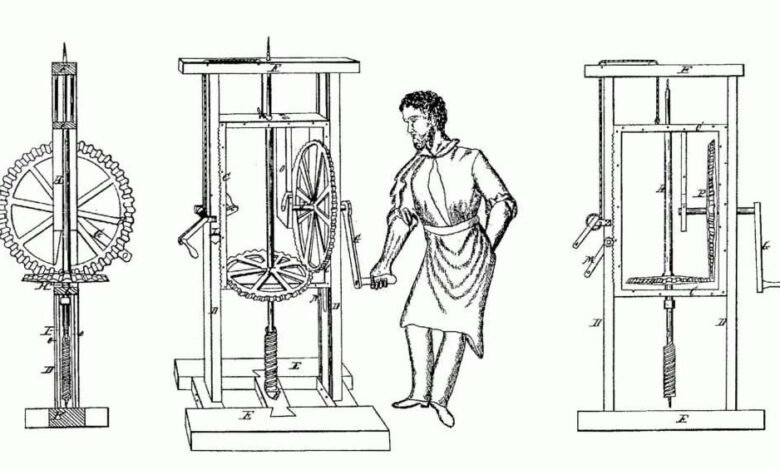
Jedidiah Beckwith’s machine for boring timber is the earliest Saratoga County patent that survives completely intact. Beckwith’s invention was submitted in Saratoga Springs and accepted on December 21, 1830.
The book Repertory of Patent Inventions (1829) describes the tool: “A frame is made having two uprights, like those of a standing press. A cylindrical vertical shaft fits and turns freely in holes at the top and bottom of the sliding frame; the augers or bits, with which the boring is to be performed, are adapted to the lower end of the shaft. By means of a handle, motion is given to the vertical wheel.”
Beckwith also patented a rotary pump on April 16, 1831 and a double-acting metallic pump on December 27, 1833, making him the county’s most prolific early inventor to submit patents. He must have provided the Patent Office with copies of his patents after the fire, since all three survived in their entirety.
Samuel Allen of Saratoga Springs patented a pulley system for increasing the power generated from a farm horse. Oliver Davidson of Ballston Spa submitted that village’s earliest surviving patent on March 30, 1835 for a door spring.
Valentine Brown submitted Clifton Park’s only X-patent on May 14, 1836, which fortunately survives to this day. His canal gate signal employed “vertical rows of friction rollers parallel to each other and embedded in the inner side of the uprights of the main gate.”
Brown’s patent and John Drummond’s grain cutter were two of the last to be accepted before the fire.
Perhaps we should be grateful that 14 of the pre-1836 patents survive completely intact with drawings and text, but to historians this is little consolation.
Timothy Starr has published 25 books on Saratoga County and Capital District history, focused on industries, inventions and most recently railroads. He is a former board member of the Saratoga County History Center. His books are available at Brookside Museum and on line at Timothy Starr – American railroads, inventions and industries (1850 to 1950).
This essay is presented by the Saratoga County History Center.
Illustration: Patent drawing for the Beckwith Boring Machine ca. 1830.
Source link