I began working in theatre in my twentieth year, at the start of the 1990s, at the National University of Rwanda. The country was then in the midst of a civil war, and theatre became, for us as young students, a means of understanding and representing the singular moments the Rwandan society of that time was going through. We were not writing plays; we limited ourselves to performing African classics, most often by authors from West Africa.
To the physical violence of war was added another, very specific form of violence: violence embedded in language itself—an unbridled verbal violence that would culminate in public calls for mass murder and, three years later, the 1994 genocide against the Tutsi.
When one considers the four years preceding the genocide in Rwanda, what is striking is that the genocidal project was not secret. Its plans were openly articulated by its architects in the media. Yet when the genocide began in April 1994, we were taken completely by surprise, as though the sky had suddenly fallen on our heads.
In retrospect, one wonders why we failed to foresee the genocide, when the memory of humanity-events could have allowed us to compare our situation with other, similar situations that had led to crimes against humanity of the same nature. Our society increasingly resembled Europe in the 1930s: the same hate media, the same types of discourse, the same racist and fascist parties, the creation of militias, and a government that became more criminal by the day targeting part of its own population. At no point did we draw a parallel between our situation and that of Europe in the 1930s and 1940s. And yet this was one of the historical periods we knew best. It was taught at every level of education and transmitted through literature, works of art, cinema, television, music, and theatre.
This inability to learn from the totality of human experience stems from our narrow relationship to universal memory, from which our aesthetics of representing the world derive. In other words, we had never drawn historical lessons from the rise of fascism in Europe or from the genocide of the Jews during the Second World War, because we considered these realities to have nothing to do with us. In a blunt and crude way, European history seemed to us at that time, a history of white people, while our own realities belonged to typically African histories—Black histories.
I would go further and say that representations of these historical episodes reached us in an essentialized form that kept us locked into a compartmentalized vision of the world. We perceived racism and fascist policies as white afflictions. Even as our country’s political landscape increasingly resembled that of Europe in the 1930s, we continued to regard fascism and racism as forms of European atavism.
I realized that even in the arts, even in theatre, a narrow spiritual vision of the world persisted—one that prevents artists and audiences alike from drawing on the full breadth of human experience.
From the day after the genocide, the subject of political violence became a central axis of my artistic work. Working both in Europe and in Africa, I realized that even in the arts, even in theatre, a narrow spiritual vision of the world persisted—one that prevents artists and audiences alike from drawing on the full breadth of human experience.
I have led several projects about the genocide in Rwanda, most often presented to distant audiences: in Europe, the United States, and Asia. Each time, I asked myself through what mediation these audiences might absorb this history as their own, not as an exotic narrative removed from their daily lives, but as the expression of one of the most recurrent phenomena in contemporary societies?
In a world increasingly folded in on itself, where walls continue to rise between peoples, the artistic community can enable contemporaries to fully inhabit their world and their time by spiritually de-compartmentalizing universal memory.
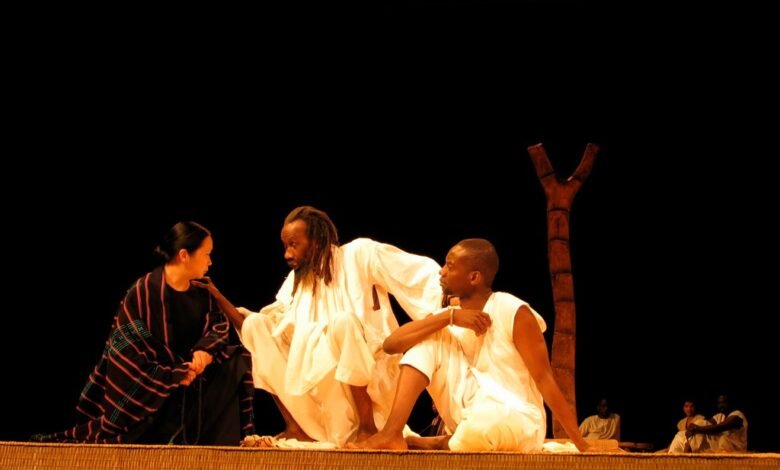
Two experiences convinced me of the power of representations freed from identity-based assignments. Upon leaving theatre school, the first director to extend a hand to me was Peter Brook. I was then playing the role of the Malian writer Amadou Hampâté Bâ in his narrative Tierno Bokar staged by Brook. The actress playing my mother, Hélène Patarot, was of Vietnamese origin; one of our schoolmasters was Yoshi Oida, a Japanese actor. This ensemble not only worked coherently, it also allowed the international audiences of Brook’s productions to experience this African story as their own. Later, Brook staged the same work with a Middle Eastern cast, largely composed of Palestinian actors, and it worked just as well. No one wondered why Palestinians were playing Africans.