 My introduction into exploring the depths of waterways began at Lake George on June 14, 1981. On that date, I completed a check out dive off Diamond Island to acquire my scuba certification.
Diamond Island, four miles north of Million Dollar Beach, has for over six decades been the site where thousands of scuba students have taken their practical “exam” to become certified scuba divers.
On August 31, 1981, less than three months after becoming a scuba enthusiast, I was at Lake Champlain undertaking a subsurface operation testing a sonar unit. Several weeks later, the equipment was employed by two intrepid university professors and their team exploring the jungles of central Africa, looking for a dinosaur-like creature called “Mokele-mbembe.”
That sonar evaluation on August 30, 1981, was one day after the “Does Champ Exist?” symposium that was held in Shelburne, Vermont. Several scientists, researchers, and many members of the public attended to discuss and debate if the 110-mile-long Lake Champlain was the home of Nessie-like animals called “Champ.”
Among the 1981 conference presenters were Dr. George Zug (Smithsonian Institution), Dr. Roy P. Mackal (University of Chicago), J. Richard Greenwell (University of Arizona), Dr. Phil Reines (SUNY-Plattsburgh), Sandra Mansi (Champ eyewitness), me, and others. The event was sponsored by the Lake Champlain Committee, a citizens’ group that worked toward a healthy waterway.
 Prior to the seminar, Dr. Mackal asked me to organize a field test of a new sonar he recently acquired. The gear would be mounted on a wooden dugout during an expedition into the Congo River Basin.
These scientists, called cryptozoologists (searchers of hidden animals), would be tracking unidentified elephant-sized animals known as the Mokele-mbembe. Said to look part brontosaurus and part dragon, these creatures reportedly lived in one of the remotest tropical rain forests in Africa.
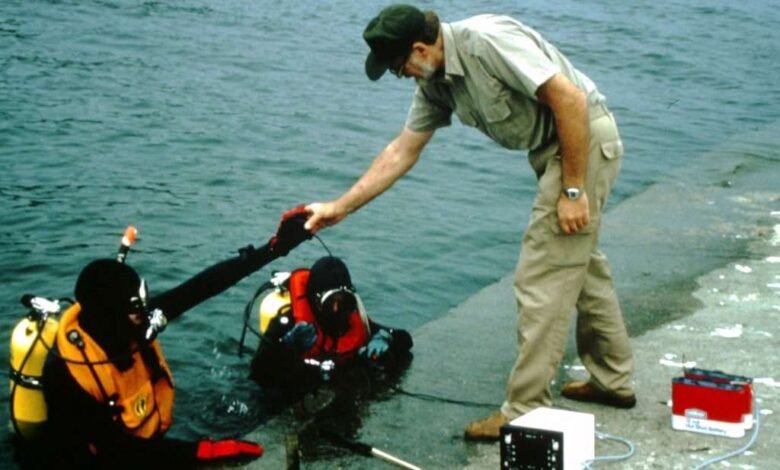
Over August 30–31, 1981, Mackal, Greenwell, Pat Meaney (now my wife) and I were at Button Bay State Park on Lake Champlain, near Vergennes, Vermont. We had permission from state officials to use a nearby uninhabited island as our camp.
Pat Meaney and I donned scuba gear and anchored the sonar’s transducer to the lake bottom. We then swam transects past the sonar transducer to determine how well the equipment performed. Dr. Roy P. Mackal and J. Richard Greenwell were satisfied with the sonar’s test results.
 From late October into early December 1981, Mackal and Greenwell’s team of scientists and African support personnel explored the Likouala Swamp of the Democratic Republic of the Congo.
During their expedition they also undertook scientific studies that included an inventory of flora and fauna, the latter catalogued species of fish, reptiles, birds, amphibians, and mammals. Crocodiles were also recorded on their dugout’s sonar screen.
Mackal, Greenwell, and another team member, M. Justin Wilkinson, concluded in their field report: “As to… unknown animals [Mokele-mbembe] surviving in the Likouala, there is only anecdotal evidence. Our [1981] expedition found no compelling evidence…, but we think that the historical and anecdotal evidence that does exist is sufficient to warrant further investigation.”
A version of this article first appeared on the Lake George Mirror, America’s oldest resort paper, covering Lake George and its surrounding environs. You can subscribe to the Mirror HERE.
Illustrations, from above: Left-to-right, Joseph W. Zarzynski, Pat Meaney, and Dr. Roy P. Mackal testing sonar in Lake Champlain in 1981 (photo courtesy J. Richard Greenwell); The 1981 expedition in the Republic of the Congo in search of the Mokele-mbembe (courtesy Dr. Roy P. Mackal); and an illustration depicting the reported likeness of Mokele-mbembe next to a Pygmy person from Central Africa (courtesy Dr. Roy P. Mackal).
Source link