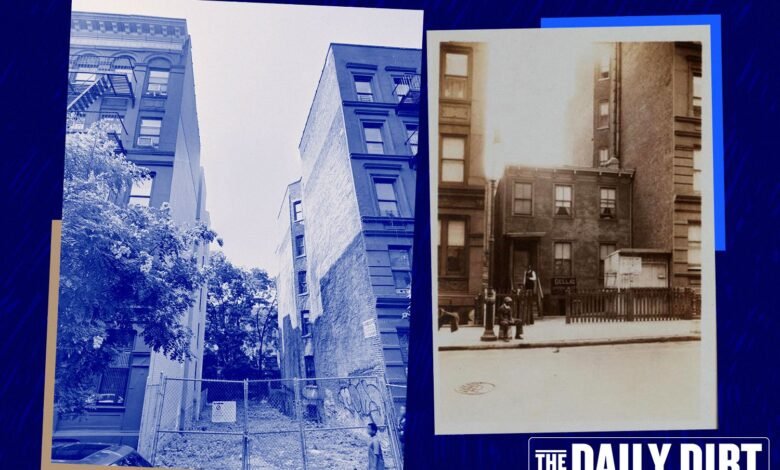

Last Tuesday’s Daily Dirt about four long-vacant Harlem lots getting affordable housing — for an average of $909,000 per unit — caught the attention of an investor who owns and manages a portfolio of rent-regulated and free-market apartments in Brooklyn and Manhattan.
The lot at 136 West 137th Street, he noted, “has been empty forever.” But that didn’t surprise him in the least, because a cost of $900,000 per unit would be “somewhere in the realm of obnoxiously possible.”
It’s a narrow lot that will be “extraordinarily hard to build on — the basement needs to be excavated in sections with shoring on both sides,” wrote the investor, who sometimes writes about real estate under the pen name Craig Roche.
Long ago, many 50-foot-wide Harlem lots were split three ways, leaving 17-foot lots. Developers built party walls to maximize usable space, and when owners abandoned them, the city tore down the front and back but left the party walls standing, Roche said.
New construction must be effectively freestanding and requires thicker walls than the original ones, reducing the usable width. “Meanwhile, you have to adhere to modern standards — sprinklers, wide hallways/stairs, increased setbacks, vestibule depth, etc.,” he said. “In a rational world, bunches of these buildings would be torn down to make way for newer buildings with larger floor plates, but zoning, rent regulations, historic districts, etc. make all of that too hard.”
The builder will need separate permits for water, sprinkler and dual sewer hookups, he said.
“What this illustrates is that New York City makes it extremely hard to build because the code is so complicated and requires a lot of stop-start,” Roche added. “There are two houses on the block that have been under renovation for 10-plus years.”
I looked up the demolition permit for the lot at 136 West 137th. It was filed 30 years ago. This lot has been empty for a while, and the cost of rebuilding helps explain why.
The SRO that once stood there was seized by the city for unpaid property taxes in 1970. Fifty years passed before someone filed plans to replace it. It took more than two years for the city to approve them.
What we’re thinking about: A few readers complained when I wrote during the campaign about a few ways that Zohran Mamdani could help real estate. One that I left out is his support for the four borough-based jails, which are actually mixed-use projects. The developments, now with an estimated total cost of $13.8 billion, were launched and continued, respectively, by his predecessors Bill de Blasio and Eric Adams. City & State has an update on where each one stands. Send thoughts to eengquist@therealdeal.com.
A thing we’ve learned: Death came quickly to EmPower Solar after the Trump administration ended the 30 percent rooftop solar tax credit at the end of last year. The company, which grew to as many as 150 employees after its founding on Long Island in 2003, is shutting down. Founder and CEO David Schieren told Newsday that the end of the tax credit was the “most acute” of several factors that killed the business. “We just didn’t have any sales after that ended,” he said.
Elsewhere…
FacilitiesDive ran a feature about the geothermal system at LCOR’s 400,000-square-foot, mixed-use project at 1515 Surf Avenue in Coney Island. The upshot: Geothermal can work in a dense urban development.
The wells had to be dug in a tight space because buildings surrounded the site. But LCOR can now claim to have the largest district geothermal system in the city (“district” means it’s more than one building). It was more expensive than a conventional system, but will cost less over time to operate and maintain.
LCOR, the first developer to use geothermal in a residential building in the city, got $1.62 million from New York’s community heat pump pilot program, $2.9 million from Con Edison’s utility clean heat program and a 30 percent federal tax credit.
Because the high-efficiency geothermal heat pumps were connected to the same ground source loop, it qualified more equipment for the tax incentive. “It astronomically increases the incentive that you’re going to get from the federal government,” an executive at Ecosave, which worked on the project, told FacilitiesDive.
Closing time
Residential: The largest residential sale Tuesday was $34.5 million for 15 East 63rd Street. The Lenox Hill mansion is 18,000 square feet. Brown Harris Stevens has the listing.
Commercial: The largest commercial sale was $102.5 million for 1160 Teller Avenue. The Concourse public health care facility is 215,000 square feet.
New to the Market: The highest price for a residential property hitting the market was $28.8 million for 176 Perry Street, Unit 10S. The West Village condo unit at the Meier South Tower is 11,000 square feet. The Corcoran Group’s Deborah Grubman and David Adler have the listing.
Breaking Ground: The largest new building permit filed was for a proposed 86,913-square-foot, 14-story, mixed-use building at 120 Court Street in Brooklyn Heights. Thomas Scibilia of NA Design Studio is the applicant of record.
— Joseph Jungermann