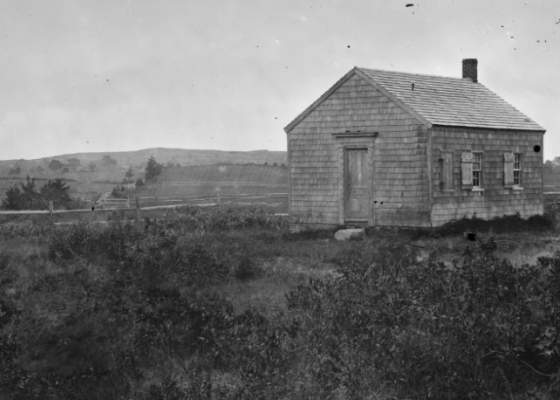
 Humble in appearance, one-room schoolhouses might be easy to overlook, but their existence hints at a broader social, cultural, and educational history.
Hundreds of one-room school houses were built across Long Island and many still survive, either adapted to new uses or restored and open for public access.
Zach Studenroth, architectural historian and preservationist, documents this history in Historic Schoolhouses of Long Island (Arcadia, 2025), written with his co-author, the late Kurt Kahofer.
From the simplest, pre–Revolutionary War period “Town House” in East Hampton to the trendy, octagonal schoolhouses constructed in Brentwood and Yaphank in the 1850s, Long Island saw a great variety of these distinctive structures.
Responding to an 1812 New York State law requiring towns to lay out school districts within walking distance of its younger residents, many early population centers received schoolhouses by the 1820s.
Even a handful of Long Island’s schoolhouses are associated with the great American poet Walt Whitman, who taught school as a young man in the 1830s and later shared his concerns about the teaching methods then in vogue.
By the end of the 1800s however, Long Island’s one-room schoolhouses became outdated and no longer accommodated the growing population. Luckily, many were saved and repurposed as sheds, workshops, and even seasonal dwellings.
On the latest episode of the Long Island History Project podcast, Zach Studenroth elaborates on the role of New York State in establishing schools in the 1800s, Walt Whitman’s brief foray into teaching, and the surprising afterlife of school buildings as churches, fire houses, and storage sheds.
You can hear the episode here.
The Long Island History Project is an independent podcast featuring stories and interviews with people passionate about Long Island history. It is hosted by academic librarian Chris Kretz.
Read more about the history of New York State’s 19th century common schools.
Photo: George Bradford Brainerd photo of a Long Island one-room schoolhouse (courtesy Center for Brooklyn History).
Source link