 In 1946, New York and the nation were in the throes of what was generally being called “reconversion” – redeploying workers and the industrial base away from the largest war in U.S. history toward a peacetime economy.
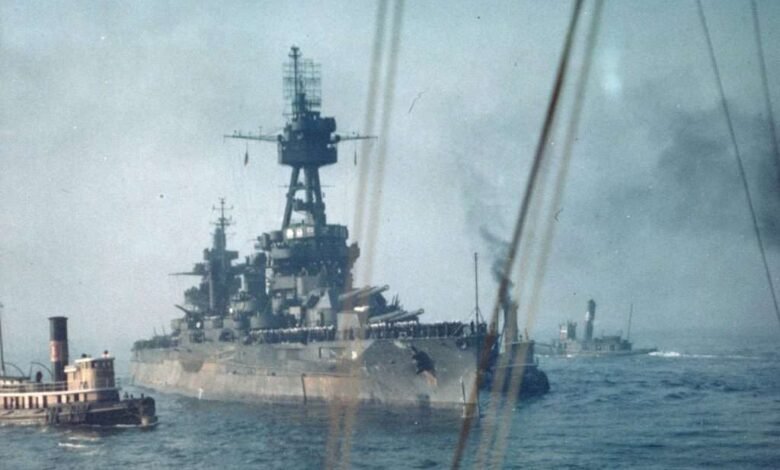
A moment in time: on January 25, 1946, the venerable dreadnought U.S.S. New York (BB-34) slipped her moorings at Pier 26 in the North River, at the foot of Beach Street in Manhattan, bound for the Pacific.
There the 32-year-old veteran of two world wars, including service with the British Grand Fleet in World War I and deployment off North Africa, Iwo Jima and Okinawa in World War II, and ferrying troops home after the Japanese surrender, would be subjected to a series of atomic bomb tests at Bikini Atoll in the Marshall Islands.
 Built at the Brooklyn Navy Yard from 1911 to 1914, the New York was a fitting symbol of her namesake state’s past industrial prowess – and its journey toward putting the war behind it. The same month she left New York City for the last time, the Committee for Economic Development (CED), a nonprofit New York-based think tank, reported that reconversion of war-directed jobs and resources was 90 percent complete.
Reconversion was a national priority. President Harry S. Truman had tapped his friend, banker John W. Snyder (1895-1985), as Director of War Mobilization and Reconversion. Snyder estimated that Army demobilization would approach 500,000 troops a month, and that 5 million U.S. wartime workers would be displaced, with unemployment reaching 8 million by spring 1946 (in fact, U.S. unemployment, which had fallen from 15% in 1940 to under 2.5% by 1944, would only reach 4.2% by year-end 1946).
One example: at its peak, the Brooklyn Navy Yard employed 70,000, falling to around 10,000 by late 1947. City relief rolls rose in in the months after war’s end for the first time in a decade.
But the CED said that the “industries of New York have on file the greatest backlog of unfilled industrial orders in all history,” and projected that postwar-related unemployment would be short-lived as workers were redistributed to meet peacetime needs in industries such as metals and machinery, textiles, chemicals, and building materials.
(In fact, New York City’s employed workforce totaled 3.3 million by November 1946, vs. 2.8 million six years earlier.)
 As troops came home from duty abroad, postwar victory celebrations greeted them. That January of 1946, amid flapping flags and streamers in a cold wind, 13,000 troops marched four miles up Fifth Avenue, from the Washington Square Arch to 86th Street, as The New York Times put it, “a living memorial to the ‘doughfeet’ of the global war.”
Leading the parade was Brooklyn-born Maj. Gen. James M. Gavin (1907-1990) of the 82nd Airborne, the youngest general since the Civil War to command a U.S. Army division. The division’s journey mapped the liberation of the European continent, from North Africa, to Sicily, to Anzio, Normandy, and the Bulge, as well as occupation of postwar Berlin.
After the First World War, the city had welcomed home the 27th Division, the New York Guard unit that helped break Germany’s Hindenburg Line, along the same route in a parade disrupted by crowd surges amid euphoria for the home state boys.
The Times in 1946 noted the contrast between the two celebrations, editorializing, “The hysterical rejoicing of Armistice Day was lacking. Americans have looked back long enough to realize that ours was a solemn victory, won at terrific cost. So, in a sense, this was a solemn Victory Parade.”
New York tried to move into the golden sunlight of peacetime. Governor Thomas Dewey in his January 1946, annual message to the state legislature crowed that “our state conversion to peace has progressed vigorously and with a degree of harmony among business, labor and government unequalled in any other industrial state.”
 In fact, the readjustment was anything but smooth, The Times noted, with the State Industrial Commissioner reporting that “strikes in 1946 were by far the most serious in the history of New York State in terms of numbers made idle and production lost.”
In April 1946, New York City Mayor William O’Dwyer introduced a proposed a record $857 million city budget a 12% increase. The mayor attributed the jump to the costs and pain of reconversion – including deferred expenditures for upkeep.
“During the past four years our expenses have been gaited to a wartime economy,” he stated. “Numerous items of equipment and supply were unobtainable. Necessary repairs to our operating plant were deferred.”
The freshly elected O’Dwyer – who had served in the Army during the war, achieving the rank of brigadier general and serving as executive director of the War Refugee Board – warned of continued postwar economic pain:
 “We are now converting to a peacetime status. The deficiencies of wartime must be corrected. Employees must be returned to a normal way of life… Progress is the rule by which the success of a community is measured, but before we make any progress we must regain the ground lost during the war. The road back will not be a pleasant journey.”
As the civilian world readjusted, the Armed Forces demobilization continued. The Navy was in the process of reducing its fleet from 500 front-line ships (fleet carriers, battleships, cruises, destroyers) to 200.
As for the U.S.S. New York? Moored in the lagoon of Bikini Atoll, she survived the July 1946 Able and Baker nuclear blasts of Operation Crossroads. Two years later, worn out and radioactive, she was sunk as a target ship in deep waters off Pearl Harbor.
Read more about World War Two in New York.
Illustrations, from above: The USS New York (BB-34) welcomed home to New York Harbor in 1945; USS New York underway at high speed on May 29, 1915 (National Archives); US Army 82nd Airborne Division parades through Washington Square Arch, January 1946; Graph showing the number of workers involved in US strikes each year according to the US Bureau of Labor Statistics, the 1946 post-war strike wave is the tallest blue line; and the Baker atomic test during Operation Crossroads, Bikini Atoll, July 25, 1946, USS New York is just to the right of the explosion column.
Source link