
International training for pandits and panditas in Germany promotes Hindu rites in the West

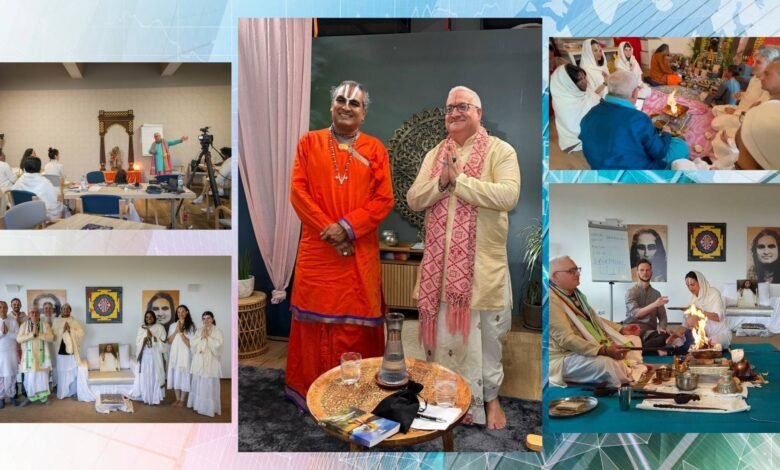

An intensive course led by the Ceuta-born pandit Krishna Kripa Dasa brings together participants from various countries at the Shree Peetha Nilaya ashram to train in the samskaras—the rites of passage in Hinduism—within an international and contemporary context.
At a time when spirituality is seeking to rediscover its most authentic and practical essence, the rigorous training of spiritual guides has become a fundamental necessity. In this context, Pandit Krishna Kripa Dasa (Juan Carlos Ramchandani) recently delivered an intensive training course for pandits and panditas at the Shree Peetha Nilaya ashram, the international spiritual centre of the Bhakti Marga organisation, located in the town of Springen, near Frankfurt, in Germany.
This training programme, spread over three intensive days, focused on the samskaras, the rites of passage in Hinduism that accompany a person throughout their entire life. The samskaras constitute a unique system within the world’s religious traditions, as they span from the prenatal stage to funeral rites, sanctifying every key moment of existence. These are not merely external ceremonies, but processes of purification, elevation and connection of the individual with the divine.
The course was taught in English, with extensive use of Sanskrit, the liturgical language of Hinduism, which allowed the authenticity of the mantras, rituals and traditional formulas to be preserved.
Both theoretical and practical aspects were covered during the training. The prenatal samskaras, unique to Hinduism, were studied in depth, highlighting the importance of life even before birth. Likewise, post-birth rituals were covered, with practical demonstrations of fundamental ceremonies such as the Nama Karana (naming ceremony), the Anna Prashana (first intake of solid food) and the Mundanam (tonsure ceremony or first shaving of the head).
It is worth noting that these ceremonies were not mere simulations, but actual rituals performed for children from the community itself, which brought a deeply authentic, experiential dimension to the training.
The final session was devoted to Antyesti, the Hindu funeral rites, approached from a Western context. In this section, Ramchandani shared not only the traditional fundamentals, but also experiences and anecdotes drawn from over four decades of study and 32 years of priestly practice, offering a perspective adapted to the realities of Hindu communities outside India.
This seminar forms part of a wider training programme. A first level, held in February, was devoted exclusively to Vivaha Samskara, the traditional Hindu marriage ceremony, one of the most complex and significant rituals within family dharma.
The training brought together seven pandits and panditas from different countries — Switzerland, Italy, the United Kingdom, Germany, the United States and Brazil — reflecting the truly international character of the contemporary Hindu community. This cultural diversity highlights how Sanatana Dharma is a living, universal and ever-expanding spirituality.
The Bhakti Marga organisation, host of the course, promotes the path of devotion to God (bhakti) and has a presence in nearly 80 countries, with approximately a hundred temples and ashrams spread across the globe, bringing together thousands of practitioners. Its founder, Paramahamsa Sri Swami Vishwananda, originally from Mauritius, is considered one of the most influential voices in contemporary Hinduism globally. He is affectionately known by his disciples as Guruji, and his message centres on divine love, devotion and grace. He also teaches meditation techniques such as Om Chanting and Atma Kriya Yoga.
The Shree Peetha Nilaya ashram forms the spiritual heart of this community. It houses a traditional Hindu temple with deities such as Radha Krishna, Sri Narasimha, Sri Lakshmi and Ranganatha, as well as other shrines scattered throughout the grounds. In this setting, retreats, seminars and international gatherings are held, such as the ‘Just Love’ festival, which brings together thousands of people from across Europe.
During this visit, Pandit Krishna Kripa Dasa and the other pandits were invited to officiate alongside Paramahamsa Sri Swami Vishwananda in a significant ceremony that included a Griha Pravesha (house blessing) and the Prana Pratishtha, the consecration of a Lakshmi Narasimha deity. The event, which combined traditional rituals and devotional chanting, concluded with the distribution of prasadam (blessed food) to around a hundred devotees in attendance.
Beyond the transmission of ritual knowledge, this training addresses a deeper need: to preserve the authenticity of spiritual traditions in a globalised world. The role of the pandit or pandita is not merely that of an officiant, but that of a spiritual guide who accompanies people during the most important moments of their lives.
In this sense, the inclusion of panditas also reflects a significant evolution, bringing a special sensitivity to certain rituals, particularly those linked to women and the family, where closeness and understanding are essential.
The course concluded in an atmosphere of gratitude and commitment, with participants ready to serve their communities through knowledge, responsibility and devotion.
As Ramchandani himself noted at the end of the training:
“It has been an honour and a privilege to have been chosen by Guruji for this important task of training pandits and panditas, and to help share the knowledge of the samskaras or rites of passage of Hinduism in a world where Hinduism is growing so much in numbers both outside India and amongst people of different ethnicities and nationalities who have embraced this tradition as their spirituality and way of life.”
Ultimately, the samskaras remind us that human life is a sacred process. From before birth to the final moment, every stage can be experienced as an opportunity for connection with the divine. And it is precisely in that awareness that true transformation lies.
Source link


