 As we approach the 250th anniversary of the American Revolution there is a concerted effort to broaden the story of our founding by seeking out the stories of those who either labored in the background on both sides – women, the enslaved, and Native Americans for example – or those who outright opposed the Revolution.
Variously labeled Tories, Loyalists or Royalists, some of these men are famous, or infamous depending on your view. Benedict Arnold comes to mind, as does Joe Bettys, the Ballston patriot soldier who switched sides, spied for the British and paid the price – death by hanging.
More commonly, those men and women who remained loyal to the King endured hardship in standing up for their beliefs.
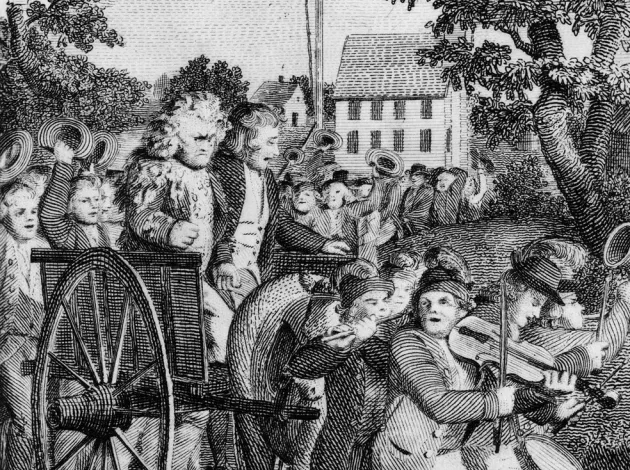
Many loyalists were captured by militia units, some imprisoned, others escaped and were banished to Canada, their families scattered, their property confiscated.
Their stories often remain untold, lost even in modern day reenactments where red-coated British regulars face off again blue and buckskin clothed rebels.
Isaac Mann was one of those loyalists you never heard of. Born in the city of New York into a merchant family in 1723, he became prosperous enough to purchase extensive property along the west side of the Hudson River midway between Waterford and the estate of Philip Schuyler on Fish Creek.
There he erected grist and sawmills, bringing in nearly 200 families who settled in the area of the present village of Stillwater, Saratoga County.
 Interestingly, in 1762 George Palmer arrived in the area as a member of the Congregational church of Caanan, Connecticut which elected to move their church en-mass to Stillwater.
This group of New Englanders formed the foundation story of Stillwater. Sylvester’s 1878 History of Saratoga County devotes pages to the arrival of the church and the history of the Palmer family.
Isaac Mann’s settlement, which was well established by 1762, is only mentioned in passing. Sylvester states “Isaac Mann, of whom the Palmer tract was bought, must have been a still earlier pioneer, but of him we have no account.”
In fact, before the Revolutionary War Isaac Mann was a prominent and well-known community leader, serving as a Justice in the Albany County court, and Colonel of the 2nd Regiment of the Albany County Milita during British rule.
The relationship between Palmer and Mann was established early on. In 1764 George Palmer purchased 200 acres from Isaac Mann, but there appeared to be some dispute over this transaction.
Palmer thought Mann’s mills were included, but apparently they were not and almost ten years later he purchased an additional 305 acres and access to the mills at a public sale. It seems on the eve of the Revolution Mann suffered some financial setbacks.
As conflict approached the two took opposite sides in the struggle. Palmer was an ardent patriot, serving on the Albany Committee of Correspondence and as an ensign in the New York 1st Regiment of the Continental Line, while Mann became a vociferous advocate of the King and continued British rule. Mann and his family would pay the price for their stance.
The Albany Committee of Correspondence was formed in January 1775, one of numerous local committees throughout the colonies whose purpose was to implement the Resolves of the First Continental Congress held in Philadelphia the previous September.
All residents were encouraged to sign an Association, pledging their loyalty to the Patriot cause. It became the litmus test for distinguishing friends from foes and was used to identify Loyalists throughout the Revolution.
Isaac Mann, loyal British subject, refused to sign as did his sons John, Thomas and Isaac, all young men in their 20s.
In a narrative written after the war, Isaac did not mince words about his opinion of those who opposed the King, saying they were “subverters of good government, consisting mostly of persons whose zeal was blind or fortunes desperate who insensibly lead [others} in open rebellion, under the preposterous pretense of relieving from tyranny and oppression the freest and happiest people existing… and becoming their own tyrants!”
The Albany Committee was not amused. Issac’s sons John and Thomas were committed to the Albany jail before being disarmed and released in February 1776.
Isaac himself was not afraid to follow through on his beliefs. He admitted to having “concealed and provisioned numbers of distressed Loyalists who fled to me for succor, several of which I found means to convey to [the city of] New York and some to Canada.”
For that he was arrested in March and held in the Albany jail, beginning a tortuous imprisonment. Taken first to Fishkill, he was marched along with 130 other loyalists to Exeter and then Amherst, New Hampshire, where he was held in close confinement from November 1776 until January 1778.
During his confinement, his sons joined the Loyalist regiment accompanying General John Burgoyne’s invasion force and Thomas was captured and taken to the Albany where he was exchanged two days before his trial for high treason.
As Burgoyne’s army approached, Isaac’s wife Ann and their 13-year-old son William were forced from their Stillwater home to relocate to Albany as refugees. They fled in an ox cart loaded with furniture which was plundered during the trip. Their home was stripped and their papers destroyed by militiamen.
His wife, however, was a resilient soul, pestering the Albany Committee to release her husband. In January 1778 they relented, and Issac was returned to Albany for trial.
After several months, Isaac and his family, having lost their land, house and property to confiscation, was allowed to “repair forthwith by flag [of truce] to Canada” where they arrived on September 1, 1778.
After the war Isaac submitted a claim for his wartime losses totaling £4,672 and was awarded £280 which he called a ‘trifling sum.”
In 1787 he received a grant of 2,000 acres at Cross Pointe on the north side of Restigouche River on the Gaspe Peninsula, along the south shore of the St. Lawrence River in Ontario.
Disputes over this land grant continued after Isaac’s death in 1803, but he and his sons became prominent members of their new community, even if forgotten by those in his former home.
Read more about the American Revolution in New York State here.
This essay is presented by the Saratoga County History Roundtable and the Saratoga County History Center. Follow them on Twitter and Facebook.
Illustrations, from above: Engraving showing Patriot treatment of Loyalists during the American Revolution (Library of Congress); and George Palmer Historic Marker in Stillwater.