 Oneida County, NY, was part of Marquis de Lafayette’s 1824-1825 visit to America. His interest in visiting the site of the Battle of Oriskany was partly responsible for bringing the aged general to the area.
Unlike George Washington’s comment about Oriskany – “In their hands rested the fate of a nation” – Lafayette’s sentiments are lost and can only be surmised from his well-known reverence for liberty.
Lafayette entered Oneida County from Syracuse via the Erie Canal on June 10, 1825 when he arrived in Rome, NY. Throngs of people – civilians, soldiers and veterans – were waiting to cheer him as the canal boat docked near the United States Arsenal on what is today West Dominick Street. (The old Erie Canal was rerouted leaving little evidence at this location.)
 After arriving he rested at the Mansion House a short distance away (113 East Whitesboro Street). A committee of prominent citizens led by Judge Nathan Williams were in Rome to escort Lafayette to Utica.
Following the rest period, he traveled by canal boat to Oriskany. He dined with Colonel Gerrit G. Lansing with whom he had served during the siege at Yorktown.
There is a history marker near the corner of Dexter Avenue and Utica Street (Oriskany), placed there by the Oriskany Chapter of the Daughters of the American Revolution (DAR).
Next was a visit to the home of the late Hugh White (at Whitesboro) to visit with White’s widow (a small monument now identifies the location east of the village green). Hundreds of people greeted his arrival. Lafayette had stayed with the White family when he helped negotiate the 1784 Treaty of Fort Stanwix with the Iroquois.
Following a visit with Mrs. White, he boarded a fancy barouche coach borrowed from Stephen Van Rensselaer III (1764–1839) and used for his journey to the Utica (then a town of 5,000).
The coach was driven by Theodore Faxton, known for being the best coach driver in the region. He no longer routinely drove for the stagecoach company as he had risen to the level of management. However, for special occasions, he would occupy “the box”.
It was hauled by six “matching grays” (horses) that were adorned in resplendent silver-plated harnesses. Everything had to be of high quality for the transport of the revered Lafayette.
The coach had an escort of cavalry commanded by General John J. Knox. The procession was completed by a rear squadron of cavalry headed by Lieutenant Cone. The entrance to Utica was lined on both sides by uniformed troops.
Utica was a town full of energy with its main street paved with cobblestones. It was a town where the bells of seven churches rang out each Sunday morning. The churches provided moral and cultural influences that were beginning to replace the crude way of life of a frontier community.
The nearly completed Erie Canal (the first section from Rome to Utica was completed in 1819, it was finished in 1825) provided a new era of transportation importance for Utica, the site of a big celebration in honor of Lafayette’s arrival in 1825.
Lafayette was surprised by the advancement of this community compared to the former wilderness outpost he remembered from his sojourn during the Revolutionary War.
The town was resplendent with flags and bunting from porches and fences. Flowers were strewn in the pathway of this most prestigious column of coaches, horses and many following on foot – creating a parade of some proportions. The route of the Lafayette procession was jammed with people giving the General a raucous reception.
In addition to the cheering spectators on both sides of the roadway, he arrived in Utica to a twenty-four-gun salute as the coach made its way to Shepard’s Hotel (Bagg’s Hotel leased by Shepard) on Main Street at Bagg Square.
The procession entered Utica on what was Rome Street, renamed Lafayette Street in his honor. It remains Lafayette Street to this day, although a portion is obliterated by the new Wynn Hospital now occupying its western portion.
A building was razed to make way for allowing six high-stepping horses to make a wide turn onto the newly renamed Lafayette Street – indicative of the importance of this fancy coach and its valued passenger.
 A large historical plaque was installed on the facade of a bank building near Rome (Lafayette) Street that reads:
“By this highway June the tenth 1825 General the Marquis de Lafayette entered the Village of Utica in commemoration of this visit and in grateful recognition of his unfaltering zeal in our war for independence this tablet is erected by The Oneida Chapter Daughters of The American Revolution AD 1897.”
It was moved to the south facade of Hotel Utica in 1914 (the northwest corner at Lafayette and Seneca Streets) when the bank was razed, where it’s still displayed.
As Lafayette’s carriage passed Genesee Street (the canal bridge), he could view an archway with a sign over the canal:
“Lafayette, Apostle of Liberty, We Hail Thee Welcome!”
He was greeted at the hotel by the village president William Clarke. Also, present was a large group of Revolutionary War veterans, some of whom he recognized. Revolutionary War veterans from all over the county, with whom Lafayette had served at Yorktown and elsewhere, gathered at Shepard’s Tavern (Bagg’s Hotel).
From the front of the Inn hung a painting by a local artist, Mr. Vanderlip, with words, “Welcome Lafayette.”
Americans in their Sunday best – gentlemen in top hats, ladies elegant in laces, silks, and feathered bonnets; with military men in their gold-braided uniforms contrasted with the clothing of the Native People present in their head dress and beaded costumes. All came to pay their respect to the much-admired Marquis de Lafayette.
It is known that public amusements were rare in those days, and that made Lafayette’s visit all the more exciting and memorable. This is not to diminish the high level of importance his visit achieved throughout the 24 states he visited. The crowd came from all over the countryside by foot, horseback, carts, and canal.
This visit by the renown Marquis de Lafayette created a “cause celeb” that was discussed, over many years, by those who were there; and by those who were told by their parents and grandparents about the illustrious affair.
It is written Lafayette “thought out loud” that there were not many Native People, from the ranks of his troops during the war, present in the crowd. This was confirmation of Lafayette’s concern for Indigenous People, as well as women, Black Americans and the voting rights of all citizens.
One might posit; it is indicative of the reason he is considered with such awe – thinking of the well-being of others without concern for the benefit that one might gain for oneself.
 Lafayette asked if someone would gather some of his Indigenous war comrades so he could have a few minutes conversing with these seemingly forgotten allies. He had met with his old comrade, the Seneca leader Red Jacket, while in Buffalo.
Three Oneida leaders: Taniatakaya, Sanyouxyonta and Doxtator, were invited to a personal meeting with Lafayette. Two of them had served with Lafayette. They were very old and Lafayette was surprised to find them still alive.
Amos Parker of Augusta (Oneida County) had the opportunity to visit with the General whose life he saved during the Revolutionary War. He shot and killed a sniper who had taken aim on an unsuspecting Lafayette. At the time, an order had been given by Lafayette not to fire until ordered to open fire.
Seeing the sniper take aim, Parker disobeyed the order. Parker was court-martialed for not following an official order. However, when the full reason for his action was made known the charges against him were dismissed.
Parker was said to be the tallest man in the colonial force at well over 6’ 10” (some say near 7’ tall). He entered the Marquis’ room at the Shepard’s Hotel and startled the resting Lafayette. Once he recognized Parker, it is recorded the meeting was the most heart-warming event of the many held at the hotel that day.
This is the second Oneida County man to have a hand in tending to the well-being of General Lafayette during the Revolution – the other was the previously mentioned Dr. John Cochran, who tended to the wounded Lafayette in battle on two occasions.
Lafayette then visited at the home of Arthur Breese — Oneida County Surrogate Judge (listed in the 1817 City Directory at Broad Street and John Street, East). Breese graduated from Princeton University, settled in Whitesboro in 1793 and moved to Utica in 1808.
Amid cheering crowds along the street, Lafayette then made his way to the home of village president William Clarke (listed in the 1828 City Directory at 53 Genesee Street).
One must recognize the magnanimous spirit in this French nobleman, as he made it his responsibility to visit the homes of local luminaries and not expecting them to come to his hotel.
Following all the festivities and reunions at the tavern, Lafayette boarded the barouche of Mrs. Henry Seymour and was driven to visit Abigail Adams Johnson at the Johnson mansion on Genesee Street (now the location of a gold domed bank). Lafayette had requested this drive so he could “visit the granddaughter of my friend, John Adams.”
After his visit with Mrs. Johnson, Lafayette returned to Bagg’s Hotel. Under another 24-gun salute, ending his Utica visit, he boarded a packet boat – the Governor Clinton, renamed the Lafayette – for the canal trip to Schenectady.
This essay was drawn from The Marquis de Lafayette by Joseph P. Boƫni (former Oneida County Historian, now retired) with Leslie Raney, DAR Oneida Chapter Regent and Chair of the Oneida-Herkimer County Committee for the Bicentennial of Lafayette’s Tour (American Friends of Lafayette). You can read the entire book here, which documents their efforts celebrating this Bicentennial of Lafayette’s Farewell Tour.
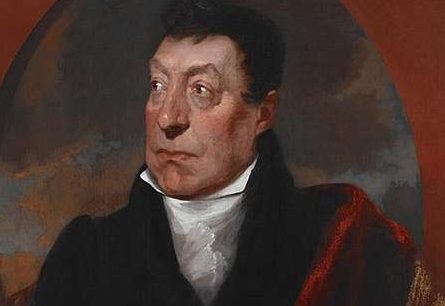
Illustrations, from above: Detail from a portrait of Marquis de Lafayette by Samuel Morse, 1825; The Mansion House in Rome, NY, in a painting by Donald Thayer, commissioned by the Destito family of Rome; historical plaque on the facade of a bank building in Utica marking Lafayette’s 1825 visit; and a detail of a print depicting George Washington and the Marquis de Lafayette on horseback, visiting soldiers at their winter encampment at Valley Forge (Library of Congress).
Source link