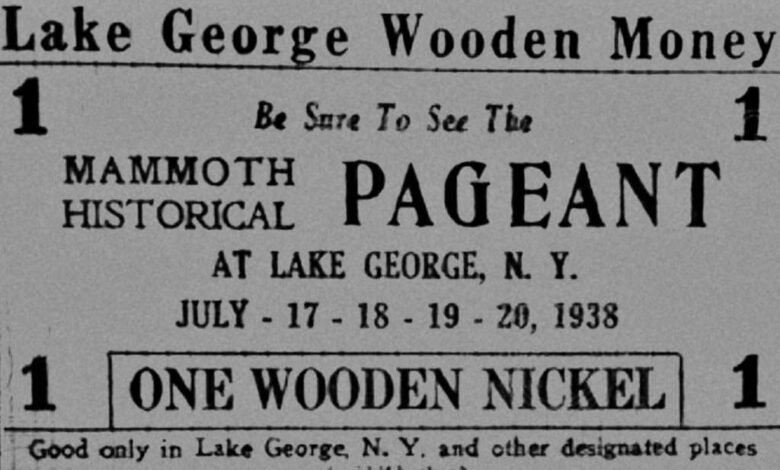
 It was 1938 and the United States was in the midst of the “depression within a depression” a particularly difficult time during the Great Depression. As with most American communities, money was tight at Lake George, NY.
Therefore, to fund a mammoth local history pageant, the event’s organizers came up with a novel idea. They printed wooden nickels called “Lake George Wooden Money” and the best thing about the fake coinage was that it worked.
The Lake George wooden nickels, shaped like currency and stamped onto thin sheets of plywood, sold for a dime. Local merchants accepted the “money” at its face value, a nickel. The other five cents went to support an historical celebration. Moreover, many people just kept the wooden nickles as souvenirs, a reminder of the historical extravaganza.
The heritage performance was called “The Romance of Lake George” and the play ran over four nights from July 17–20, 1938. The drama, which told the early history of the Lake George region, had a cast and chorus of over 500 people. A New York Times story explained that the performance was done in pantomime with a narrator reading the text to explain each scene.
The performers came from local towns and villages. High school student musicians from Lake George, Lake Luzerne, and Warrensburg performed the musical score. The pageant’s director was brought in from Ohio. The Sir William Johnson Bicentennial Committee, which was marking the anniversary of Sir William Johnson’s arrival in the Mohawk Valley in 1738, sponsored the cultural spectacular.
The performances drew many prominent citizens including the president of the now defunct New York State Historical Association, the Union College president, and the state Attorney General. According to the Albany Knickerbocker News, the pageant reportedly “exceeded expectations in splendor and magnitude.” It was reported that about 1,500 people attended each nightly presentation.
 Brooklyn-born comedic actor and Kattskill Bay (on Lake George) summer resident Edward Everett Horton (1886–1970) made the introductions for one of the four nightly programs. Horton was in over 120 Hollywood films during his career, and he reportedly was quite impressed by the 1938 event.
He commented on the colossal show by saying “It is an encouraging sign to see so many people willing to turn back the pages of history in order to put Lake George in the forefront of great vacationlands.”
A popular saying during the Great Depression was “don’t take any wooden nickels,” but in Lake George in 1938 many businesses were eager to accept them. By doing so they promoted Lake George history and fostered community spirit during a challenging time for most Americans.
Edward Everett Horton told a reporter that covered “The Romance of Lake George” pageant that when he returned to California after his vacation at Kattskill Bay, he would take back “a bunch of Lake George wooden nickels.” Horton intended to give the unusual “coinage” to his celebrity friends to help explain the remarkable Lake George history celebration of 1938.
A version of this article first appeared on the Lake George Mirror, America’s oldest resort paper, covering Lake George and its surrounding environs. You can subscribe to the Mirror HERE.
Illustrations, from above: “Lake George Wooden Money” and Edward Everett Horton.
Source link