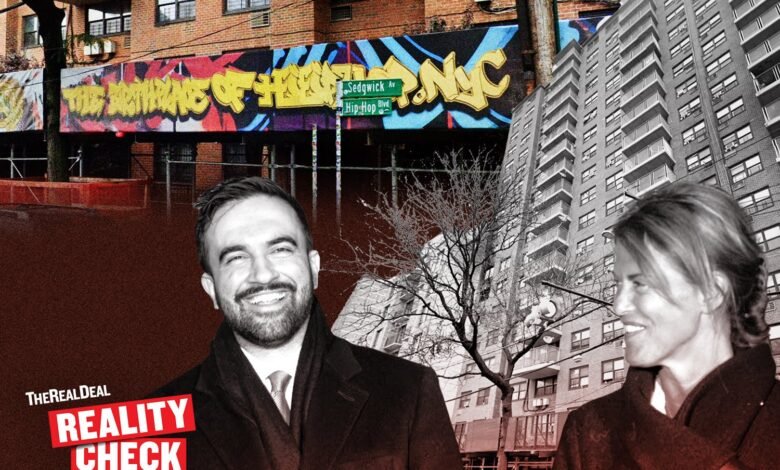
In Mayor Zohran Mamdani’s telling, the Bronx building where hip hop began is also the key to housing affordability.
But there’s more to the story. There always is.
First, the mayor’s version.
In his fourth day as mayor, to announce Dina Levy as his Department of Housing Preservation and Development commissioner, Mamdani chose that apartment building as his venue.
He held up the building, at 1520 Sedgwick Avenue, as a model for how the forces of good can fix dilapidated housing and keep it affordable by snatching it from the clutches of the rapacious real estate industry.
“When it exited Mitchell-Lama in the 2000s, its new landlord plunged it into decay and neglect, forcing immediate maintenance issues,” Mamdani said, referring to an affordable housing program with a 20-year subsidy.
“The situation was getting worse and likely would have entered a terminal spiral were it not for Dina. She organized the tenants, she advocated on their behalf and when they bought the mortgage with the help of a $5.6 million loan from HPD, they reclaimed control over their own homes and their own futures.”
That wasn’t quite true — tenants didn’t buy the mortgage, nor have they ever controlled the building. But Levy wasn’t going to correct her boss in public on her first day.
Instead, she said, “We were also engaged in an epic, years-long battle to stop a predatory landlord from acquiring and demolishing their homes.”
Also not quite true. She did not stop the landlord, Mark Karasick, founder of the Manhattan-based firm 601W Companies, which today has $7 billion in assets, from acquiring 1520 Sedgwick Avenue, a 102-unit building completed in 1969. And he never planned to demolish it.
The mayor’s press release said Levy “led a successful organizing campaign in 2010 to replace a predatory equity investor with a more responsible landlord.”
Predatory is a loaded term, and whether you want to portray 1520 Sedgwick as a triumph of affordability or an aging relic being propped up by taxpayers, it’s easy to take a set of facts and twist them into any shape you want.
Allow me to demonstrate:
Four days before Mamdani’s January 4 visit to 1520 Sedgwick, a city inspector reported that Unit 8F had an “infestation consisting of roaches in the entire apartment” and an “infestation consisting of mice in the entire apartment.” Another violation was issued for broken or defective plastered surfaces.
Two flights down in Unit 6B, the problem is not mice — it’s rats, violation records show.
A good propagandist might say the building is crumbling and overrun with vermin. But wait, there’s more.
The tenant in 9A complained about a lack of heat, which an HPD inspector confirmed on Dec. 13. Upon visiting the boiler room to identify the problem, the inspector found it locked — another violation.
Four days before that, three violations were issued for Unit 11E, including a broken self-closing door — the same problem that allowed a fire to race through a Bronx building in one of the deadliest fires in city history.
Other violations were issued to the building for mold, no hot water, broken window guards, a bad window and a defective door.
All of these problems were logged in December alone. Previous months show a similar pattern. On the day Mamdani visited, 1520 Sedgwick had 194 open violations.
If the mayor wanted to scapegoat the landlord, he could have called it a moldy, violation-ridden fire trap where rats, mice and roaches roam, the heat and hot water fail, children are at risk of falling from windows, plaster crumbles from the walls and the boiler room is locked to keep inspectors out.
Mamdani might have added that the tenants of 1520 Sedgwick suffered for four years with a sidewalk shed shadowing their building before anyone did a lick of work to repair the dangerous facade.
See how easy this is?
Then he could have spread that misleading message across social media with tweets and TikTok videos. It wouldn’t have been hard to get the media to parrot it.
But Mamdani wanted to portray 1520 Sedgwick as a paradigm of paradise that thousands of other distressed buildings could follow. So he flipped that storyline on its head.
Reality check: The building at 1520 Sedgwick is not the cesspool I described above. Nor is it a utopia rescued from evil capitalists. It is somewhere in between those extremes.
Its violation count of 1.9 per unit is high but not unusual for low-rent properties built in the 1960s.
Like any rental with dozens of tenants, it has a few — six, to be exact — who call 311 a lot and open their door for inspectors to write violations. But the tenants don’t always let inspectors back in to clear them. This can paint a picture of a property in disarray, bolstering any litigation they have brought against their landlord.
For these reasons, violation counts are an imperfect measure of a building’s health. But it’s clear that 1520 Sedgwick has its share of problems. Rats have been an issue since at least 2008. Building personnel have come to accept the rodents as inevitable because the property is at the bottom of a hill and next to the Harlem River.
Tumultuous history
As for the claim that 1520 Sedgwick was saved from demolition by a “predatory” investor when tenants bought the mortgage, here’s what really happened.
When its Mitchell-Lama subsidies expired in 2008, the building immediately became financially unsustainable. The rents were simply not enough to repair and maintain it. It needed either private investment or more government handouts. This is a common scenario with Mitchell-Lamas.
Housing costs money and private investment requires a return, so rent increases were indeed in the offing for 1520 Sedgwick. The mayor calls that predation. You could also call it math.
The other solution, requiring subsidies, was fought for by activists and politicians, notably Sen. Chuck Schumer and then-Rep. José Serrano. In early 2008 the Bloomberg administration blocked the building’s sale to investors led by Karasick, deeming $9 million too high a price for 1520 to remain a Mitchell-Lama. That bought more time for tenants who wanted to buy their massive brick building, but negotiations failed.
On Sept. 29, two weeks after Lehman Brothers collapsed, Karasick bought 1520 Sedgwick from investors led by Frank Phelan. (Their limited-profit housing company had owned the building since its construction.)
The deed says Karasick paid $7.1 million, a mere $70,300 per unit. Sovereign Bank provided a mortgage of $7.24 million, which suggests that Karasick might have kicked in cash that went unrecorded.
But even if Karasick had paid $9 million — just $89,100 per unit — he hardly needed free-spending gentrifiers to flock to the West Bronx to make the investment work. Unfortunately, the Great Financial Crisis savaged the economy and the middle-class renters Karasick expected never came. His mortgage was in trouble from the day he signed it, and he would default in 2010.
Karasick cashes in
Meanwhile, Levy, a relentless tenant organizer, had made the building a cause célèbre, drawing media attention and advocacy from the publicity-hungry Schumer. The senator became a thorn in the side of the owner. Tenants put HPD on speed dial and, without subsidies padding the building’s finances, violations piled up.
Then Karasick made a deal that would define 601W as a major real estate player. In August 2011 he and other investors sold the Starrett-Lehigh building at 601 West 26th Street in West Chelsea for $920 million, about six times what they paid Harry Helmsley’s estate for it in 1998.
“He didn’t care about 1520 Sedgwick at this point,” surmised one person close to the saga. With little or no equity in the Bronx building, his investment strategy dashed and politicians villainizing him, Karasick and co-owner Rachel Cohen Skydell (the wife of 601W’s Harry Skydell) were not desperate to keep it.
This gave Levy — the future HPD commissioner — and other activists a second chance to steer 1520 Sedgwick down their preferred path: subsidized affordability and removal from the tax rolls.
She hunted around for a buyer to go that route. Investors didn’t exactly line up for the opportunity. Levy wanted someone who would accept a minimal profit: She had previously criticized Joe Tahl of Tahl Propp Equities for telling state regulators he wasn’t satisfied with a 6 percent return on his buildings.
“Real estate is real estate is real estate, and all buildings should make huge profits. This is the exact definition of predatory equity,” she said in 2008 about 1520 Sedgwick’s owners. “Every piece of tangible evidence suggests that they’re not good guys and they don’t care about affordable housing.”
Eventually Levy persuaded for-profit affordable housing operator Workforce Housing Group to take the plunge. She knew WHG’s founder, John Crotty, from their days at City Hall. Crotty had been Mayor Michael Bloomberg’s director of city legislative affairs and a top executive at the Housing Development Corporation.
Crotty lined up a $5.6 million mortgage from his former city agency, bought the delinquent mortgage and foreclosed in September 2011 for $364,000. Crotty transferred 1520 Sedgwick to a nonprofit entity under Levy’s employer, Urban Homesteading Assistance Board, freeing it from property taxes and positioning it for low-interest mortgages.
Is this scalable?
In early 2012, the new owner increased its HDC loan to $6.2 million and signed a regulatory agreement to keep rents low. In July it borrowed another $15.7 million from the nonprofit Community Preservation Corporation.
By comparison, Karasick, whom critics had accused of overleveraging the building, had borrowed just $7.2 million.
Maintaining rents affordable to low-income tenants allowed WHG to unlock large loans from the city, but this came with tradeoffs. One is that 1520 Sedgwick has to wade through a thicket of bureaucracy to get anything done, such as the facade work so the sidewalk shed could finally come down.
Today, it’s undergoing another overhaul, funded by yet another city loan, this time for $9.8 million. The work will wrap up in a few months, some five years after the owner first requested approval for it. Fifteen months of the delay was waiting for then-Comptroller Brad Lander to sign off on the mortgage.
HPD says the project will cure the violations. (The six tenants on a first-name basis with the staff at 311’s call center might have something to say about that.)
In an interview with Kathryn Brenzel of TRD, Levy said, “It’s understandable that as things age, they need to be recapitalized, but that’s what a responsible landlord does, and that’s what’s happening at Sedgwick. It’s 100 percent the right model.”
But can the city replicate that model for all distressed rentals? Mamdani, who is trying to close a $5.4 billion budget gap, cannot forsake property taxes from thousands of buildings, nor conjure up tens of billions of dollars to give them sweetheart mortgages.
Most of the city’s aging multifamily housing stock is rent-stabilized. Its owners don’t have low-interest mortgages and zero property taxes like 1520 Sedgwick. They cannot dial up new financing as if they’re ordering pizza. Some owe more on their loans than their buildings are worth.
Lenders have fled from the asset class, and those that remain are exceedingly cautious. JPMorgan Chase is still lending on rent-stabilized, but only at 50 percent loan-to-value, one landlord told me.
The mayor can call 1520 Sedgwick a success, but he cannot call it scalable. For all the talk about how Karasick overpaid, public and mission-oriented nonprofits have sunk several times more money into the building than he did. There is no magic bullet.
Lining up government support and coping with the bureaucracy that comes with it is a hassle. But for affordable and rent-stabilized housing alike, what has really made operating these buildings a constant struggle is a litany of other problems: Tenants skipping rent, violations mounting, housing court taking forever and insurers jacking up rates.
For older properties with regulatory agreements that restrict rents, this is the usual state of affairs, as any of their operators will tell you.
“The distress in this sector is absolute,” said one. “Everyone’s getting killed.”
Read more

Julie Won’s AMI (absent-minded idea)

4 inconvenient facts about Mamdani’s model project

The Daily Dirt: The political theater of Mamdani’s bad-buildings list