 In the 1930s William Beebe (1877–1962), director of the Bermuda Oceanographic Institution sponsored by the New York Zoological Society (now the Wildlife Conservation Society), was described as “the most popular scientist in the world.”
Beebe began his career studying exotic birds, insects, and marine biology. The Brooklyn-born naturalist then gravitated to exploring the Atlantic Ocean’s abyss.
Moreover, the oceanographer co-invented the Bathysphere. The globe-shaped diving chamber had portholes and the unpowered steel craft was supported by cables from a surface vessel. Beginning in 1930, Beebe and his colleague Otis Barton employed their compact submersible making dives off Bermuda conducting undersea observations.
 William Beebe’s mother, Henrietta Marie Younglove, was a Glens Falls, NY, native who married Charles Beebe from Brooklyn. William Beebe’s parents are buried in the cemetery on Bay Street in Glens Falls, so it was not surprising that the renowned scientist accepted an invitation to lecture in the community in the foothills of the Adirondacks.
On February 6, 1933 Beebe, then living in New York City, presented a lecture on his exploits to 1,200 people at the Glens Falls Junior High School auditorium. The program detailed Beebe’s and Barton’s 1930 plunge in a five-foot-diameter Bathysphere to a depth of 1,426 feet.
Their subsurface foray created the same media frenzy as Charles Lindbergh’s 1927 trans-Atlantic flight. In 1934, Beebe and Barton would descend to 3,038 feet, then a world record.
Beebe was a zookeeper caring for the birds at the newly opened New York Zoological Park (now the Bronx Zoo) when a series of research expeditions around the world documenting the world’s pheasants, published as the four-volume A Monograph of the Pheasants from 1918 and 1922, made him one of the United States’ most popular naturalists.
For Beebe’s later aquatic studies, his writing numerous articles and books, and his promotion of ecology more generally, the scientist would receive two honorary doctorates. Beebe’s feats also inspired Richard Garrett, a Glens Falls High School student, to fashion a homemade helmet to dive into the waters of the 32-mile-long Lake George.
Beebe’s Lake George Inspiration
In 1932,  after Richard Garrett’s junior year in Glens Falls High School, the teenage inventor took a five-gallon oil can and removed its bottom. He then cut two holes that received glass plates to serve as viewing windows.
A bicycle tire pump operated by his father off a dock, provided air to the young explorer. He held weights in his hands to keep from being buoyant.
The reason for Garrett’s diving helmet was to locate an outboard motor lost in 20 feet of water in the lake. The teen adventurer did not find that particular boat motor, but Richard Garrett did recover another one lying on the lake bottom.
Garrett presented a talk about his 1932 dive into Lake George at a school assembly, held a few days before Beebe’s February 6, 1933 lecture in Glens Falls.
Not only did Richard Garrett present a talk on his underwater exploits at Lake George, but the youngster likewise met an idol, William Beebe, America’s first great scientific submariner.
Read more about diving in New York State.
A version of this article first appeared on the Lake George Mirror, America’s oldest resort paper, covering Lake George and its surrounding environs. You can subscribe to the Mirror HERE.
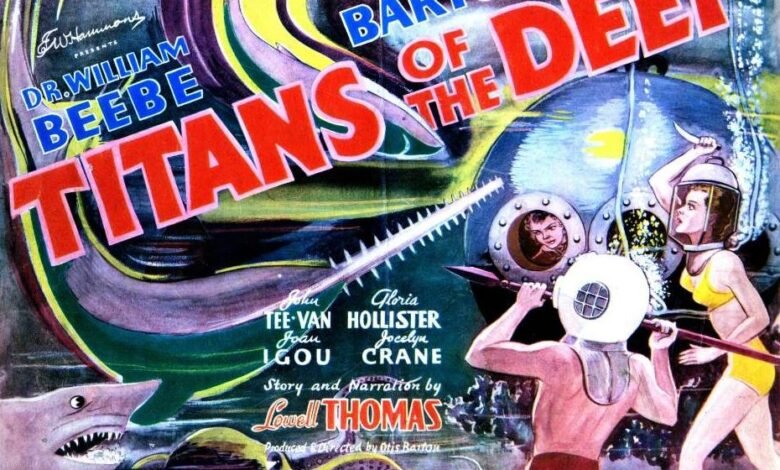
Illustrations, from above: William Beebe (left) and Otis Barton (right) pose next to their bathysphere in 1934 (photo courtesy NOAA); the Bathysphere on display at the National Geographic Museum of Exploration; and a film poster advertising the 1938 “semi-documentary” about the undersea exploits of William Beebe and Otis Barton (courtesy A Grand National Picture).
Source link