 In 1895, railroad travel through the Champlain Valley got a service upgrade. “Vestibule dining room cars will be run on three of the Delaware and Hudson trains beginning July 1,” The Morning Star of Glens Falls reported on June 29, 1895. “Train No. 102’s dining car will run from Plattsburg to Whitehall, No. 101 from Whitehall to Rouses Point, and Train No. 8 will serve supper from Rouses Point to Plattsburg.”
In other 19th century railroad news collected from Northern New York historic newspapers:
“There are 80,000 locomotives in the United States, and each contains 2,800 different pieces, requiring renewal every ten or twelve years. This conveys a necessity of the industries which the rail road fosters,” the Elizabethtown Post & Gazette reported on March 18, 1880.
“Railroad accidents have been of very common occurrence for the past few weeks. The question arises, should trains be run on a schedule time during the cold weather?” The Commercial Advertiser of Sandy Hill (now Hudson Falls, Washington County, NY) reported on Jan. 26, 1881.
“Trains of the Rensselaer & Saratoga Railroad frequently run on straight sections of track at the rate of a mile a minute,” The Glen’s Falls Republican reported on November 22, 1881.
“The Glens Falls passengers on the regular train from Lake George were carried through to Fort Edward. On arriving at the junction of the new state road with the old, the train stopped but did not back up to the depot,” The Glen’s Falls Messenger reported on June 2, 1882. “No announcement was made by the trainman, and so the passengers kept their seats, with the result stated above.”
“The travel over the N.Y. & C.R.R [New York & Canadian Railroad] has increased to such a extent that the extra freight trains that have heretofore been run are now regular freight trains Nos. 27 and 28, now run through from Troy to Plattsburgh and vice versa,” the Ticonderoga Sentinel reported on April 14, 1882.
“The Delaware and Hudson pay car made Glens Falls a visit yesterday and made railroad employees happy. The paymaster was accompanied by a tailor, who measured station agents, conductors and brakemen for new uniforms,” The Morning Star reported on October 18, 1887. New conductors’ uniforms would be double-breasted Prince Albert style coats with six large silver buttons and fancy embroidery.
“The order has been given that the coats must be kept buttoned, and as the conductors are to have no pockets in their coats, they are at a loss what they should do with their punch, change, etc.,” the paper reported.
“The first train in which cars were heated by steam on the Delaware and Hudson road passed northward through Fort Edward at seven o’clock Wednesday evening. The experiment is said to have been satisfactory,” The Morning Star reported on December 30, 1887.
“The two Whitehall trains in charge of conductor Callaghan of the Delaware and Hudson Company are fitted with the new system heating apparatus, and on Monday the fires in the stoves will be discontinued,” The Morning Star reported on December 31 1887.
“Granville and Middle Granville have furnished many excellent men for the rail road company. They are faithful and efficient and, beginning at the bottom of the ladder, they soon work themselves to the top,” The Granville Sentinel reported on September 11, 1891.
“Among the number is Frank J. Cavanaugh, who has been baggage master on the Schuylerville branch for several years. So faithfully has he discharged his duties the company has given him a better position. … Frank is a first-class gentleman, and the Sentinel is pleased to note his promotion.”
“The Long Lake Railroad Company was incorporated today to construct a steam railroad in the Adirondacks ten miles in length from Axton to Long Lake, connecting Axton with Raquette Lake, capital $100,000,” the equivalent of $3.74 million in 2024 dollars, The Morning Star reported on July 4, 1895.
Axton refers to Axton Landing, which was located on the Raquette River at the end of Corey’s Road. It was established by Cornell University to serve its forestry program.
“Electric headlights for locomotives have been successfully tried on a number of roads and have proved their usefulness in several ways,” The Granville Sentinel reported on July 5, 1895.
“The new electric railroad from Cohoes to Green Island and Troy will open for traffic tomorrow. William Fennigan, recently superintendent of the Glens Falls road, will occupy a similar position on the new road,” The Morning Star reported on July 12, 1895.
“The Fitchberg Railroad received at Mechanicville Thursday night from the Schenectady locomotive works the finest passenger locomotive ever seen in that vicinity. It is designed for hauling heavy fast passenger trains between Boston and Williamstown,” The Granville Sentinel reported on August 2, 1895.
“A feat in railroading was performed Saturday in this section on the New York Central, which, though not frequently paralleled on this most efficient and speedy of roads, is certainly calculated to make one wonder,” The Morning Star reported on August 16, 1895.
“The feat was nothing less than the accomplishment by the great Empire Express of a distance of 148 miles in 140 minutes, something impossible, with safety, to a less thoroughly governed and mechanically perfect road.”
“The Delaware and Hudson Railroad is having built three large locomotives. The drive wheels will be sixty-eight inches in diameter and the entire weight of the locomotives 120,000 pounds each,” The Granville Sentinel reported on September 20, 1895.
“Chauncey Depew is right to be pleased over the fact that the distance a crack French train travels in 16 miles at a cost to each passenger of $78 can be made in America in 10 hours at a cost of $25,” The Morning Star reported on October 3, 1895.
Read more about the history of railroads in New York State, or about New York’s transportation or engineering history.
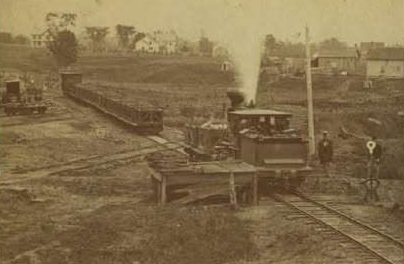
Illustrations: Detail of a Seneca Ray Stoddard stereograph of Crown Point Iron Company’s Railroad crossing the New York and Canadian Railroad line in Moriah, NY, ca 1900 (Adirondack Experience).

Source link