
 Oaths of office date back at least to the time of ancient Rome, and, since then oaths have become a staple of representative government. Oaths have been a requirement for public office from the nation’s inception.
“An Act to regulate the Time and Manner of administering certain Oaths” was the first law passed by the United States Congress after the ratification of the U.S. Constitution. It was signed by President George Washington on June 1, 1789, and parts of it remain in effect to this day.
While the Constitution does not mandate that anyone in particular should administer the presidential oath of office, it has been administered by the chief justice beginning with John Adams, except following the death of a sitting president.
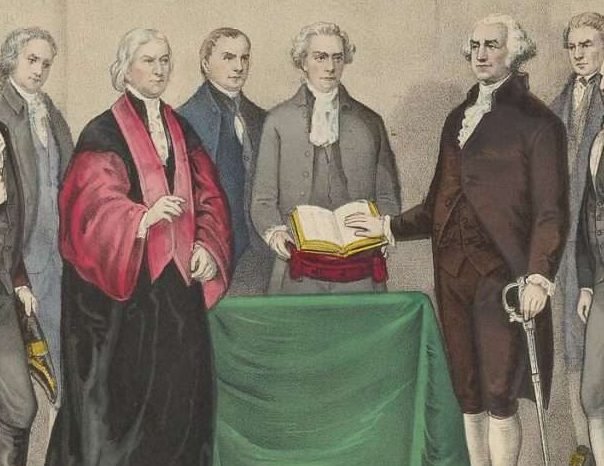
George Washington was sworn into office during his first inauguration, on April 30, 1789, by Chancellor of New York Robert Livingston. William Cranch, chief judge of the U.S. Circuit Court, administered the oath to New Yorker Millard Fillmore on July 10, 1850, when he became president after the death of Zachary Taylor.
Upon being informed of Warren Harding’s death, while visiting his family home in Plymouth Notch, Vermont, Calvin Coolidge was sworn in as president by his father, John Calvin Coolidge Sr., a notary public.
Federal Judge Sarah T. Hughes administered the oath of office to Lyndon B. Johnson aboard Air Force One after John F. Kennedy‘s assassination on November 22, 1963; the only time a woman has administered the oath of office.
Oaths in New York State
New York State’s Public Officers Law Section 10 and Town Law Section 25 require that every public officer “take and subscribe” an oath of office “before an officer authorized by law to administer oaths” and to file that oath of office before he or she performs any official duties.
The oath of office for an elective office must be taken and filed before duties are performed and within 30 days after the commencement of the term of office. The oath of office for an appointive office must be taken and filed within 30 days after notice of appointment or within 30 days after the commencement of the term of office.
All “town officers” are subject to this requirement – any position where the functions and duties directly affect the citizens of the town and involve the exercise of the powers of the town, would be considered a town officer (including deputies, planning and zoning board members, assessment review board members etc.).
The above cited section of the Public Officers Law also outlines who may administer an oath of office. These include notary publics, town councilmen or town justices in the town they serve, town supervisors or town clerks if they have taken their oath of office, justices of the State Supreme Court or Court of Appeals and several others (see Public Officers Law Section 10).
Once the oath has been completed, the oath of office needs to be filed with the town clerk’s office, and town justices and court clerks must additionally file an oath of office with the county clerk and the Office of Court Administration. The oath of office is good for the term of the office for which it is taken.
Taking and filing an oath of office is very important because if an individual refuses or fails to file in the time limit established by law, the office automatically becomes vacant
per Public Officers Law Section 30 (1)(h). Taking and filing the oath late does not cure the vacancy.
If the appointing body so desires it may fill the vacancy that occurs in this instance. The only exemption to this time frame deals with members of the Armed Forces who are absent from the county they reside in at the time of appointment and this case has its own time requirements.
The actions of officers who continue to serve in their positions after a failure to file their oath are still considered valid under Public Officers Law Section 15, but the officer can be notified of the vacancy by the town and then replaced at any time.
A version of this essay was first published in the New York State Tug Hill Commission‘s Tug Hill Times.
Illustration: Detail of “The Inauguration of Washington as First President of the United States, April 30th 1789 – At the Old City Hall, New York – The oath of office was administered by Chancellor Livingston of the States of New York” (Currier and Ives, 1876).

Source link