 A crucial strategic site for both the Patriots and the British, the city of New York played an instrumental role in the founding of the United States.
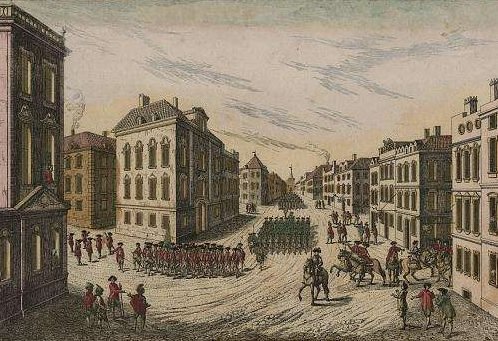
The city was arguably the most significant strategic hub of the American Revolutionary War, serving as the British base of operations for seven years of their occupation (1776–1783) and later becoming the first capital of the United States. Its deep-water harbor and central location between the northern and southern colonies made it a strategic key for both sides.
In celebration of the 250th anniversary of these events, the Museum of the City of New York (MCNY) and Gotham Center for New York City History will present “The Occupied City: New York and the American Revolution,” a new exhibition opening on May 1, 2026.
This 7,000-square-foot exhibition will take over MCNY’s entire third floor for a year, offering an immersive exploration of the city’s pivotal role during the Revolutionary War.
Visitors will encounter New York from the era of the Imperial Crisis in 1763 through its emergence as the nation’s first capital in 1790, experiencing the Revolution as it unfolded across a complex and divided city.
“The Occupied City” reveals how the city’s diverse population — from revolutionaries and loyalists to enslaved and free Black New Yorkers and Native peoples — shaped the events that gave rise to a new nation.
It highlights both the city’s strategic importance and the profound challenges faced by its residents during British occupation, as well as their resilience in the face of upheaval.
Exhibition Highlights
Through a dynamic mix of historical objects, interactive media, and immersive environments, the exhibition hopes to transport visitors into Revolutionary-era New York.
Across these environments, objects from MCNY’s collection play a central role, shaping both the visual experience and the exhibition’s historical interpretation.
In a recreated tavern, the Museum’s decorative arts holdings are integrated into the setting, with original seventeenth- and early eighteenth-century jugs, bottles, drinking vessels, and tableware — including a “flip” glass, flagons, plates, and canns (tankards) — arranged on open shelving as a cohesive ensemble.
Similarly, in a coffeehouse environment, objects from the Museum’s collection furnish and animate the space. A five-legged gaming table and period seating are paired with a silver coffee service — coffeepot, sugar dish, teaspoons, and porcelain cups and saucers — displayed as if in use.
These are complemented by a portrait of King George III and a loaned “No Stamp Act” teapot, situating the environment within the political tensions of the era and illustrating how spaces of sociability were also sites of debate and dissent.
A vignette devoted to Alexander Hamilton anchors the exhibition in the life of a key historical figure. Hamilton’s desk and armchair, drawn from MCNY’s collection, are presented alongside personal artifacts including a marble bust, a miniature portrait, and even a preserved section of a tree he planted, as well as a portrait of Elizabeth Schuyler Hamilton.
Additional highlights include a rarely seen volume of the “Inspection Roll of Negroes” (aka “Book of Negroes”) on loan from the National Archives — one of only two known copies — presented alongside an interactive kiosk that brings its recorded names to life.
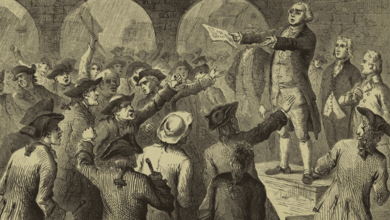
The exhibition also features immersive experiences such as “Canvas Town,” a refuge for displaced New Yorkers, and multimedia installations that dramatize key events including the Battle for New York and the toppling of the statue of King George III at Bowling Green.
The exhibition also builds on the Gotham Center’s Revolutionary NYC digital walking tour, now available as a mobile app, offering visitors additional context and opportunities to explore the city’s Revolutionary history beyond the gallery.
Programs
“Revolutionary New York: Then and Now,” a new six-part public program series connected with the new exhibit examines how the American Revolution continues to shape New York City and the nation today.
Moderated by journalist Antonia Hylton, the series brings together leading historians, public thinkers, and cultural leaders to explore the Revolution as both a historical event and an ongoing civic project—examining its impact on colonial-era New Yorkers, its role in shaping the city, and its continued relevance today.
Upcoming programs inspired by “The Occupied City” include:
Fashion of the Founding Fathers: George Washington
Thursday, May 7, 2026, 6:30 pm.
A Divided City: Revolutionary-Era New York and the Politics of Polarization
Friday, May 15, 2026, 6:30 pm.
Revolution Remembered, Stories Forgotten
Tuesday, June 23, 2026, 6:30 pm.
“The Occupied City: New York and the American Revolution” is made possible by an Anonymous Family Foundation, Carnegie Corporation of New York, and Kenneth C. Griffin and Griffin Catalyst.
Other benefactors include Elizabeth Belfer, The National Endowment for the Humanities (NEH), and The Robert David Lion Gardiner Foundation.
Additional support provided by advocates Chris Brown, Heather and William Vrattos, Matt and Marisa Brown, Stavros Niarchos Foundation (SNF), and The Achelis & Bodman Foundation. Other sponsors include Daryl B. Uber, and friends, The Blanche and Irving Laurie Foundation and Peck Stacpoole Foundation.
Curatorial and collections work on this exhibition is provided by the Laura and Ray Johnson Fund and Robert A. and Elizabeth R. Jeffe.
Learn more about the exhibit here.
Read more about the American Revolution in New York City.
Source link