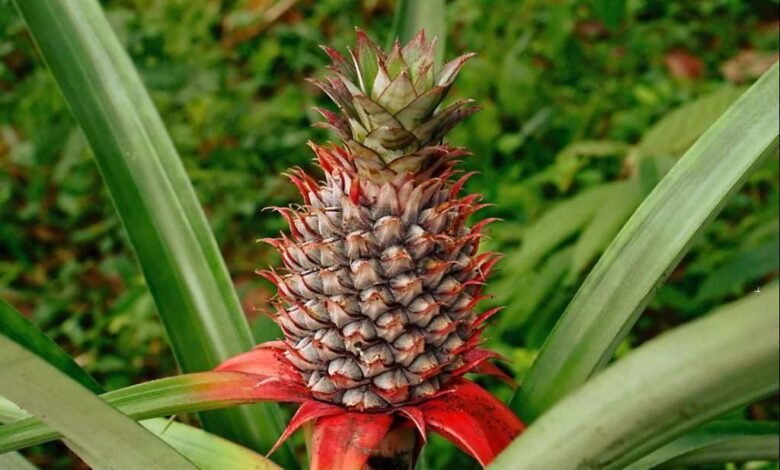
 Pineapples originate from the Orinoco River basin from where indigenous peoples spread specimens across parts of South America and towards the Caribbean and Bahamas. The early history of pineapple cultivation was a European, post-Columbus affair. The American passion for pineapple evolved from the eighteenth century when colonists began importing the fruit from the Caribbean.
Rare and restricted to the elite for some time, imports increased rapidly and the fruit became widely available. Such was its popularity that the pineapple became a feature of America’s cultural identity.
Flavor memories linger to this day (in craft beers for example), despite Donald Trump’s sworn deposition (October 2022) in which he labeled the fruit (as well as tomatoes and bananas) “dangerous stuff,” expressing anxiety that the pineapple had been weaponized by protesters.
Curious Import & Dutch Heat
Soldier and botanist Gonzalo Fernández de Oviedo y Valdés (1478-1557), commonly known as Oviedo, took part in the Spanish colonization of the West Indies, arriving shortly after Christopher Columbus had put the region on the map. His chronicles (1526 and 1535) are rare primary sources of events that were studied widely at the time.
Orviedo introduced Europeans to tobacco. He compared the fruit to a pinecone from which it derived its Spanish name. He included a woodcut to his description of the “piña” or pineapple.
 The fruit captured curiosity as early as 1493 when Christopher Columbus discovered it in Guadeloupe and brought a sample back to Spain.
Its appearance and fine taste as well as its assumed medicinal properties made gardeners keen to introduce the pineapple to European consumers, but long-distance transport presented a problem. Even when picked green, the fruit had rotted by the time it crossed the Atlantic.
Although tropical plants grew in southern Europe, they were impossible to cultivate in chilly northern parts. To create a suitable environment needed innovative technology. Pineapple cultivation was pioneered in the Low Countries.
The Dutch West India Company (WIC) held a trade monopoly in the Caribbean since 1621 and began importing the plant stock in the form of seeds and crowns. The quest was on to develop techniques to grow heat-loving plants in a damp and muddy environment.
In 1682, the first hothouse was designed at the “Hortus Medicus” in Amsterdam, using glass and peat heating. Three years later the “Hortus Botanicus” started its experiments in Leiden. Some wealthy individuals followed the trend at their estate gardens.
Widowed at the age of forty, art collector and amateur horticulturalist Agneta Block set up a garden on her “Vijverhof” estate at Loenen on the River Vecht in Gelderland. During the late 1680s, she made a scientific breakthrough in fruiting the first pineapple in Europe. She used cuttings from Leiden’s “Hortus” that originated from the Surinam colony.
Around the same time, cloth merchant and economist Pieter de la Court (the son of Flemish Protestant refugees) and his head gardener Willem de Vink were also experimenting with the fruit’s cultivation on his “Meerburg” estate near Leiden.
Continuing the work, his son Pieter de la Court van de Voort became famous for the research he did on his estate at nearby Voorschoten. His results were closely studied after he published an account of methods in 1737.
Caspar Fagel, former Grand Pensionary of Holland, was another enthusiastic horticulturalist. At his seat “De Leeuwenhorst” in Noordwijkerhout, near Leiden, he cultivated a range of exotic plants.
Having died in 1688, his stock of plants was acquired by Hans Willem Bentinck, adviser to Prince William of Orange, who shipped the entire delicate collection over to Hampton Court palace after William’s accession to the throne of England and Ireland in 1689.
Pineapples had been around in England for a while. The court of Charles II first served the fruit during a reception for the French ambassador in 1668. At the time, the pineapple was referred to as the “king pine,” reinforcing its Royal status, but efforts to grow the fruit at home started later.
King William III and Queen Mary made substantial renovations to the Royal gardens. They commissioned Hendrik Floris, a Dutch expert carpenter, to construct three glass cases to shelter exotic plants in the palace gardens which included guava, mango, banana, passionflower, tomato, and pineapple.
Pineapple Pits
Economist and merchant Matthew Decker was born Matthijs Decker in 1679 in Amsterdam into a family of Flemish refugees. His father was a prosperous linen bleacher in Bloemendael (near Haarlem).
Having received an education in commerce, he moved to London in 1702 and became a powerful advocate of free trade in the City. He was one of the leading backers of Robert Harley’s South Sea Company and served as Governor of the East India Company. He was made a baronet in 1716.
Away from business, his passion was his Pembroke Villa estate at Richmond. His Dutch gardener Henry Telende made a significant breakthrough around 1714 in their efforts to cultivate the pineapple.
 Relying on techniques introduced by Pieter de la Court, he developed “bark stoves” (also called “pineapple pits”), i.e. glass-walled frames with holes in the ground where pineapples were potted in mixed layers of horse manure and tanner’s bark, yielding a fermentation process that trapped heat around the plants.
Decker was the first person in Britain to grow pineapples at a commercial scale. In 1720, he commissioned Theodorus Netscher to produce a painting with an image of the fruit as the sole object of admiration.
Pineapple “mania” was to follow. Its cultivation in special hothouses became a costly pastime of horticultural enthusiasts among members of the gentry. The list of gentlemen engaged in this activity reads like a Who’s Who of Georgian society and includes the poets William Cowper and Alexander Pope, and the architect Lord Burlington.
By the end of the eighteenth-century improvements to hothouses meant they could use the heat of sunlight. It simplified the cultivation of tropical plants and boosted market gardening. By 1809 about 3,500 acres in Surrey were under active cultivation to supply fruits and vegetables to London.
Colonial Blessing
Considered one of the “blessings” of colonial rule, pineapple images were intertwined with those of enslaved people. They featured in paintings by Haarlem-born Frans Post, one of the first European painters to depict landscapes of the Americas having joined Johan Maurits van Nassau-Siegen’s expedition to Brazil on behalf of the WIC in 1637.
Nicknamed the “Canaletto of Brazil,” he produced dreamy scenes of local life, flora, and fauna. Staying for seven years in the colony, his depictions often feature pineapples.
 Commissioned by plantation owner Philip Gibbes and first minted in 1788, the “Barbados Pineapple Penny” was designed by the Royal Mint’s medallist John Milton. The coin shows an image of a crowned slave on one side with the caption “I serve” and, on the reverse side, a pineapple.
Over 5,000 pennies were issued that remained in circulation on the island and elsewhere in the Caribbean into the early twentieth century, although the British authorities never recognized them as an official currency.
Pineapples were a status symbol. During the eighteenth century and beyond they decorated secular and religious buildings, including the West towers of St Paul’s Cathedral and the tower of the Church of St John the Evangelist in Westminster, London.
 Built in 1761, the “Dunmore Pineapple” (located near Airth in Stirlingshire) is an imposing “folly” designed as a summerhouse on the estate of John Murray, 4th Earl of Dunmore. It shows a detailed stone top in the shape of a pineapple perched on a classical pavilion.
Pineapples appeared on metal railings, gateposts, garden urns, and internal decorations. Potter Josiah Wedgwood produced expensive yellow and green pineapple themed ceramics, ranging from sugar bowls to teapots.
Nurseryman Daniel Grimwood called his premises at Arlington Street, Piccadilly, “The Pineapple,” and used the image for his shop sign and business stationary. The fruit became a logo for confectioners.
Italian immigrant Domenico Negri was active in London in the second half of the eighteenth century, but nothing is known about his background. In 1757, he opened a pastry shop at Berkeley Square, Mayfair, under the sign of “Pot and Pine Apple.”
His business card (held at the British Museum) lists specialties such as “Naples and devils diavoloni, citron ices, all sort of ice, fruits and creams in the best Italian manner.”
The pineapple represented prosperity as well as hospitality. It was the latter aspect that would become a feature of the American love of pineapples.
American Hospitality
Apart from incidental reports of pineapples being grown in the 1760s and 1770s, North American cultivation of the fruit did not begin until the 1830s. It took another couple of decades before native gardening books would appear, but imported pineapples were sold widely.
William Cobbett mentioned buying them in 1820. Supplies increased as demand for fresh fruit rose. Charles Dickens, visiting the city of New York in the summer of 1842, described refreshing pineapples kept on blocks of ice whilst crossing Broadway.
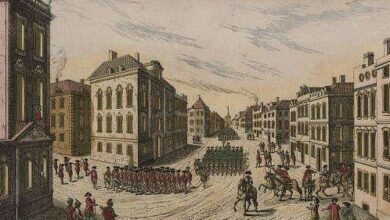
Colonists had begun importing pineapples from the Caribbean that brought forth a thriving trade that developed in the early 1700s. Serving pineapple at dinner was restricted to festive occasions and special guests. By the mid-eighteenth century, the popularity of decorative pineapple tableware had reached the colonies.
Just before the American Revolution, silver coffeepots and teapots displayed the British fashion for lids topped by pineapples. As the fruit symbolized kindness and friendship, the hospitality industry used the image in the decoration of bedposts, tablecloths, napkins, and other items to greet guests and visitors.
New England sailors, upon returning from arduous voyages in the Caribbean, would stake a pineapple on their fence post as a symbol of safe return. It was both a greeting and an invitation to visit.
 The welcoming sign struck a chord and spread throughout colonial America, including New York City. It became a prevalent motif in architecture, statuary, and interior decoration. Architectural pineapple motifs appeared as early as the 1730s but became even more popular with the rise of Colonial Revival building during the 1870s.
Many of Manhattan’s impressive stoops have wrought iron handrails, their tops crowned with an ornament. The pineapple carried on scrolls was one of the more desirable decorations. Townhouses in Greenwich Village feature many such iron railings and gates.
In older New York neighborhoods, pineapples may be found alongside other traditional motifs such as acorns (indicating strength) and pinecones (fertility and rebirth), examples of which survive at Central Park’s Bethesda Fountain (completed in 1873).
In Brooklyn’s historic “fruit streets” (Pineapple, Orange, and Cranberry) there are many examples where the pineapple theme is rooted in local history.
Withdrawal & Welcome
In the sixteenth and seventeenth centuries, the term “hothouse” meant any heated room, but often referred specifically to a bathhouse or brothel. During the eighteenth century, the meaning shifted to an artificially heated glass structure to cultivate tropical plants.
A surge in rare plant collecting led to widespread construction of greenhouses, orangeries, and pineapple pits in the nineteenth century. The hothouse was a symbol of nurtured and delicate plant life.
European writers and artists of the late nineteenth century used the hothouse metaphor for illustrating their vision of over-refined metropolitan life, perverse sexuality, and a morbid “underside” of consciousness.
The hothouse created an environment where things grow quickly, carrying connotations of artificiality and putrefaction. It was the central metaphor of the Decadent Movement, symbolizing an unnatural world that fostered an exotic but sickly beauty.
The “hothouse flower” embodied the paradox of splendor before decline. The metaphor reflected an “end of century” mood that seemed to suggest that European civilization had over-ripened and entered a state of graceful decay. The full scope of themes had been outlined in 1884 in A Rebours (Against Nature) by the French novelist Joris-Karl Huysmans. It became the bible of the movement.
American outward-looking culture did not suffer such morbid introspection. The pineapple was an import, not a hothouse product.
 It remained a popular symbol of cordiality, affability, and sociability well into the twentieth century, embellishing architectural features such as the 1990 “Pineapple Fountain” at Charleston’s Waterfront Park.
The Art Deco Chrysler Building was erected in 1930 in Manhattan. Its themed ornamentation distinguished the building from other skyscrapers of the period. The tower features at its 24th-floor corners nine-foot-high pineapple sculptures made of white brick and stainless steel.
Designed by Brooklyn-born William Van Alen, these decorative elements reflected the “hospitality” spirit of the era. The architect was a descendant of immigrants from the Low Countries who had settled in Kinderhook, New York, in either the seventeenth or eighteenth century.
In view of the pineapple’s early history, it seemed fitting that the Chrysler Building’s design reflects this Dutch involvement.
Read more about architecture in New York State.
Illustrations from above: An unripened pineapple on its parent plant; Jan Weenix’s “Agneta Block and her Family at Vijverhof,” showing pineapples at bottom left, 1693/4 (Amsterdam Museum); Theodorus Netscher’s “Pineapple grown in Sir Matthew Decker’s garden at Richmond, Surrey,” 1720 (Fitzwilliam Museum, Cambridge); Barbados Pineapple Penny, 1788 (National Museum of African American History & Culture, Washington DC); The “Dunmore Pineapple” (1761), Stirlingshire, Scotland; Pineapple ironwork handrailing at 127 West 11th Street, Manhattan; and the “Pineapple Fountain” at the Waterfront Park, Charleston.
Source link