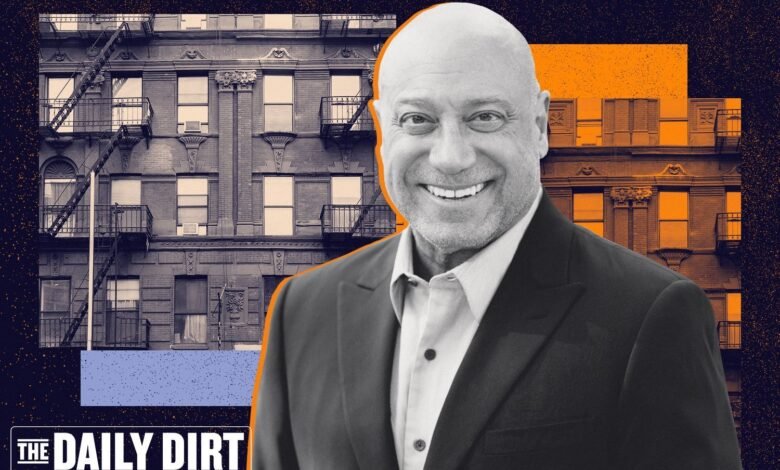

Joe Cafiero shared some interesting details about what it’s like to take over buildings whose owners have essentially walked away.
According to Cafiero, a receiver whom the public advocate erroneously included on the “worst landlords” list, one of the hardest tasks is collecting rent.
“In most cases, the rent collection rate is 40 percent or 50 percent,” he said in a phone interview. “The tenants are not paying.”
But he doesn’t blame them because of the condition of the buildings.
“They’re in disrepair. Open accessways, doors, roofs are open, boilers haven’t been serviced, sometimes there’s no heat, tons of water intrusion,” he said. “Everybody is angry [because of] the deferred maintenance. Now we’ve got to make friends with everybody.”
Making his job tougher, he’s not the first stranger to have come knocking on tenants’ doors.
“Some of these old landlords, they’ve sold their collection rights to somebody else,” Cafiero said. “So now you have three or four different guys coming in to collect rent saying they’re the new manager. They’re collecting cash. Now we come along and [the tenants] say, ‘Who are you?’”
It would help if he had a list of tenants’ names, but often the landlord doesn’t turn over those records. So Cafiero tries to tag along with an inspector from the Department of Housing Preservation and Development.
“If I introduce myself with HPD, I come in with credibility,” the receiver said.
But often, that’s not possible. So Cafiero and his staff also come with court orders, company ID tags and body cameras.
A lot of the buildings he services are in Williamsburg and Borough Park. “Probably 40 percent of my population is Spanish speaking,” said Cafiero, adding that the buildings also have many African tenants.
Communication with tenants can be challenging. “But when you show them a court order,” he said, “they see it’s an official document. You start to have a little more faith.”
What we’re thinking about: State Sen. Brian Kavanagh, who chairs the upper chamber’s housing committee, told Politico he doesn’t expect the legislature to change 485x this year to solve the 99-unit problem (which comes as no surprise to me). The senator denied that the wage floor and associated risk triggered by 485x projects of 100 or more units are the reason developers are building so few of them. Rather, he blamed high interest rates and the fact that developers are busy doing office-to-residential conversions and finishing 421a projects. Does that ring true? Send your thoughts to eengquist@therealdeal.com.
A thing we’ve learned: Cynthia Allison Malkin, the sister of Empire State Realty Trust CEO Tony Malkin, is married to U.S. Sen. Richard Blumenthal, D-Connecticut. Their engagement, when the bride-to-be was a senior at Harvard University and Blumenthal was 35, was covered by the New York Times in 1981. “Miss Malkin Plans Bridal” was the headline.
Elsewhere…
In the arcane world of New York rent regulation, three-bedroom apartments have lower rents, on average, than one-bedroom apartments, according to the New York Apartment Association.
From a housing policy or economics perspective, that makes no sense whatsoever. But if you know the history of rent stabilization in New York, it makes perfect sense.
Large, low-rent units are incredibly valuable to tenants, so people keep them in the family for decades. Under the previous rent regulation regime, low turnover for a given apartment meant its rent grew exceptionally slowly.
High turnover did the opposite: Vacancy allowed for a 20 percent rent hike plus the opportunity to make improvements and raise the rent commensurately.
All that changed with the new rent law of 2019, but the inversely proportional rent discrepancy between large and small apartments remains to this day. In fact, it’s locked in.
On social media, the NYAA’s Kenny Burgos highlighted a unit vacant since 2022 that needs more than $200,000 in renovations but has a legal rent of $815.
Closing time
Residential: The top residential deal recorded Tuesday was $11.8 million for a 3,008-square-foot resale condominium at 212 Fifth Avenue in Flatiron. J. Chris Sousa with Sousa Real Estate had the listing.
Commercial: The top commercial deal recorded was $22.25 million for 242 Elizabeth Street and 236 Elizabeth Street for a combined 12 units and 14,450 square feet.
New to the Market: The highest price for a residential property hitting the market was $23 million for a 3,547-square-foot condominium at 50 West 66th Street on the Upper West Side. Janice Chang with Douglas Elliman has the listing.
Breaking Ground: The largest new building permit filed was for a proposed 43,937-square-foot, 10-story, 89-unit mixed-use project at 311 East 148th Street in Mott Haven. Nikolai Katz filed the permit on behalf of developer Joel Guttman.
— Matthew Elo