 Following his death Sunday, the legacy of the United States’ longest-lived president, Jimmy Carter, will be the topic of much discussion.
For historians and journalists, there are plenty of records available.
The Presidential Library system formally began in 1939, when President Franklin D. Roosevelt donated his personal and Presidential papers to the Federal Government.
At the same time, Roosevelt pledged part of his estate at Hyde Park to the United States, and friends of the President formed a non-profit corporation to raise funds for the construction of the library and museum building.
In 1955, Congress passed the Presidential Libraries Act, establishing a system of privately erected and federally maintained libraries.
The Act encouraged other Presidents to donate their historical materials to the government and ensured the preservation of Presidential papers and their availability to the American people.
Under the Presidential Libraries Act and subsequent acts, more libraries have been established. You can read more about the Presidential Libraries here.
Opened on October 1, 1986, the Jimmy Carter Presidential Library in Atlanta holds 27 million pages of records, half a million photographs, and hundreds of hours of film, audio, and video from the Carter administration.
Records cover the wide-ranging topics of the administration including the energy crisis, SALT II, Panama Canal Treaty, Camp David Summit and the Camp David Accords, Deng Xiaoping’s visit to Washington, establishment of the Department of Education and the Department of Energy, Iran Hostage Crisis, and more.
 Jimmy Carter also holds several interesting U.S. and world records as president. In addition to our longest-lived president, he was the third oldest world leader.
In 2012, he surpassed Herbert Hoover’s record for longest-retired president. He and his wife Rosalynn had the longest presidential marriage at over 77 years.
Additionally, Carter holds many presidential firsts, including being the first president born in a hospital. On October 1, 1924, he was born at the Wise Sanitarium, the hospital where his mother worked as a nurse. He’s also the only president to graduate from the U.S. Naval Academy in Annapolis.
The Carters in Schenectady
In 1952, Jimmy Carter began an association with the Navy‘s fledgling nuclear Submarine Service, led then by captain Hyman G. Rickover. Carter later said that, next to his parents, Rickover had the greatest influence on his life.
He was sent to the Naval Reactors Branch of the Atomic Energy Commission in Washington, D.C. for three-month temporary duty, while Rosalynn moved with their children to Schenectady, New York.
In March 1953, Carter began a six-month course in nuclear power plant operation at Union College in Schenectady. His intent was to eventually work aboard USS Seawolf, which was intended to be the second U.S. nuclear submarine.
His plans changed when his father died of pancreatic cancer in July, two months before construction of Seawolf began, and Carter obtained a release from active duty so he could take over the family peanut business.
Deciding to leave Schenectady proved difficult, as Rosalynn had reportedly grown comfortable with their life in Schenectady and was reluctant to leave. She said later that returning to small-town life in Plains, Georgia seemed “a monumental step backward.”
Jimmy Carter left active duty on October 9, 1953, although served in the Navy Reserve until 1961.
Run For The Presidency
Despite being governor of Georgia, Jimmy Carter had low name recognition in a crowded primary field for the 1976 presidential race. He began using the line “I’m Jimmy Carter, and I’m running for president,” and he’s the only president to use his nickname officially on all presidential records.
During the election, he debated President Gerald Ford in three televised debates, the first since the famous 1960 Kennedy-Nixon debates. In the months leading up to the election, Carter allocated funds to the presidential transition.
He was the first president-elect to formalize that process, which was standard practice until the defeat of Donald Trump in the 2020 Election when Trump refused to concede the election.
Love Canal
In 1978, Carter declared a federal emergency in the neighborhood of Love Canal in Niagara Falls. More than 800 families were evacuated from the neighborhood, which had been built on top of a toxic waste landfill. The Superfund law was created in response to the situation.
Federal disaster money was appropriated to demolish the approximately 500 houses, the 99th Street School, and the 93rd Street School, which had been built on top of the dump; and to remediate the dump and construct a containment area for the hazardous wastes.
This was the first time that such a process had been undertaken. Carter acknowledged that several more “Love Canals” existed across the country, and that discovering such hazardous dumpsites was “one of the grimmest discoveries of our modern era.”
International Legacy
During his term, Jimmy Carter took 12 international trips and visited 25 different countries. He was the first president to visit Nigeria (and sub-Saharan Africa) and Guadeloupe.
After leaving the presidency, Carter championed humanitarian causes and engaged in conflict mediation through the non-partisan and non-profit Carter Center.
In 2002, his efforts were recognized with the Nobel Peace Prize, at the time he was only the third U.S. President to be awarded this prize.
You can also find records of the Carter Administration in the National Archives Catalog.
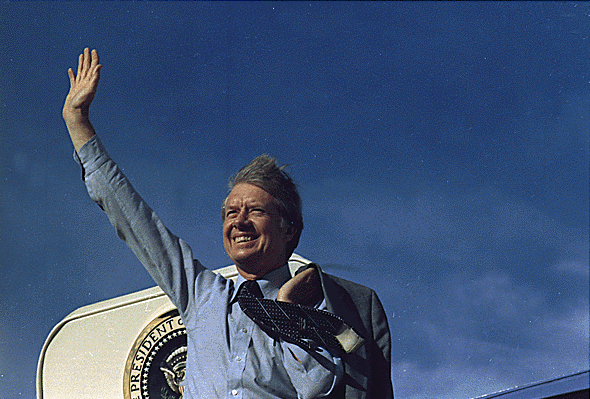
Photos, from above: Jimmy Carter waving from Air Force One in 1977; and Jimmy Carter and Rosalynn Carter in 1978 (National Archives).

Source link