
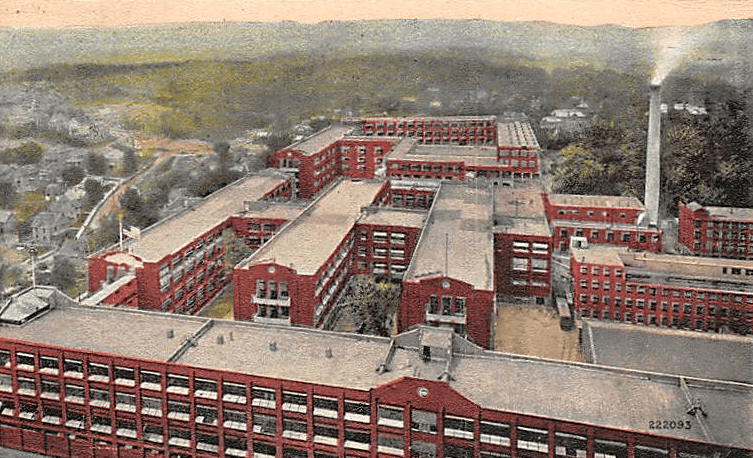
 The former historic Remington Arms factory in Ilion, Herkimer County, NY, closed in March 2024, ending over 200 years of operation and laying off 270 workers. In the 1990s the company had employed about 1,100 people.
Many Republicans, including US Representative Elise Stefanik and state Senator Mark Walczyk, who both represented Ilion, blamed New York’s “unconstitutional gun-grab policies,” as Stefanik said, for the closure, according to a report in the Albany Times Union.
“RemArms is excited to expand our facilities in Georgia, a state that not only welcomes business but enthusiastically supports and welcomes companies in the firearms industry,” the company said in a statement emailed to the Times Union at the time, though a new environmental assessment says the parent company “cited high maintenance costs for the aging, inefficient multi-story facility.”
Walczyk said that the state’s 2021 Gun Industry Liability Law, which allows civil lawsuits against firearm manufacturers and dealers who endanger public safety through illegal or irresponsible marketing, manufacturing, and sales, pushed Remington out of New York. The law was upheld as constitutional by a U.S. District Court.
The United Mine Workers of America, who represented the facility’s workers, said the closure of the plant had nothing to do with the with the state’s gun laws.
“It is not our understanding or our belief whatsoever that this has anything to do with the laws,” union’s spokesperson Erin Bates told the press. “They’re obviously moving to a very non-union state.” For more than two years after the RemArms purchase workers had tried to negotiate a labor contract.
 Remington Arms, said to be “America’s oldest gunmaker,” began making firearms in Ilion in 1816, as E. Remington & Sons and located on the Erie Canal until it was rerouted and filled between 1912-1925.
The company was a significant supplier of weapons to the United States Army during the Civil War, producing over 150,000 revolvers, thousands of Model 1863 “Zouave” rifles, and various carbines. It produced weapons for both World War I and World War II.
The company had made major contributions to Stefanik and Donald Trump. Opponents of the company’s moves told the Times Union that Stefanik “shielded them from criticism and responsibility” for impoverishing the company to line their own pockets.
In 2007, private equity firm Cerberus Capital Management (named after the three-headed dog that guards the gates of the Underworld in Greek mythology) purchased Remington Arms pulling “hundreds of millions of dollars” out of the company creating massive debt by 2012.
A lawsuit was filed against the company by the families of nine victims after a Remington rifle was used in the mass shooting at Sandy Hook Elementary School in 2012, killing 26 students and teachers. The company settled for $73 million in 2022.
In 2014, the company moved some operations to Huntsville, Alabama and promised about 1,800 non-union jobs. It filed for bankruptcy in 2018 and again in 2020.
The site in Ilion is currently under redevelopment being managed by Herkimer County Industrial Development Agency, with Turin Management LLC under contract to purchase the property for $10 million.
 New Environmental Assessment
A report has been released presenting the results of the Phase II Environmental Site Assessment at the site on multiple parcels along Hoefler Avenue, East Main Street, Commerce Street, and Highland Avenue in Ilion.
It was completed by HRP Associates from August through October of 2024.
The investigation assessed potential environmental impacts associated with the current and historic use of the sites as an industrial facility which manufactured not only firearms and ammunition, but also agricultural equipment, bicycles, steam cars, typewriters, sewing machines, and cash registers.
The 38-acre Site is occupied by 45 industrial buildings totaling about a million square feet.
The various contaminates are likely from the site’s former use as a foundry by Remington Arms from at least 1884 to approximately 1959, and from coal and petroleum storage on the site, an oil-filled transformer house, gasoline fueling stations, and other industrial processes.
No PCBs were detected, but petroleum related Semi Volatile Organic Compounds (SVOCs) were detected at concentrations “exceeding applicable regulatory criteria” in three of the samples collected. Benzo(a)pyrene was detected at concentrations exceeding Commercial Use and several other SVOCs were also detected.
 Petroleum VOCs were detected at concentrations exceeding applicable regulatory criteria in two of the samples collected, including petroleum related BTEX (Benzene, Toluene, Ethylbenzene, and Xylene) compounds.
Methylene chloride, a common laboratory contaminant, was detected but did not exceed applicable regulatory standards for commercial use according to the report.
Metals, including arsenic, copper, lead, and nickel were detected at elevated concentrations, some higher than typical background levels – including arsenic, copper, lead, and nickel.
A soil sample collected in the shooting range floor of Building 52 showed substantially elevated lead concentrations, attributable to years of shooting in the building’s basement.
The Phase II ESA (available here) was completed for the Herkimer County Industrial Development Agency under a United States Environmental Protection Agency (EPA) Brownfields Assessment Grant (BF 96240822), in accordance with the Site-Specific Quality Assurance Project Plan (QAPP) dated June 10, 2024, and approved by the EPA on July 24, 2024.
The Remington Arms Museum, which was located on the site, closed in about 2000.
Illustrations, from above: Postcard of Remington Arms plant at Ilion, ca. 1900; early postcard of the plant, then located on the Erie Canal; Remington Arms’ site map from the Phase II Environmental Site Assessment (2026); and a gunsmith assembling a World War One weapon at Remington Arms, 1917.
Source link