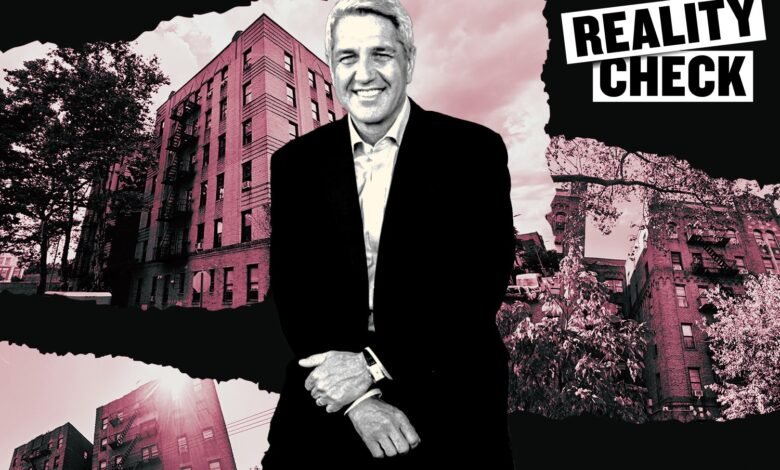
When you think of rent-stabilized bankruptcies, you probably think of overleveraged buildings in Upper Manhattan and the South Bronx — not conservatively financed ones in white-ethnic Brooklyn neighborhoods.
Think again.
Consider the bankruptcy that Samuel Hertz filed in late January for 420 Avenue F and 320 Ocean Parkway in Kensington and 2302 85th Street in Bensonhurst, which have 145 apartments in all. Their tenants have names like Melnikova, Akramov, Durglishvili and Ananin.
Hertz bought the three buildings in January 2018 for $46 million with a $25 million loan from ConnectOne Bank. That’s a loan-to-value ratio of only 54 percent. It must have seemed like a safe bet at the time and was also a 1031 exchange, allowing Hertz to defer capital gains on a very profitable 2017 sale.
But 2018 was a terrible, awful, no-good year to buy a rent-stabilized building. It’s hard to imagine that any deals that year didn’t end up in some kind of trouble. And $317,000 per unit was a lot for Hertz to pay.
The big blow was the rent-strangling Housing Stability and Tenant Protection Act of 2019, followed by the pandemic, “cancel rent” movement, eviction moratoriums and housing court dysfunction. Then operating expenses surged but the Rent Guidelines Board remained stingy with rent increases.
The 2019 law and pandemic fallout “have dramatically eroded the value of the properties and hindered rent collections,” Hertz wrote in his court filing.
Hertz, based at 1080 Ocean Avenue, seems to have tried to do the right thing. The investor actually paid down his mortgages by $1.83 million and sunk in another $1.95 million to subsidize operations, in part by taking out more loans.
But in retrospect, it looks like he threw good money after bad. Every month, all three buildings lose money.
Take 420 Avenue F. The monthly rent collection is $96,000, or about $1,900 per unit (three units are not producing rent).
Monthly costs include $49,000 for mortgage interest, $20,000 for property taxes, $7,000 for management fees, $6,000 for insurance and $6,000 for water and sewer.
Add in other expenses and the total comes to $106,000, which means the building loses $10,000 every month.
But it’s probably worse, because Hertz’s filing says repairs and maintenance cost just $32 per unit. A realistic number is several times that amount. Also, his actual rent collection is probably lower than the 96 percent shown in his filing.
The mortgage calls for him to pay down nearly $13,000 in principal each month. That brings the monthly loss to more than $22,000.
The 85th Street building loses $18,000 a month, and 320 Ocean Parkway, the most valuable in the portfolio, loses $22,000. Half of those losses are going to pay mortgage principal, as lenders now commonly require for rent-stabilized buildings.
But even if the loans were interest-only, Hertz would be swimming in red ink.
Paying mortgage principal is fine when your property value is going up, but not when it’s going down. It’s kind of like making car loan payments when you owe more than the vehicle is worth.
Hertz sought bankruptcy protection after ConnectOne Bank filed a foreclosure action in November.
He said in the filing that he is “continuing to struggle with rent collections, evictions, and the increased cost of maintenance and operations.” But he noted the buildings would be financially viable if the mortgage debt were reduced.
That’s one option for ConnectOne Bank. Another would be to sell the loans for dimes on the dollar. A third would be to foreclose and sell the properties at auction.
As the saying goes, pick your poison.
Read more

Harry Jeremias sells three-building BK portfolio for $46M

The Daily Dirt: The problem with judges

Educating Zohran: What nonprofit housing actually costs