 We recently passed the 50th anniversary of the release of Robert Caro’s Pulitzer-prize-winning book about Robert Moses: The Power Broker. Exhaustively comprehensive, Caro’s monumental tome nonetheless virtually ignores one of the most fascinating chapters of Moses’s career: his time as Chairman of the Power Authority of the State of New York (PASNY) from 1954 to 1962.
While heading PASNY, known today as the New York Power Authority, the legendary New York City builder oversaw the remaking of Niagara Falls and the St. Lawrence River for hydropower.
Both the Niagara and St. Lawrence projects, built in tandem with Canada, had enormous ecological consequences, as some of the largest rivers on the continent were transformed, and involved Moses’s rough treatment of people in the way – particularly indigenous people.
Arguably, these two megaprojects changed landscapes on a larger spatial scale than Moses’s many New York City undertakings. Moses was headhunted for the PASNY position chiefly to see through these two transborder hydropower projects.
 On both of these rivers, in the late 1950s and early 1960s New York State built major powerhouses that bore Robert Moses’s name. Moses had relatively little interest or background in hydropower — but he had extensive experience and interest in planning the linked parkland and parkways.
And, of course, Moses already had extensive experience when it came to moving people for large infrastructure projects.
St. Lawrence
For the St. Lawrence Seaway and Power Project, PASNY was responsible for building the U.S. share of the major power dam and acquiring New York property affected by the reservoir flooding. Initially called the Moses-Saunders generating station, it would have a capacity of 1,880,000 kilowatts.
It was built by both PASNY and Ontario Hydro, with the two halves meeting in the middle where they were bisected by the international border; for several decades it was the world’s largest transborder dam.
 But the aspect of the St. Lawrence power project that would prove more politically challenging was all the “rehabilitation” involving the 40,000 acres that would be flooded out by the new reservoir, with about 18,000 of that in American territory.
In a publication intended for public consumption, Moses outlined the land acquisition process in New York. He stated that a “sacrifice” had to be made “for the common good,” while warning that PASNY would not “be cajoled, threatened, intimidated or pressured into modifying sound engineering plans to suit selfish private interests.”
In Moses’s mind, anyone who did not willingly give over their land was a speculator, and those who did not agree with all aspects of his plans were part of the selfish private interests.
PASNY adopted a blanket expropriation plan, but without a bonus for inconvenience. Homeowners were usually offered a market value price with little room for negotiations, though many did not know what constituted a fair market value anyway.
Residents were made to feel that the first offer was the best they could expect. If they refused, property owners were forced off their land and told that they could argue about compensation afterward.
The complaints about land acquisition offers and techniques were noticeable enough that New York Governor W. Averell Harriman brought them up with Moses, and President Dwight Eisenhower inquired into the matter.
Moses responded by stressing the urgency of the acquisitions and argued that “quite a few complaints which have emanated from the St. Lawrence area have been motivated by the most dubious political and personal considerations by owners and their representatives who are primarily interested in speculative increases in value.”
New York State Senator Robert C. McEwan protested the need to take all riverside land, and criticized the acquisition agents’ approach. Moses retorted in characteristic fashion with a nasty letter, stating that McEwan’s correspondence “consists almost entirely of garbled, rambling assertions unsupported by evidence.”
The St. Lawrence project had especially significant repercussions for the transborder Akwesasne (St. Regis) Mohawk community. In 1956, the Mohawks filed a $33.8 million suit against New York State for compensation. The case rose to the state’s highest court of appeals, but failed to halt the project.
Furthermore, the industrial companies established upstream because of the availability of cheap hydropower then plagued this Mohawk community with toxic pollution.
Niagara
In 1950 the United States and Canada agreed to the Niagara River Diversion Treaty. This accord set up a water diversion regime so that New York State and Ontario could produce more hydropower, and also called for remedial works to hide the visual impact of diverting the majority of the Niagara River’s water before it went over the falls.
 Among other modifications, these works would involve reshaping the lip of the Horseshoe Falls and shrinking it by 355 feet; excavation took place along the flanks of the Horseshoe Falls (64,000 cubic yards of rock on the Canadian flank; 24,000 cubic yards on the American flank) in order to create a better distribution of flow and an unbroken crest line at all times. A control dam with gates was installed above the falls.
The 1950 treaty restricted the flow of water over Niagara Falls to no less than 100,000 cubic feet per second (cfs) during daylight hours of the tourist season and no less than 50,000 cfs during the remainder of the year. This meant that the two nations together take about half of the total flow over the falls during tourist hours, and three-quarters the majority of the year.
As has been detailed in my book Fixing Niagara Falls, this transformed the waterfall into a hybrid infrastructure blending the artificial and the natural.
Eventually, after the Schoellkopf generating station collapsed, PASNY was given the right to develop Niagara power. PASNY would build a huge hydropower station just south of the Niagara Escarpment, directly across from Ontario’s new Beck generating station.
Initially called the Tuscarora power plant, it was the largest hydro power station in the western hemisphere. All the related infrastructure and changes — water conduits, roadways, parks, etc. — had an enormous footprint requiring far-reaching land acquisition.
PASNY largely continued the same land acquisition practices it had employed along the St. Lawrence, but sought to make it even easier to take property. PASNY had the NYS Legislature pass a bill giving it the right to appropriate, without first condemning, lands needed for the project.
Many people felt pressured or bullied into giving up their property quickly. For Moses, the ends justified the means.
Initially, PASNY had planned to take 1,684 acres from the Tuscarora Reservation. The Tuscarora, part of the Haudenosaunee Confederacy, formally objected, arguing that it was feasible to redesign the reservoir so that it did not impinge on their land. Moses quickly became impatient and combative.
In the long run, PASNY would end up spending so much on legal fees, delays, and other costs that it probably would have been cheaper just to acquire nonreservation
land.
 For Moses, however, quashing opposition at any cost seemingly trumped other practical considerations. No one, particularly not seven hundred Tuscarora occupying what Moses deemed worthless land for nonproductive purposes, could be allowed to stand in the way.
Both sides appealed to the media. Moses tried to turn the surrounding communities against the Tuscarora. Occasionally, he tried to balance his many sticks with a few carrots.
The Tuscarora took legal action, contending that PASNY could not take their land. A series of legal cases and appeals would stretch for two and half years and reach all the way to the Supreme Court of the United States.
In March 1960 the Supreme Court ruled against the Tuscarora. “A Niagara of fictional treacle of molasses has been poured on the Indians,” Moses crowed, “a sticky flow finally stopped by the United States Supreme Court. We have never harmed the Indians. We have been more than generous in delaying with them.”
Now, he condescendingly and paternalistically chided, “we only hope that they will use the money we pay them for a fraction of their land wisely and in the interest of their children.”
In retrospect, the deck was surely stacked against them, and given Moses’s stature and PASNY’s importance, it was virtually inevitable that the legal apparatus of settler colonialism would be mobilized against the Tuscarora.
PASNY ultimately was able to build a 60,000 acre-feet reservoir that required less Tuscarora land than originally sought: about 550 acres including eleven houses. The name of the new power plant was son changed from “Tuscarora” to “Moses.”
Conclusion
The Tuscarora did stand up to Moses and force alterations to his plans, which garnered a wide degree of media attention and public support.
Considering that a number of Moses’s schemes for more New York City expressways were successfully blocked around this time, the battle with the Tuscarora fits into a broader pattern of grassroots resistance to Moses’s imperial projects.
Moses frequently employed the saying that one had to break some eggs to make an omelette; this attitude was apparent in his PASNY undertakings in Northern New York.
But the eggs-omelette metaphor elides the externalized cost to the chickens, who ultimately pay the biggest price; that is worth pointing out because with the many projects Moses spearheaded, it was frequently minority groups such as the Haudenosaunee, as well as the nonhuman environment, that paid the biggest price.
The historical perception of Moses is still largely defined by Caro’s work, which paints a negative portrait of the man. However, a number of commentators have offered more sympathetic assessments of Moses in the intervening decades, contending that the good outweighed the bad.
Taking Moses’s PASNY tenure into account, I would say Caro’s appraisal is closer to the mark.
Read more New York environmental history.
Dr. Daniel Macfarlane is an Associate Professor in the School of Environment, Geography, and Sustainability at Western Michigan University. He is the author or co-editor of six books that deal to varying degrees with the environmental history and politics of Upstate New York, including his 2024 book The Lives of Lake Ontario: An Environmental History. This essay draws from his previous books on Niagara Falls and the St. Lawrence Seaway and Power Project, as well as his article about Robert Moses published in the New York History Journal.
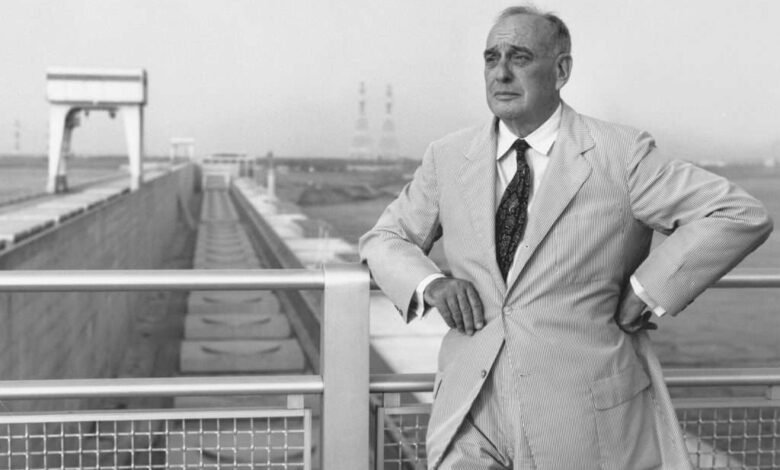
Illustrations, from above: Robert Moses at the St. Lawrence-Franklin D. Roosevelt Project in Massena (courtesy NYPA); Map of “Lake St Lawrence” created by Daniel Macfarlane; Moses Station under construction (New York Falls Public Library); GIS map of modifications to Horseshoe Falls, including lines of recession (green indicates reclaimed land and shrunken crestline while area in red shows excavation) by Jason Glatz and Daniel Macfarlane; and Robert Moses at a generating station (courtesy of NYPA),
Figure 1: Map of Lake St. Lawrence. Created by Daniel Macfarlane.
Figure 3: Robert Moses at a generating station. Courtesy of NYPA.
Figure 4:
Figure 5: Aerial Photo of Niagara Power Project under Construction. Courtesy of NYPA.
Figure 6: Moses Station under construction. Courtesy of New York Falls Public Library.
Figure 7: Robert Moses with Richard Nixon and Pierre Trudeau. Courtesy of NYPA.

Source link