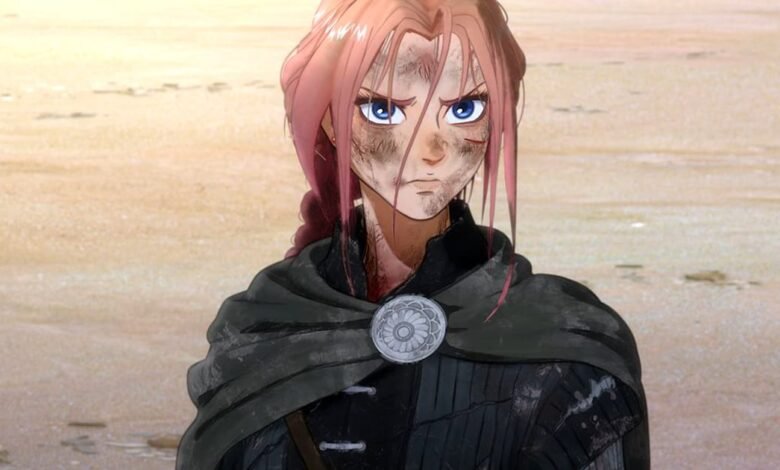

Across his two-decade feature career, Mamoru Hosada has stuck to a handful of thematic preoccupations. Family in all its complexity; forgiveness over revenge, and an earnest belief in the innate collective goodness of humanity. He explores these subjects via epic fantastical premises with giant emotions but keeps the character scope intimate, and even when touching suicidal ideation, foreign interventionism and animal abuse, Hosada keeps his tone generally light while unafraid to pull on the heartstrings. It’s a template which has served the Japanese director very well as his ambitions grew, but unfortunately falters with Scarlet.
A loose adaptation of Hamlet – marking the third such to hit UK cinemas in three months – we follow 16th century Danish princess Scarlet (a gender-flipped Hamlet) who sees her father’s throne violently usurped by her evil uncle Claudius. When she fails in her quest for revenge, she falls into The World Between, a barren wasteland of a purgatory where the sky is an ocean patrolled by dragons who shoot lightning, time folds in on itself, and Claudius tyrannically rules over its people by holding hostage passage to The Infinite Land where the dead can live instead of fading into nothingness. Joining Scarlet on her odyssey for vengeance is Hijiri, a pure-hearted Japanese medic from the present day who serves as the forgiving ying to her embittered yang.
Get more Little White Lies
Hosada likely views Scarlet as his epic. The number of shots which aren’t wide-angle or showcase vast landscapes, with at least one montage calling to Lawrence of Arabia, can be counted on both hands. There are giant battle setpieces, awe-inspiring digital effects work with the oceanic skyboxes, cacophonous sound design, and a busy narrative taking constant detours. On paper, it’s Hosada’s usual tunes blown up on a grander scale.
In practice, the results are an overstuffed yet simplistic mess. Whilst many individual shots and character designs are striking with classically muted colours, the decision to render The World Between via digital animation aiming to ape traditional 2D animé in three-dimensions with an accompanying lowered frame-rate leads to distractingly stiff character movement and stunted choreography. The uncanny digital feel which worked for Belle’s virtual world here resembles a mid-tier PlayStation cutscene and, unlike Belle, the vast majority of Scarlet and its biggest emotional swings take place in this uncanny valley of souls.
More fatally, Hosada’s usual family-aimed writing comes unstuck with this darker material. His sincere commitment to people’s fundamental goodness and a rejection of violence, which already risks corniness in his great films, curdles into condescending naivety when the antagonist is an unrepentant power-hungry despot. The fact that divine intervention ends up being what resolves the central conflict, rather than Scarlet herself doing much of anything, is endemic of the detrimental didacticism in Hosada’s screenplay. The sheer number of characters, concepts, and generally choppy plotting on display calls to mind the hats-on-hats-on-hats nature of Makoto Shinkai and I do not make that comparison as a compliment to either filmmaker. Worst of all, neither Scarlet or Hijiri are developed or entertaining enough characters to sell the raging heartfelt emotions Hosada has successfully pulled off before. By the time the climax is outright repeating the end of Belle, one has to concede that the harmonies just aren’t coming together this time.