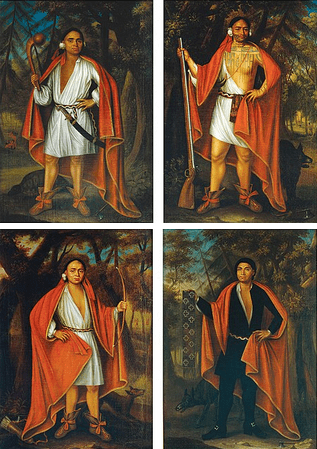
 The “Four Kings” were Native American leaders who traveled to London, England in 1710 during Queen Anne’s War as diplomats of the Mohawk Valley. They met with Queen Anne in London, where their portraits, the earliest surviving oil portraits of Native people painted from life, were painted by Dutch artist John Verelst by royal commission.
Queen Anne’s War (1702-1713) was the second in a series of colonial wars fought in North America involving the Great Britain, France, and Spain. The four men, long misidentified as Mohawk leaders, were actually three Mohawks and one Mohican man.
The trip was organized by Pieter Schuyler (1657-1724), who served as the first Mayor of Albany (1686-1694) and later also as acting governor of the Province of New York twice in 1709, and governor of the Province in 1719-1720.
(Pieter Schuyler was the brother-in-law of Stephanus van Cortlandt (the patroon of Van Cortlandt Manor and a Mayor of New York City from 1677 to 1678 and again from 1686 to 1688), Nicholas van Rensselaer and Robert Livingston the Elder the first lord of Livingston Manor. His great-nephew was Continental General Philip Schuyler.)
With Pieter Schuyler, his son Philip Schuyler (1696–1758), and his brother Johannes Schuyler (1668-1747) accompanying them, they were driven through the streets of London in royal carriages, and received by Queen Anne at the Court of St. James Palace. They also visited the Tower of London and St Paul’s Cathedral and had audiences with the Archbishop of Canterbury Thomas Tenison, William Penn (at a tavern). They toured the city and attended a performance of Powell’s Marionettes at Punch’s Theatre; and a presentation of Macbeth where they sat on the stage.
“Their visages are very awful and majestick, and their features regular enough, though something of the austere and sullen,” one observer claimed. “Their health is good, as is proper for primitives; they know no gout, dropsy, gravel, or fevers.”
Schenectady Church Members
These four men and along with some 100 other Mohawk people were recently rediscovered to have been members of the First Reformed Church of Schenectady, at the corner of Union and North Church Streets in Schenectady’s Historic Stockade District.
The three Mohawk were:
Sa Ga Yeath Qua Pieth Tow of the Bear Clan, called “King of Maquas” (King of Mohawks), with the Christian name Peter Brant (he was the grandfather of Mohawk leader Thayendanegea, aka Joseph Brant, the brother-in-law of William Johnson), recorded in church records as Brant Sakwainkwarakton;
Ho Nee Yeath Taw No Row of the Wolf Clan, called “King of Canajoharie” (Great Boiling Pot), or John of Canajoharie (now in Montgomery County), known in church records as Johannes Onekoheriako; and
Tee Yee Ho Ga Row (ca. 1660-ca. 1735) , of the Wolf Clan, called “King Hendrick” (Double Life), or Hendrick Tejonihokarawa the name used in church records (not to be confused with Hendrick Theyanoguin, 1692-1755).
The Mohican was Etow Oh Koam of the Turtle Clan, mistakenly identified in his portrait as “Emperor of the Six Nations,” recorded in church records as Nicholas Etowaucum. The Algonquian-speaking Mohican people were not part of the Iroquois Confederacy however.
(It’s believed five Indigenous men set out on the journey to England, but died during the crossing.)
Recognition of these men will take place during the the First Reformed Church of Schenectady’s worship service on Sunday morning, February 1, 2026.
The church has framed copies of their portraits hanging in the Dirck Romeyn Room on the west side of the Sanctuary. The records are conserved in the church’s archives. Digital copies are planned to be made available soon.
The service will begin at 10 am, with music starting at 9:50 as people arrive. The Call to Worship will bring attention to the Haudenosaunee Thanksgiving Address, daily Words that Come Before All Else, for Our Minds to be One.
During the time of the usual anthem and children’s message the Sunday School children will present their understanding of the Haudenosaunee Legend of the Peace Tree and their Great Law of Peace. They will tell of the six nations, their clans, and of giving thanks to the Creator.
Interim-minister, Pastor Todd Buurstra, will speak of the history and legacy of the four men as part of his sermon, with music. All are invited to attend.
Read more about New York’s Indigenous history.
Source link