 Documents at the New-York Historical Society and corporate records show that the founders of Brown Brothers Harriman, based in New York City, built the bank by lending millions of dollars to Southern planters and arranging for the shipment and sale of slave-grown tobacco and cotton in New England and Great Britain.
At one point, the Brown family, which controlled a network of interlocking corporations with offices in New York, New Orleans, and Liverpool, took possession of three Louisiana plantations with 346 enslaved Africans. The Liverpool Black History Research Group is accusing the company, Wall Street’s oldest private investment firm, of sanitizing its history.
A forerunner bank was founded in 1800 as Alex. Brown & Sons by Alexander Brown (1764-1834), a Northern Irish immigrant based in Baltimore, who was one of the first millionaires in the United States.
As the company expanded, it opened offices in New York, Boston, Philadelphia, and Liverpool. Brown Brothers & Co. opened its first New York office in 1825.
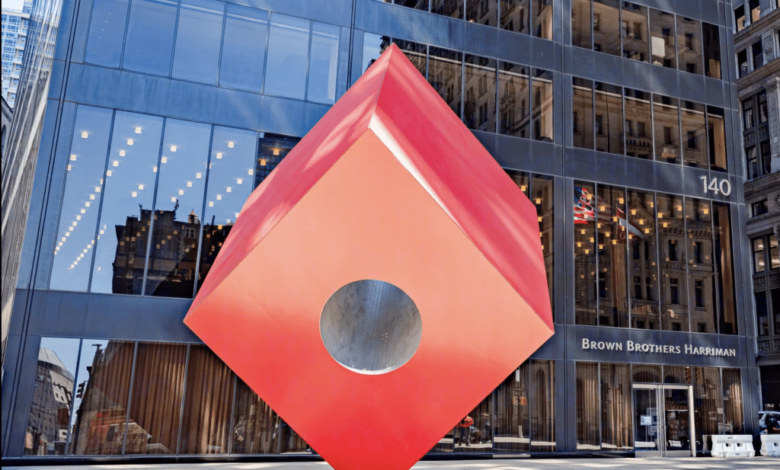
In 1931, in a Great Depression era consolidation, Brown Brothers & Co. merged with Harriman Brothers & Co. forming Brown Brothers Harriman. Brown Brothers Harriman’s current offices at 140 Broadway serve as its global headquarters.
On its website, Brown Brothers Harriman initially claimed, “there is no known instance of slaves being owned by members of the Brown family” and they described members of the Brown family as committed to the abolition of slavery.
This has been amended to acknowledge that Brown Brothers like “virtually all U.S. businesses operating in the first half of the 19th century participated in this system directly or indirectly” and that during “the depression that followed the Panic of 1837, a number of prominent southern planters went bankrupt, leading Brown Brothers in New York to foreclose on property that had served as collateral for the firm’s cash advances. The properties included several cotton plantations and associated slave labor in the South.”
According to the Liverpool Black History Research Group, “The Brown family used money they made buying and selling slave-produced cotton to establish themselves in banking – and they started to lend money to others producing cotton.”
When the Browns’ bank “foreclosed on the loan, not only did they foreclose on the land, they would foreclose on the enslaved people – so in the 19th century the Brown family ended up owning plantations and enslaved people.”
Historian Sven Beckert in his 2015 book Empire of Cotton, reported that the Brown bank eventually owned at least thirteen plantations and hundreds of enslaved Africans (223).
Although the Brown’s saw themselves as opposed to slavery, they perpetuated the systems that maintained it. They also invested the immense profits they made from brokering slave-produced commodities into railroads, banks, industrial ventures, and cultural institutions including the American Museum of Natural History and the Metropolitan Museum of Art in New York City.
Its 19th century complicity with slavery is not the firms only black mark. In the 1930s, Brown Brothers Harriman served as the United States representative for German industrialist Fritz Thyssen who helped finance Adolf Hitler’s rise to power.
Brown Brothers Harriman has been accused of maintaining racially segregated facilities during the Jim Crow era and discriminating against African American employees.
After World War II, Brown Brothers Harriman was accused of discriminatory lending practices, including charging minority home buyers higher interest rates and steering African Americans seeking mortgages into segregated communities.
During the first decade of the 21st century, Brown Brothers Harriman was partly responsible for the 2008 financial collapse, investing in and marketing toxic subprime mortgage-backed securities.
After helping to facilitate the banking collapse, Brown Brothers Harriman received $2.5 billion in emergency loans from the Federal Reserve System that was trying to stabilize the bank and the financial system.
Editor’s note: As a 2012-2013 New-York Historical Society Bernard and Irene Schwartz Fellow, Dr. Kathryn Boodry’s work at New-York Historical focused on the intersection of slavery and finance in the nineteenth century, and how coerced labor facilitated large-scale economic growth in the Atlantic world. Her particular focus was Brown Brothers’s cotton trade centered in New York.

Source link