 Spring sun warmed the air early Saturday morning, May 12, 1855, when the famous abolitionist and orator Frederick Douglass and his associates started their ten-minute walk from the New Haven Railroad Station in Mamaroneck to their destination in Rye Neck, an inconspicuous corner of Rye, in Westchester County, New York.
Leading the group was the Reverend Levin Tilmon, president of the First Colored American Congregational Grove Company of Rye Neck, the formal dedication of the “Meeting Grove” being the reason for Douglass’ visit.
Already gathered at The Grove, since dawn broke over Long Island Sound with its salty breeze drifting inland, were local African Americans, residents of Rye Neck and the nearby, small Black settlement of Saxton Woods, and from further up the line, folks from The Hills, the large Black community situated on the rugged borders of Harrison, North Castle and the county seat, White Plains.
They had been setting up planks for seats and rough wooden tables for lunch, under the direction of Henry Ewell of Rye Neck, whose son Peter, a teacher, was an ardent member of Rev. Tilmon’s First Colored American Congregational Methodist Church on Sixth Street in Manhattan.
Leaving from the church, Peter had boarded the train with the others at its Eighth Street and Fourth Avenue stop, thrilled to be in the company of such distinguished Black leaders, including Dr. James McCune Smith (1813-1865) of New York City.
He always read this intellectual’s sharp social commentary in the Black press. Today, he was anxious to hear this physician and abolitionist speak, sure he would advocate for education, schools under Black leadership, like the one planned for The Grove.
Waiting in The Grove was Diana Underhill of Rye Neck, a member of the Dinner Committee. She could barely contain her pride. As a founding member and the treasurer of the Second Colored American Congregational Methodist Church of Rye Neck, her faith was rock solid.
She loved the Gospel verse Rev. Tilmon quoted with Jesus assuring Simon Peter, “Upon this rock I will build my church.” Together, Rev. Tilmon and the congregation would build their church in the shade of The Grove.
As the ceremonies were about to begin on a small stage Rev. Tilmon stood behind the plain oak pulpit made from one of the many mature trees across The Grove’s six acres.
He would begin the dedication with a prayer, the high-point of his long ministry, twenty years as a circuit-preacher with the African Methodist Episcopal (AME) Church, and, since 1850, a settled Congregational Methodist pastor with his own church in Manhattan, and now, by extension, this meeting grove, and with his plans for its church, the cornerstone to be set this very afternoon.
He looked out at the crowd, now quiet in their individual expectations for the day’s promises. He spotted the radical Quakers Joseph and Margaret Carpenter from New Rochelle, sitting quietly with their Black neighbors. George Barry and his wife Catherine sat on a wooden bench with Noah Tompkins, the most genial, white ally he ever met.
 Rye Neck farmers, Tilmon knew them for their grand land development plans. In fact, he had acquired these six acres, known locally as Barry’s Woods, through a mortgage with George Barry.
Shifting his attention inward, knowing it was time to open his heart and mind to the divine purpose for which they were assembled, he trusted his prayers would stretch across these acres, touching these good souls, and journey further with the Mamaroneck River as it flowed along The Grove’s southwest border.
South! Yes, his prayers, all their prayers, must fly south to hurry the day of liberation of their enslaved brothers and sisters.
Out of the Shadows into the Historical Record
For over 170 years, this extraordinary event, with Frederick Douglass in Rye Neck to dedicate a Grove for African Americans to gather in revival meetings and community celebrations, has been missing from town and county histories.
In fact, not just Douglass’ participation at this celebration, but also the history of the Second Colored American Congregational Methodist Church of Rye Neck (SCACMC) and the Grove itself are missing from the history of African Americans in Westchester County.
Why didn’t Westchester County’s newspapers cover Frederick Douglass’ oration at Rye Neck? Did they even know about it? With good reason, Tilmon did not submit any news of the event in the county’s press.
In 1855, the Fugitive Slave Act in full force, Rev. Tilmon, FCAC Grove Company, and the Black community did not want federal agents invading the celebration to capture Freedom Seekers among the attendees.
Westchester County’s newspaper of record, the Eastern State Journal of White Plains, was staunchly pro-South and anti-abolitionist. When war descended on the nation rendering it asunder, Edmund G. Sutherland (1815-1883), vicious racist and publisher of the Journal, boasted in print, “When the war is over, the Fugitive Slave Law should at once be enforced.”
Notices in the city of New York’s Black press and word of mouth were the best sources of news in the tight-knit web of Black communities and churches. Frederick Douglass’ oration during the dedication of The Grove and related episodes and people in Rye Neck’s Black community history will now enter the historical record.
Reverend Levin Tilmon & Manhattan’s First Colored American Congregational Methodist Church
Born enslaved in 1807, in Caroline County, Maryland, and manumitted in his youth, Reverend Levin Tilmon was a fervent and ambitious minister, church builder, ardent abolitionist, and entrepreneur, operating an employment agency in Manhattan. At this time, such agencies were called “Intelligence Offices” and sought domestics, cooks, waiters, coach drivers, etc. to fill advertised positions.
In the anti-slavery literary tradition of the era, in 1853, he self-published his memoir, A Brief Miscellaneous Narrative of the More Early Part of the Life of L. Tilmon, in which he stated, “I wish to express indelibly, my opposition and hatred to Slavery.”
To spread the good news of the gospel and his abolitionist message, Rev. Tilmon regularly promoted his First Colored American Congregational Methodist (FCACM) Church, its congregants, events, and himself in the Weekly Anglo-African newspaper in Manhattan.
His network of Black ministers, abolitionists, and white allies stretched far and wide throughout the City, on Long Island, in Westchester County, Connecticut, and beyond. On several occasions, traveling from his home in Rochester, Frederick Douglass had lectured to the FCACM congregation, and when he attended its Young Men’s Literary Society’s Recital, in his newspaper, he lavished praise on the young speakers.
As a progressive minister, Tilmon supported women in nontraditional roles. At FCACM Church, Elizabeth Jennings was the organist and choir director. On Sunday, July 16, 1854, she gained fame as “the first freedom rider” for refusing to exit a “whites only” streetcar and suffered physical abuse from the conductor.
At his church, Tilmon presided over the heavily attended protest meeting on her behalf. Jennings won her lawsuit against the streetcar company, quite an accomplishment for that era.
The Second Colored American Congregational Methodist Church of Rye Neck
Pastor Levin Tilmon drew Black men and women from lower Westchester County to his FCACM church in Manhattan, and he found support for organizing an offspring congregation in the Rye Neck, then a section of Rye, on the Mamaroneck border.
In mid-August 1864, he met with area residents in the home of Jesse Underhill of Rye Neck. In the prescribed legal order, they organized the Second Colored American Congregational Methodist Church of Rye Neck.
 The new congregants elected officers: Trustees for Two Years: Jesse Underhill and James Thompson; for One Year, David Seeley. For Clerk, William Henry Jackson. “Resolved that Dianah Underhill shall be and is appointed Treasurer for the Society – Agreed.”
Here is another example of Rev. Tilmon’s acceptance of a woman in a prominent church role, rather than simply relegated to leadership in the Ladies Auxiliary.
Age twenty-nine, Diana was the daughter-in-law of trustee Jesse Underhill who farmed his own land in Rye Neck and worked for Quaker Abolitionist, Joseph Carpenter of New Rochelle, a verified operator of the Underground Railroad.
Lower Westchester, African Americans had kinship ties to Oyster Bay, Long Island, dating to the era of enslavement. Among those present that the organizational meeting was William Henry Dumpson, about age seventeen, born and raised in Oyster Bay. Looking ahead to his potential as a minister, the congregation appointed Henry as “Preacher of the said Society.”
The Rye Neck congregation especially demonstrated close ties to the large Black community, The Hills, in northwest Harrison. For example, William Henry Jackson, appointed Clerk, and his wife Emeline, received as a member, and their four young children, one daughter and three sons, resided in The Hills. This broad representation of members throughout lower Westchester continued in Tilmon’s next project.
First Colored American Congregational Grove Company of Rye Neck
At the organization meeting in October 1854 in the Lecture Room of the Manhattan Church, Rev. Tilmon, his close associate, Peter Ewell, and others gathered to elect officers for the First Colored American Congregational (FCAC) Grove Company of Rye Neck.
Some officers and members of its Board of Trustees resided in Manhattan, including trustees, Jemima Belkizer, Anna Montee, Anna Vandenburgh, and Diana Collamore, each woman bringing fascinating stories to church and grove company membership.
Jeremiah Mitchell, one of the founding leaders and landowners in the Black community, The Hills, served on the Board. Grove Company’s treasurer, Charles Johnson, lived with his large family on his own land in Rye Neck.
His neighbors were David Seely, James Thompson, and Jesse Underhill, all founders and trustees of the SCACM Church. The web of members of Tilmon’s two churches and the Grove Company was intricate.
The Grove was a commercial enterprise. Its investors, referred to as stockholders in the documents, offered Black-owned land to rent for Sabbath School picnics and revivals, drawing congregations from New York City, Long Island and locally. With Levin Tilmon as the Grove Company’s president, ambitious plans for the six acres did not rest entirely on picnics and revivals.
As stated in his press announcement, the stockholders “intend to erect on their land a chapel, school-house, with mechanical shops attached, for the training of colored youth in the various mechanical pursuits. Also, a suitable boarding house, for public accommodation.” But the Company needed to start with a popular event, a camp meeting, guaranteed to draw crowds for religious and social stimulation.
Like Tilmon’s FCACM Church with its integrated congregation, the Grove’s revivals also attracted white Christians, anxious to experience exhilarating preaching and exhortations. By the 1850s, especially in urban areas, the frequent camp meetings of the Second Great Awakening (1820s-1840s) had declined as the established churches preferred decorum of traditional services.
Black denominations, AME, AME ZION, and Baptist, continued to offer revivals, attracting members, making converts, and redeeming sinners. During his Civil War service in Louisiana, in his Feb. 15, 1864, letter to his wife Sarah Jane at home in The Hills, Sergeant Simeon Anderson Tierce conveyed news and reminisced.
“We had a class meeting here yesterday morning Sunday the 14th by John Thomas, Jacob Smith and myself and we had a glorious time. Brother Jacob got all off – worse than he was once at rye neck and it made me think of home,” he wrote.
Given Simeon’s description, The Hills folks traveled to Rye Neck, a distance of eight miles for rousing preaching. His comrade Jacob Smith, in a Glory moment, “got all off;” that is, filled with the spirit, he emotionally declared the glory of salvation that he was experiencing. The Hills folks likely attended The Grove’s inaugural revival.
 From August 16 -August 20, 1855, Rye Neck Grove Company sponsored a grand camp meeting as a religious event and fund raiser. As reported by Rev. Tilmon in Frederick Douglass’ Paper, “The number of persons upon the ground on Sabbath afternoon, was between two and three thousand, of all shades and complexions, who paid every attention during the hours of divine service.”
Celebratory events and revivals continued at the Rye Neck Grove through the late 1850s. However, by 1860, economic woes reduced African American groups’ and churches’ ability to sponsor celebrations, and Grove profits seriously declined.
Also, too often, the Grove company’s shareholders neglected to pay their “dues,” despite Tilmon’s admonitions in public notices. The Grove fell on hard times and Tilmon even advertised it for sale.
Personal and Broad Changes
In 1860, Rev. Tilmon experienced considerable personal changes, retiring from the ministry, and with his wife, Sarah Ann, purchasing a home on 120th Street between Third and Fourth Avenues in East Harlem. In 1860, Harlem was not yet the “Capital of Black America” that we associate with the 1920s.
The only other Black head of household near Tilmon’s residence was a laborer who rented his dwelling. In the mid-19th century, Harlem was predominately white; a mix of prosperous descendants of early Dutch and English colonizers, recent German immigrants who were skilled workers, and Irish immigrants of the laboring class.
From their home Levin, with Sarah as his assistant, commuted to their employment agency at 70 East 13th Street in or near East Greenwich Village, on the “horse-drawn rail service” extending along Third Avenue from lower Manhattan to East Harlem.
By 1860, Peter Ewell and his father, Henry Ewell, had moved their families from Manhattan, settling on their own land in Rye Neck. Also, according to the 1860 census, the Reverend Silas A. Mitchell lived in lower Harrison.
Son of Jeremiah Mitchell, a Grove trustee, Silas and his cousin, Simeon Anderson Tierce, grew up together in The Hills. Living in lower Harrison, he was able to serve the congregation in Rye Neck, just a short distance away.
1860: Events That Stunned the Nation
Following Abraham Lincoln’s election as President in November, on December 20, 1860, South Carolina became the first state to secede from the United States; six more states followed in January 1861: Mississippi, Florida, Alabama, Georgia, Louisiana, and Texas. On Feb. 2, 1861, these seven secessionists formed the Confederate States of America.
The remaining United States knew that only military force could retrieve the states that sundered the Union. Americans, especially in the North, held their breath. Retired clergyman, Levin Tilmon mustered his abolitionist zeal and patriotic fervor to confront the inevitable war.
 On April 8, 1861, in his lower East Side office, Levin Tilmon wrote to President Lincoln, volunteering his services to raise Black troops to fight with the U.S. Army. Four days later, April 12, Confederate batteries opened fire on the United State’s Fort Sumter in Charleston Harbor.
On April 15, 1861, the Civil War formally began with President Lincoln’s proclamation ordering the governors and state militias to raise 75,000 white men for a federal army to suppress the rebellion and restore the United States.
In 1862, the Rev. Mitchell as “preacher” and Henry Ewell as “Member” filed a “Certificate of Incorporation for the “Zion Mission Church of Rye Neck.” With Rev. Mitchell being an AME Zion itinerant minister, the Zion Mission would get a new circuit preacher every year or two.
Levin Tilmon’s health was weakening at this time. Fortunately, he lived to experience Watch Night, Jan. 1, 1863, when news of President Lincoln signing the Emancipation Proclamation swept through Black Churches. One of its clauses opened military service to Black men, the forces that became the United States Colored Troops (USCT).
Rev. Levin Tilmon died from consumption, that is, tuberculosis, at his home in East Harlem, New York City, on May 5, 1863; he was fifty-five years old.
While I have not found the names of itinerant, A.M.E. Zion preachers for the Rye Neck Church, its first preacher, appointed in 1854, William Henry Dumpson returned to lower Westchester County after his Civil War service in the USCT . A distinguished member of the A.M.E. Zion denomination, Elder Dumpson served in Portchester, adjacent to Rye, in the 1870s.
In its Oct. 9, 1873, edition, The Portchester Journal reported that in Rye Neck, “Peter Ewell, jr., has been appointed superintendent of the colored Sunday school.” Zion Mission Church, the heart of the Black community of Rye Neck, was preparing youth for the future.
In November 1868, to clear title to the six acres of The Grove, formerly Barry’s Woods, James Blackwell, land speculator, brought a Complaint to the Supreme Court, Westchester County, against all who had any documented interest in the Grove Company. When the agent for the complainant served the notice, he recorded the names and addresses of the defendants, providing me with valuable information.
John W. Mills, White Plains lawyer, purchased the property from Blackwell. The Complaint document is in the Westchester County Archives in Elmsford, NY. Rye Neck became part of Mamaroneck in 1895, with the incorporation of Mamaroneck Village.
Edythe Ann Quinn, Ph.D. is an Emerita Professor of History at Hartwick College. She is the author of Freedom Journey: Black Civil War Soldiers and The Hills Community, Westchester County, New York (SUNY Press, 2015).
This article is excerpted from her book manuscript, intended for a general audience, “Out of the Shadows: Black Abolitionist, Rev. Levin Tilmon and His Congregations in Manhattan and in Rye, Westchester County, New York, 1850-1860.” She can be reached at quinne@hartwick.edu.
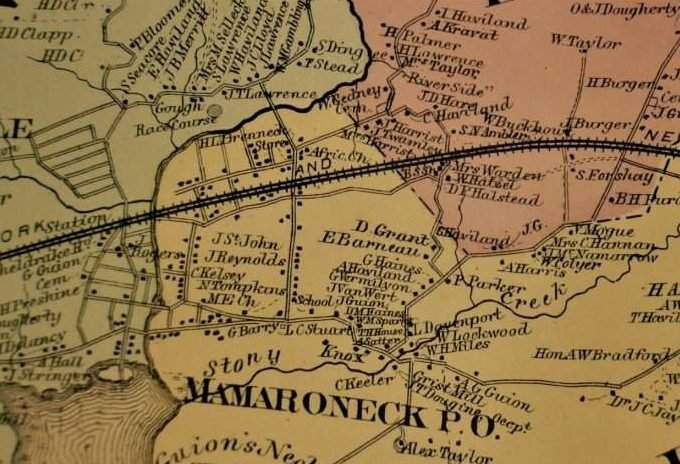
Illustrations, from above: “Afric Ch” is shown above the word “AND” along the New York and New Haven Railroad in this detail form a 1867 F.W. Beers Atlas (Westchester County Archives); “Rye Neck Grove,” Frederick Douglass’ Paper (Rochester, NY), May 25, 1855 (Library of Congress); Detail of survey of Barry and Tompkins property in Rye Neck, 1851, showing the “Colored Association” (Westchester County Archives); Detail from 1868 F.W. Beers Atlas map showing Rye Neck with its African Church, Grove, and the lands of SCACM trustees David Seely and Charles Thompson, and south of the train tracks, George Ewell’s property (Mamaroneck Historical Society); and a letter from Levin Tilmon to Abraham Lincoln, Monday, April 08, 1861 (Abraham Lincoln Papers, Library of Congress).
Source link