As the political procedural turns 50, its depiction of paranoid, uncertain times bears a chilling resemblance to our own.
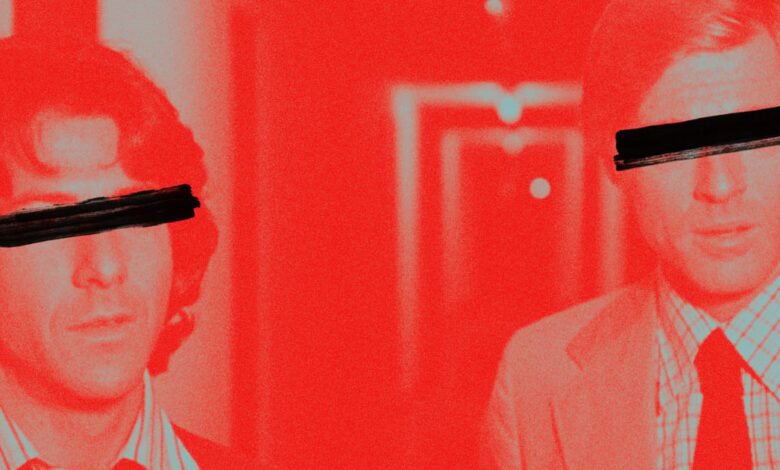
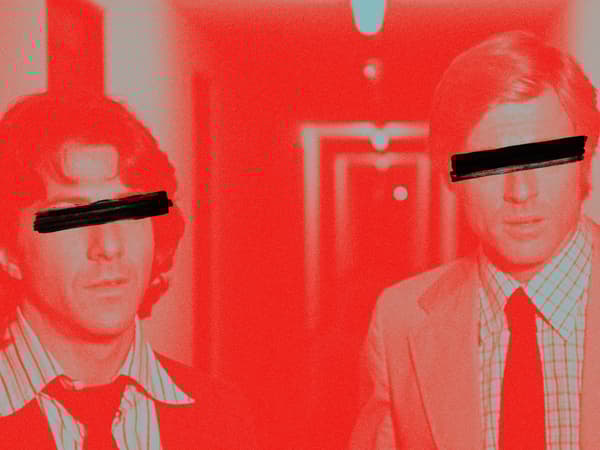
With world politics in turmoil and constant revelations surfacing of powerful individuals’ ties to corruption, it seems impossible to place trust in figures of authority. These words describe the present, of course, but could equally apply to the tumultuous times depicted in Alan J Pakula’s All the President’s Men (1976). Along with the neo-noir thrillers Klute (1971) and The Parallax View (1974) All the President’s Men completes what is informally referred to as Pakula’s ‘Paranoia Trilogy’, encapsulating the dread and turbulence of the 1970s. All the President’s Men directly focuses on the scandal which shattered the American public’s already-wavering faith in its government: Watergate.
Pakula’s Oscar-winning film tells the mythologised story of the Washington Post journalists Bob Woodward (the late, great Robert Redford) and Carl Bernstein (Dustin Hoffman) who investigated the 1972 Watergate break-in and exposed its subsequent cover-up. It is based on the book written by the real-life Woodward and Bernstein, whose remarkable reporting uncovered the White House’s illegally-funded espionage activity and led to further investigations which would culminate in Richard Nixon’s resignation in 1974.
Watergate can be looked at as a ‘liminal’ phase of American history – a state of transition or ‘in-betweenness’ marked by ambiguity and uncertainty. In its aftermath, trust in the administration was replaced with a more cynical, suspicious public attitude towards government. All the President’s Men was a product of this ‘in-between’ phase, and the unease of this transition is reflected visually throughout the film.
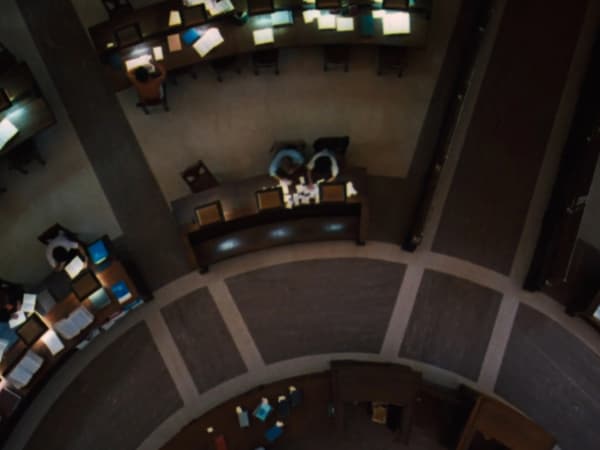
Liminal spaces – transitional spaces which feel eerie and unsettling without human presence – feature frequently. Dimly-lit empty corridors, deserted rain-slicked roads, and a dark elevator where moody chiaroscuro throws strong shadows on Redford and Hoffman’s pensive faces all evoke the atmosphere of danger and fear surrounding Woodward and Bernstein’s pursuit of the truth. Then there’s the famous overhead shot in the Library of Congress, where the camera slowly pans to 100 feet above Woodward and Bernstein as they thumb through reams of library records – the space isn’t completely empty, but it’s unsettling all the same, a striking reminder of the scale of the institution that the two small figures, literally dwarfed here by their imposing surroundings, are trying to bring down. This intelligent visual storytelling is the work of legendary cinematographer, Gordon Willis, who, fresh from painting Michael Corleone’s moral descent with evocative shadows in The Godfather Part II just two years prior, similarly conjures up the intrigue and tension befitting of a crime story – though this time it’s all true.
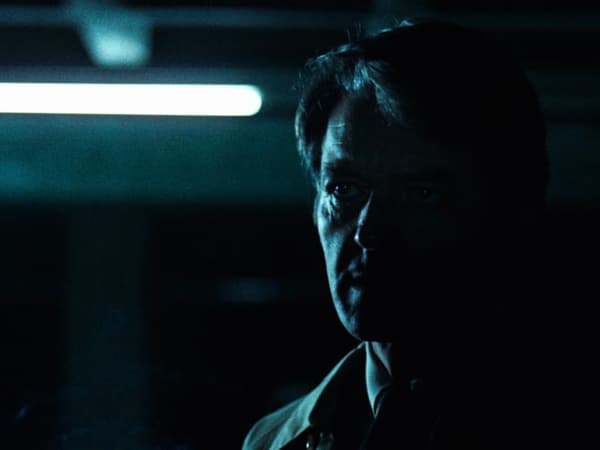
Most effective of all are the scenes where Woodward and secret government informant ‘Deep Throat’ meet in an empty underground parking garage in the middle of the night. Woodward takes two taxis to the meeting spot and the sound of a lighter points him in the direction of his contact standing in the shadows. In the darkness we can hardly see their faces, just the whites of their darting eyes, and their voices are scarcely audible above a whisper. Deep Throat, not wanting to be quoted by Woodward, speaks in riddles – himself a liminal figure, caught between the government he works for and his desire to help the press get the truth out.
All three of Woodward and Deep Throat’s meetings occur in a similar fashion, and are all moments of significant development in the investigation. Setting these scenes in the dark, transitional space of the parking garage emphasises the precariousness of their situation: it’s hard to “follow the money”, as the famous quote goes, when the truth lies hidden, obscured by both literal and figurative shadow. In the darkness, Woodward gradually realises their proximity to something much bigger than a slush fund or an orchestrated break-in. Something which could wholly undermine the nation’s trust in its government. The word ‘liminal’ derives from the Latin ‘limen’, meaning ‘threshold’, and Woodward and Bernstein symbolically stand on the threshold of uncovering a much wider conspiracy. Whether they choose to cross this boundary and run the risk of destabilising the entire political landscape is the dilemma they face.
These shadowy scenes are even more impactful in contrast with those set in the messy, brightly-lit Washington Post newsroom. The majority of the film takes place here, on a set which was meticulously realised by production designer George Jenkins. He photographed, sketched and observed the real Post newsroom, and in a feat of hard work and attention to detail very much in the spirit of the film, he faithfully re-created its sprawling mess of phone books, calendars, paper, typewriters and telephones. Carl Bernstein said that Jenkins had “recreated it down to the trash on our desks”, calling it “a verisimilitude I never quite expected from the movie business”, and Jenkins would go on to win the Academy Award for Best Art Direction alongside set decorator George Gaines.
Gordon Willis also went to great lengths to light the set with fluorescent, migraine-inducing overhead lamps similar to those used in the real newsroom. The effect is a harsh and chaotic mood in the many scenes where Woodward and Bernstein juggle phone calls, scramble to note down information and, perched at their typewriters, illuminate the truth with their words. This stark visual contrast of both space and lighting further highlights the depth of turmoil and shadow in those liminal garage scenes.
All The President’s Men ends with the two journalists still deep in the throes of their investigation, working at their typewriters while footage of Nixon’s second inauguration is broadcast on a TV in the newsroom. A split diopter shot holds both the television set and the two journalists in simultaneous focus, neatly contrasting the official party line with the truth uncovered by their reporting (there’s a subtle comparison to be made here with Sidney Lumet’s Network – also released in 1976 – about television’s obstruction of the truth).
A montage of headlines in the final moments summarises the resultant guilty verdicts, sentences and, finally, Nixon’s resignation in very abrupt fashion. Importantly, this serves the contemporary audience, who were intimately familiar with the details of the recent, much-publicised events and would not have needed a laborious re-telling of them.
To modern audiences less familiar with Watergate, however, it feels like the film ends halfway through, just as the investigation was starting to gather steam. Perhaps this, alongside the alienating onslaught of names and details, is fitting for the liminal moment in time the film itself occupies – a work birthed by and immediately responding to the in-between phase the country was going through at the time. Concluding with the investigation still ongoing is symbolic of this continued uncertainty and transition.
But tumultuous political times are not exclusive to the 1970s. The pre-Internet world of All the President’s Men might be of a bygone era, with its typewriters and its coffee-fuelled nights spent poring over library records, but what it has to say about the importance of a free press remains as relevant as ever, not least amid brutal staff layoffs at The Washington Post ever since it was acquired by Jeff Bezos and a concerningly right-leaning restructuring going on at CBS News at the behest of its Chairman and CEO, David Ellison, who is a close ally of Donald Trump. The film’s primary concern – exposing institutional corruption and criminality – draws startling parallels with the modern day. Technology might have moved on, but the search for answers remains fraught with danger, paranoia and the additional hurdles of fake news, AI hallucinations and disinformation. For today’s Woodwards and Bernsteins, the truth still lies in dark, perhaps even darker, more deeply obscured places.
Source link