 During the Beaver Wars the Haudenosaunee (Iroquois), supplied by Dutch weapons, decimated the Mohican along the Hudson River. A Mohican effort to regain control of land taken from them by the Mohawk left their strength so severely depleted that they refused to join their eastern Algonquin speaking allies in fighting King Philip’s War (1675-1676) — a war that marked the last major effort by the Native Americans of New England to drive out the English settlers.
Following that bloody conflict, defeated Indigenous refugees fled west from New England along the Hoosic River into the Province of New York. Edmund Andros, Governor of the Province, saw this exodus as an opportunity to thwart the territorial ambitions of Massachusetts.
Many residents in Massachusetts believed their colony should extend all the way to the Hudson, so Andros invited displaced Mohicans, along with Wampanoags, Narragansetts, Skokis, and Nipmucks, to settle on the meadows between the mouth of the Hoosic River and Tomhannock Creek.
He believed they would prevent squatters and act as a barrier against French raids from the north. This assemblage of peoples became known as Schaghticoke.
 Governor Andros negotiated peace with several tribes and then created a reserve on the west side of the Hudson and offered it to the Mohawk as a homeland. This, combined with the expanded settlement of Schaghticokes, created an early warning system for Albany in the case of hostile raids by the French and their Indigenous allies from the north.
To cement the alliance, the governor convened a peace council in 1676. Representatives of the English Crown and as many as a thousand Native People, along with Jesuits from the Mohawk villages, gathered to smoke calumet (peace) pipes and promise to keep the covenant made there.
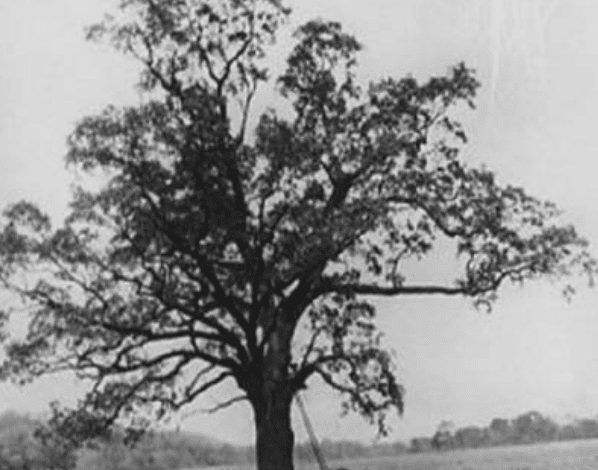
During the ceremony they planted an oak sapling — which later became known as the Witenagemot Oak — and named the place “the Vale of Peace.” The tree stood for nearly 300 years.
One hundred years later Johannes Knickerbocker III built his house at this place. The ancient tree stood behind the Knickerbocker Mansion until 1949, when it was uprooted during a winter flash flood. Saplings of the original oak now grow in its place.
Although the Schaghticoke eventually moved west, many have made pilgrimages back to this symbol of the pact.
This essay is drawn from The Northern Inland Passage: An Interpretive Guide to the Champlain Canal Region published by Lakes to Locks Passage in 2019 and funded in part by a grant from the National Scenic Byways Program and from the Alfred Z. Solomon Charitable Trust. It has been only slightly edited and reformatted.
Read more about Indigenous History in New York.
Illustrations, from above: A late 19th or early 20th century photo of the Witenagemot oak tree of peace and welfare in Schaghticoke; and a detail, showing Stillwater and Schaghticoke where the Hoosic River enters the Hudson River from “A colored map of the route between Albany and Oswego drawn about 1756 on a scale of 2 miles to an inch,” Norman B. Leventhal Map & Education Center, a larger version online here.
Source link