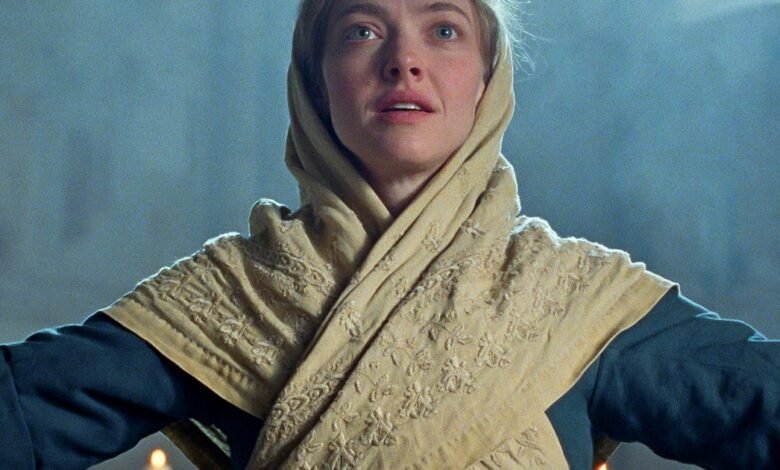

The story is delivered through the awed narration of Sister Mary Partington (Thomasin McKenzie), which allows us to enjoy the occasional juicy episode that was the product of hearsay or gossip. Yet Fastvold is admirably measured in the way she presents Lee as a figure of historical curiosity who we can never really get too close to. It’s hard to think of a more perfect performer than Seyfried for this role, her huge eyes emphasising both her ability to draw people towards her cause and her uncanny ability to power through the torments and sorrows piled onto her and her faithful followers. We learn that, in her formative years she lost four children before they reached the age of one, and the entire film can be read as Ann’s own methodology for processing a series of traumas that would have led many to give up the ghost.
Fastvold sees Ann as a pioneer of gender equality, yet her film doesn’t come close to hagiography. There is no hackneyed list of intertitles that underscore her achievements at the end of the film, rather the purpose of The Testament of Ann Lee transcends an attempt to salvage Ann’s celebrity after the fact. The film is critical and quizzical when it comes to the many contradictions of Ann’s creed, particularly in her focus on human joy and empathy and reaping the natural bounty of the earth while also rejecting sex and procreation, making the Shakers something of their own Doomsday cult. Upon their arrival in New York following a punishing Atlantic crossing, Ann immediately spits venom at the organisers of a slave auction on a street corner, yet is comfortable in exercising her own form of cultural imperialism by bringing her gospel to America. It’s a film that deals with its subject with a level of historical precision and distance that’s rarely seen in cinema, while also using this distance to add its own subtle layer of expression and commentary.
To touch on the film’s immaculate craft, shout-outs are definitely due to the cinematographer William Rexer, whose exquisite images help to elevate the film above the aesthetic banality of the typical historical biopic, while Sam Bader’s careful production design leans into the Shaker’s tastefully spartan worldview. However, top marks go to the composer Daniel Blumberg, whose richly cacophonous achievement here is head-spinning to say the least. He creates lightly modernised variations of Shaker spirituals that have been woven into the fabric of the film’s plot, and it’s admirable how strict he is with the uniform tone and dynamics of the music, never reaching out for undue moments of melody or throwing in emotive crescendos for effect. He won an Academy Award for his work on Brady Corbet’s The Brutalist (which was co-written by Fastvold, and Corbet returns the favour here), and one hopes that he’ll be be duly rewarded for a work that’s even more radical and impressive.
Yet it’s Fastvold who somehow makes all these elements coalesce with such brio and eccentricity, expanding the possibilities of filmed biography while also making a film that manages to land direct hits to the head, the heart and the gut. Unlike Ann, this is not a film that preaches to its flock, and it’s one that has led to a number of post-viewing conversations with colleagues about its aim and its purpose. On first watch, the film it reminded me of the most was Lars von Trier’s cursed digi musical, Dancer in the Dark (2000), in the way it juxtaposes the pain of human suffering with the levity of music and dance. Yet on further contemplation, I’m reminded of the cinema of the great Agnès Varda, whose avowedly feminist outlook was always subject to doubt, curiosity and the sublime mysteries of existence.