 National tragedies have historically been the catalysts for massive shifts in matters such as culture and law. One such tragedy in the twentieth century was the Triangle Shirtwaist Factory Fire of 1911.
An example of the gross negligence from factory owners so prominent in the industrial field and disregard for anything but profit, the Triangle Fire’s impact was so immense that it would ultimately serve as one of the primary catalysts that resulted in a massive labor strike in New York’s Mohawk Valley over a year later.
Working Conditions & Tragedy
Working conditions at the Triangle Shirtwaist Factory were abysmal by all accounts. Founded by brothers-in-law Max Blanck and Isaac Harris, the Triangle company primarily hired immigrant women as young as fourteen years old who were often the primary caretakers of their families.
According to the introduction in Jo Ann E. Argensinger’s 2016 book The Triangle Fire: A Brief History with Documents, machines in the factory were arranged in such a way designed to prevent workers from engaging in as little non-work-related activities as possible.
These girls and young women worked strenuous hours, often fourteen hour days for seven days a week, and were poorly paid due to various factors such as the stop and go nature of piecework and the various changes to demands and styles of the fashion industry.
As detailed in an article for Upfront Magazine, a subsidiary of the New York Times, journalist Joseph Berger recounts that one worker named Becky Reivers only made $7 a week. According to one online inflation calculator, $7 in 1911 is equal to $238 in 2026.
There are other examples of horrible conditions in the Triangle Shirtwaist Factory, but one particular piece of the oppressive structure of industrial and greater capitalism proved to be the most destructive.
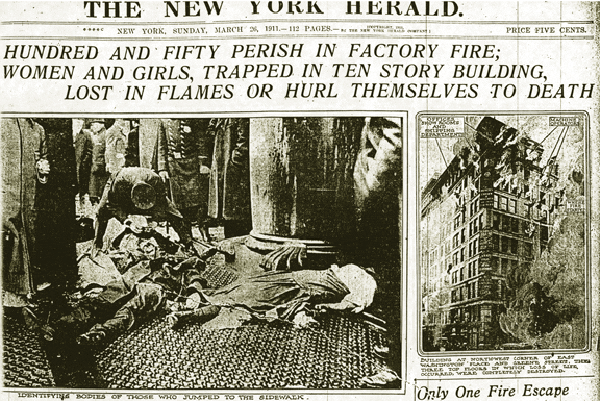
The Triangle Shirtwaist Company occupied the 8th, 9th, and 10th floors of the building they used for factory work. On March 25, 1911, a fire broke out on the 8th floor which then spread to the next two floors above.
Although a number of the staff was able to escape relatively unscathed, others were significantly less fortunate. With the only exit on the 9th floor locked until the end of the workday in an effort by the factory owners to prevent theft, workers on this floor were stuck in an extremely dangerous situation.
There was a fire escape, but it was in rickety shape. Some attempted to use the escape, but it couldn’t hold the weight of the people on it and collapsed, leading to multiple deaths. With no fire escape and no elevator access, people jumped out of the windows as a last resort to salvation.
Firemen and others attempted to save as many people as they could with safety nets, but this was largely to no avail. In total, out of the five to six hundred people employed in the factory, 146 had died.
The Aftermath
In the fallout of the Triangle tragedy, legislators throughout New York State began to propose laws in an effort to prevent such a horrific event from ever happening again.
A few months after the fire, the Factory Investigating Committee (FIC) was created to examine factory conditions and make sure that they were up to the state’s health and safety standards. Following the formation of the FIC, a New York State Assembly member from Buffalo introduced a bill that sought to reduce the work week for women in children in the industrial workforce from sixty hours a week to fifty-four.
Some business expressed their opposition to such a bill, even challenging its constitutionality, but after six months of deliberation the 54-Hour Law was passed. The law officially went into effect on October 1, 1912.
Although the 54-Hour Law was progressive in the sense that it aimed to protect people from the problems that come from such grueling hours, there was one aspect of work that was overlooked when formulating this law: wages.
The New York Times published an article on October 1 entitled “Will Obey 54-Hour Law: Textile Manufacturers of Utica Accept New Conditions in Effect Today” that touched on this problem.
“There will be no change in wages, and those whose hours of labor are reduced must stand the loss. It is not expected that there will be any trouble here,” the writer opined. While they were speaking specifically of Utica, this was not the case in the nearby community of Little Falls, in Herkimer County.
Little Falls
Textile workers in Little Falls, specifically many of the working-class immigrant women in the city, were paid meager wages on par with those paid to the women of the Triangle Shirtwaist Company.
Prior to the enactment of the 54-Hour-Law, these women took home anywhere from $7.50 to less than $6 a week from their jobs at the Phoenix Mill and Gilbert Mill.
Upon seeing that their pay had been cut, women from Slovakia, Poland, and other eastern and southern European countries decided that they weren’t going to just sit and take this attack on their ability to provide for their families.
 On October 9, 1912, women from the two mills initiated a strike citing dissatisfaction with this mass wage cut. This strike lasted nearly three months, with the women receiving aid from both the Socialist Party and the Industrial Workers of the World in various forms during their struggle.
Major names from both organizations provided either direct aid on the picket line or support from afar, including “Big” Bill Haywood, Matilda Rabinowitz, George R. Lunn, Schenectady, New York’s only socialist mayor, Helen Schloss, a nurse, suffragette, and socialist with an incredibly unsung legacy, and even Helen Keller, who donated money to the strikers.
So while the Triangle Shirtwaist Factory was not directly responsible for the Little Falls Textile Strike of 1912-1913 in the traditional sense, its resulting legislation resulted in a major strike in New York’s Mohawk Valley.
Read more about the Little Falls Textile Strike.
J.N. Cheney is an independent historian focusing on the labor movement, radical politics, and community action where he lives in the Mohawk Valley. This is an excerpt from his book Women, Immigrants, and the Working-Class Battle in Little Falls, New York: The Textile Strike of 1912-1913 (Algora Publishing, 2025).
Illustration above: Triangle Shirtwaist Factory Fire, 1911 (New York Herald).
Source link