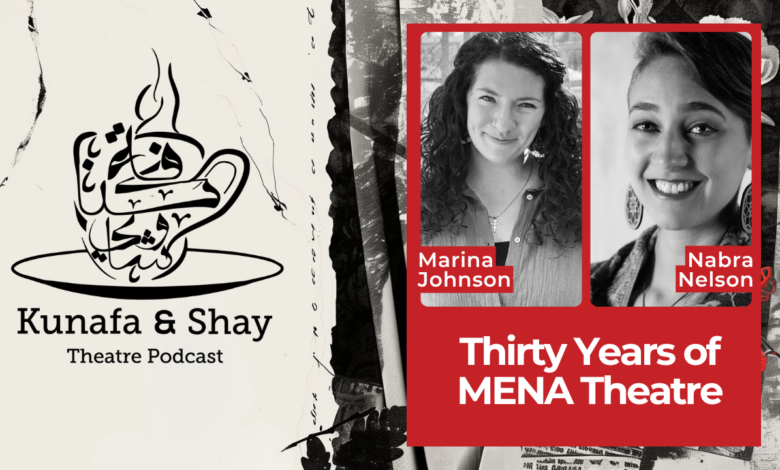
Nabra Nelson: Salam Alaikum! Welcome to Kunafa and Shay, a podcast produced for HowlRound Theatre Commons, a free and open platform for theatremakers worldwide. Kunafa and Shay discusses and analyzes contemporary and historical Middle Eastern and North African, or MENA, and Southwest Asian and North African, or SWANA, theatre from across the region.
Marina Johnson: I’m Marina.
Nabra: And I’m Nabra. And we’re your hosts. Our name, Kunafa and Shay, invites you into the discussion in the best way we know how, with complex and delicious sweets like kunafa and perfectly warm tea, or in Arabic, shay.
Marina: In each country in the Arab world, you’ll find kunafa made differently. In that way, we also lean into the diversity, complexity, and robust flavors of MENA and SWANA theatre.
Nabra: Season six of this podcast marks a double milestone, the thirtieth anniversary of Golden Thread Productions, the oldest MENA theatre company in the US, and my first year as the theatre’s new artistic director. Across ten episodes, we use Golden Thread as a case study to revisit landmark productions from 1996 to 2026, and trace shifting tropes, political urgencies, and aesthetic strategies that shaped the company’s early decades.
Marina: This season also expands to reflect on the past three decades for MENA theatres across the US—not as a closed chapter, but as a living archive, one that illuminates where we’ve been and where we’re headed.
Nabra: We’re back for season six, and we are recording in the same place for the very first time ever.
Marina: That’s not entirely true, because we recorded at MENATMA like two or three years ago with people, but now we are sitting together in Nabra’s living room in the Bay where we both currently live for a brief time together. Okay, we don’t live together.
Nabra: It would be nice if we did.
Marina: It would.
Nabra: But no, she’s going to move to Palestine again. So for now, we are in the Bay for a brief and beautiful period of time.
Marina: Yeah. So here we are with season six. I’m sitting with the new Artistic Director of Golden Thread Productions, which was where the impetus for this season came from.
Nabra: Yes. Before Marina knew that I had gotten that job, I pitched this season to her.
Marina: We really went back and forth for a long time about what would be a good season six.
Nabra: Because we wanted it to not be focused on the fact that I’m the new AD, but rather, you know, a season on its own merit that was of interest to a wide audience. And so this episode especially is going to cover a lot of different theatres across the US. And then the rest of the season is going to hone in on Golden Thread, but mention and talk about what was going on across the US in MENA theatre at the time. So before Middle Eastern theatres, I mean, stories even just had a place on the US stage, before Arabic names could be spoken without explanation or apology, there was a noticeable absence in American theatre. And that absence was not accidental. It was shaped by stereotypes, erasure, and deep misunderstanding. So artists didn’t wait for a space to be made for them. They made it themselves.
What emerged wasn’t just a collection of companies, but an ecosystem rooted in refusal, imagination, and community.
Marina: And what we want to do with this episode is talk about what it means to found something because you have to. Because the stories are urgent, the stakes are real, and waiting for permission is not an option. So we’re looking at the rise of MENA and SWANA theatres in the United States, starting with Golden Thread Productions in San Francisco, which was the first, and moving through the past thirty years to the present moment. Along the way, we’ll explore how these theatres responded to misrepresentation, carved out space where truly none existed, and insisted again and again that Middle Eastern stories are not marginal or optional, but central to the American theatrical landscape. What emerged wasn’t just a collection of companies, but a powerful ecosystem rooted in refusal, imagination, and community building.
Nabra: It’s easy to think that much SWANA cultural production in the United States began in a post-9/11 world, but Golden Thread began in 1996, five years before 9/11. It was still urgent in the nineties and before.
Marina: I was seven years old when Golden Thread Productions began, so I don’t remember a world where representation wasn’t a buzzword. And for a while, diversity seemed like tokenism at best.
Nabra: The lineage of Middle Eastern theatre companies in the United States began in 1996 in San Francisco with the founding of Golden Thread Productions, the first professional theatre company in the country dedicated to Middle Eastern voices, founded by Torange Yeghiazarian. Golden Thread emerged as a response to decades of absence and distortion on US stages, where Middle Eastern characters were largely confined to caricature, villainy, or abstraction. By insisting on complexity, cultural specificity, and self-representation, the company laid critical groundwork for what would become a broader national movement. In the early 2000s, this impulse spread geographically and aesthetically.
Marina: The attacks of September 11, 2001 did not create the problem of Middle Eastern representation, but they did radically intensify its stakes. Increased surveillance, racial profiling, and public hostility made cultural production both more dangerous and more urgent. So we’d love to start with a theatre that we’ve talked about before that emerged in 2002, so very shortly after 9/11, and it’s gone through several names. So it started as Silk Road Theatre Project in 2002, it changed its name to Silk Road Rising in 2012, and in 2024 its name changed to Silk Road Cultural Center. And that Silk Road story continues to inspire us all. Silk Road Cultural Center was founded by Malik Gillani and Jamil Khoury, and Jamil is who you’ve probably heard before on the podcast, and it was an intentional and creative response to the terrorist attacks of September 11. They realized that this was going to shape so much of the US discourse and pose urgent challenges for Pan-Asian, North African, and Muslim communities. So they’ve articulated that this backlash post-9/11 is something that still today underscores their commitment to educating, promoting dialogue, and healing rifts via the transformative power of storytelling.
Nabra: They quickly expanded their focus to encompass the vast territory known as the Silk Road, a network of trade routes stretching from China to Syria and beyond. The legacy of the Silk Road provides us with a narrative from which the core values would appear—discovery, empathy, and pluralism.
Marina: Silk Road Cultural Center taught me a lot about the Silk Road, which I truly knew very little about before working with them for the first time. So this vast trade network began in China, stretched west across Central and South Asia, the Middle East, and into the Mediterranean.
And so from the second century BCE to the fifteenth century CE, these land and sea routes formed a really powerful corridor from the east to the west, linking regions as far apart as Japan and Italy. Of course, silk was one of the famous goods exchanged, but the road itself was just
as significant because that’s where cultural encounters could occur. Ideas circulated, aesthetics were traded, beliefs, artistic forms—this is how they got across continents. So as Jamil often says, the Silk Road is not only a historic geography, but it’s a metaphor. It’s a way of imagining a polycultural worldview shaped by exchange, relation, and movement. If you map it onto today’s borders, the territories connected by this silk road would include nearly two-thirds of the world’s population. Politically, it offers a model of interdependence among neighboring regions that predates European imperialism and these logics of conquest and division that have shaped our borders. So in that way, the Silk Road is an anti-colonial, anti-Orientalist framework that continues to shape how the Cultural Center operates.
Nabra: And its new kind of reinvention as a cultural center from a theatre project to Silk Road Rising, they say this allows them to reimagine their programming within a multidisciplinary and interdisciplinary arts framework. A curatorial approach to connecting creative mediums provides artists of Pan-Asian, North African, and Muslim backgrounds an expansive landscape from which to broaden the American story and honor the historic Silk Road.
Marina: In the early seasons, you can really feel the post-9/11 urgency. I want to touch on two of the plays that I really loved from these time periods. So there’s Mosque Alert, which is written by Jamil—actually, both plays that I’m going to mention are. And then in his play Precious Stones, which is one of the first MENA plays I ever read. It’s about two women, Andrea, who is Jewish, and Leila, who’s Palestinian, and they meet in a Jewish-Palestinian dialogue group and they fall in love. So these actors portray many different characters on stage, but I’d never—when I first read this play, which was the early 2000s—I’d never seen a play that dealt with something that at the time we would call maybe the Israeli-Palestinian conflict, class dynamics, and sexuality on stage. And one of my other favorite things about Silk Road Cultural Center is, long before the pandemic normalized streaming, they were experimenting with digital storytelling and free online distribution, imagining theatre as globally diasporic and technologically nimble. Jamil was on the past episode, as I mentioned, where we talked about the MENA theatre movement today, and it was in the last episode of season one. So harken back if you’re interested.
Nabra: Next, we want to talk about the creation of the ArabAmerican Comedy Festival in 2003 by Dean Obeidallah and Maisoon Zayed, which marked a decisive shift in Arab American cultural production by building a highly visible platform for Arab, Arab American, and Muslim comedians at a moment of intense post-9/11 surveillance and racialization. The festival staged multi-night showcases of stand-up, sketch, and political satire, bringing together performers who directly addressed airport profiling, media stereotyping, US foreign policy, disability, gender, and inter-community contentions, often by naming them explicitly and making them laughable. It toured to major cities, college campuses, and expanded access by foregrounding disabled performers and audiences, and deliberately cultivated an audience that included both Arab Americans and the broader public. In doing so, the festival didn’t just celebrate comedy, it actively trained audiences to hear Arab American voices as sharp, self-aware, and politically articulate. Wow, that’s a hilarious moment to say articulate wrongly. And used humor as this collective tool for survival, critique, and public presence. And it continues to today, so it’s also one of the oldest establishments of Arab or Arab American performance in the US.
Marina: Jumping ahead in the timeline a little bit, so not going linearly in the same way, we have Hilarious Habibis.
Nabra:Hilarious Habibis is a nationally touring stand-up comedy show featuring comedians of Arab, Middle Eastern, and North African descent, produced by Los Angeles-based Syrian-American comedians Lynn Maleh and Gena B. Jones. So women-led, women-created, and often featuring and putting to the forefront women MENA stand-up comics, which is very exciting. So it really brings that female voice to our comedy landscape, but also integrates folks of all genders.
Marina: And Nabra and I have both gotten to see Hilarious Habibis in different places, and the lineup is frequently changing, so check them out because you’re always going to find some very funny folks there.
We’ve talked about this before in maybe season one, but to contextualize the timeline, my favorite book slash documentary film came out in this time around 2006, and it’s by Dr. Jack Shaheen, Reel Bad Arabs. Reel meaning like film, reel, R-E-E-L, but Reel Bad Arabs: How Hollywood Vilifies a People. And in this book, you can really see so far before 9/11, these tropes that surrounded Arab representation. And so whenever we say Golden Thread was starting in 1996, and it was already responding to these misconceptions, like very willful misconceptions, Dr. Jack Shaheen has documented this in pretty vast ways.
Nabra: We started season one, episode one of this podcast, we started with quoting a lot of Reel Bad Arabs. We have kind of more of a philosophical analysis of the world of MENA theatre in the US and beyond. So check that out if you want more of an overview of our kind of philosophies around MENA theatre. Though we’re going to go back into the timeline. Hopefully. I’m sure we’re missing things, by the way. That’s a disclaimer to have.
But, trying to plot the major theatres that are coming out in order, mostly. So going back to
the early 2000s, we have Noor Theater founded in 2009 in New York. And that really reshaped the landscape of American theatre by commissioning and producing specific, formally ambitious works by Muslim and Middle Eastern American artists by moving those works into major institutional spaces. Through its playwrights retreat and commissioning programs, Noor paired writers with dramaturgs and directors over multiple years, emphasizing craft, structure and experimentation rather than topical urgency alone. Just as importantly, Noor cultivated leadership pipelines, mentoring artists who went on to shape programming and decision making at institutions like the Public Theater and Playwrights Horizons. Other New York institutions, especially, ensuring that Muslim and Middle Eastern American presence extended beyond the stage and into the infrastructure of US theatre itself.
Marina: Around this time as well, The Lark had a series produced by Catherine Coray across several years where she was working with Middle Eastern playwrights on these beautiful readings of their plays. I had the chance to see two different play readings there at different points and was really grateful for the work she was doing in creating a pipeline in this way in New York.
Nabra: Yeah, that’s one of those post-COVID things that got cut that we are really missing is the Middle Eastern theatre program at The Lark. It was such an important institution especially for developing new plays by MENA writers.
Going on to another huge and super important institution, New Arab American Theater Works was founded in 2014 in Minneapolis by a collective of local educators, artists, writers, and organizers who saw a deep absence and distortion of SWANA, Arab American, Muslim American stories on US stages and in media and wanted to reclaim those narratives on their own terms. Over the years, they’ve brought at least eight distinct works to the stage ranging from Rosette by William Nour, a coming-of-age story about a Palestinian Christian teenager in Haifa wrestling with loss and identity, which by the way I was in a reading of back when I was part of the inaugural playwrights cohort at New Arab American Theater Works with William Nour.
There’s also Zafira and the Resistance by Kathryn Haddad, who is the Artistic Director of New Arab American Theater Works and brilliantly leads this incredible institution. That play examines anti-immigrant sentiment and institutional racism through the experience of an Arab American teacher confronting a despotic climate. Beyond theatre production, New Arab American Theater Works runs programs like the Playwright Development Program to help writers refine scripts with dramaturgical feedback, which I know was super helpful for me when I was a part of it; Yalla Drum Ensemble, Minnesota’s only Arabic percussion group; and actors training in decolonized performance techniques—creating a vibrant cultural ecosystem where performance, music, and community engagement intersect.
Marina: Another one that we’ve talked about in the past but deserves to be covered again in this sort of lineage, Masrah Cleveland Al-Arabi is a community-centered theatre ensemble which launched in 2018 as part of the Cleveland Public Theatre. Created for, by, and with Arabic-speaking communities in Northeast Ohio to tell their own stories on stage. Rather than simply presenting scripts by outside playwrights, the ensemble develops original work through a collaborative devising process led by ensemble members with CPT facilitators like Raymond Bobgan, compiling personal narratives, family histories, and cultural traditions into bilingual productions performed in both Arabic and English, though I think Arabic is sort of where their bread and butter is. Its inaugural summer event featured community testimonials, poetry, music, dance, and a short original play. In December 2018, the group presented Dream of Home, a workshop production of ensemble-generated stories about belonging and heritage, which evolved into a fully-staged world premiere in the spring of 2019. And then in early 2020, Masrah Cleveland Al-Arabi mounted its first full-length ensemble play, And Then We Met, a narrative about strangers from diverse backgrounds navigating prejudice, family responsibilities, and identity, which went on to tour the Arab American National Museum in Dearborn. Most recently, the company created Seeds of Tomorrow, an evening of short plays developed by ensemble members that continued the group’s mission of celebrating family, dignity, and freedom of expression while challenging stereotypes and building cross-cultural empathy.
Nabra:Seda Iranian Theatre Ensemble was founded in 2019 in Seattle by playwright and scholar Naghmeh Samini and designer and performance artist Parmida Ziaei, as the first Iranian-focused theatre company in the Pacific Northwest. We interviewed them in an earlier season of this podcast as well, so check that out. It was born out of living room conversations about the need to amplify immigrant and refugee voices that too often go unheard. The word Seda means voice in Persian, and from its outset, the company has produced bilingual, community-rooted work that speaks directly to displacement, identity, and cultural memory, while exploring theatre as a way to create a more inclusive space rather than a fixed home. Their inaugural staged production was The Forgotten Historyof Mastaneh, written and directed by Naghmeh Samini, which premiered in 2023 at Taproot Theatre and later at Seattle Public Theater, which they’ve collaborated with since. It traces the lives of young women in post-revolution Iran as they navigate secrecy, war, and the search for autonomy.
Marina: Beyond main stage productions, Seda offers workshops and community events, from introductory theatre workshops in Farsi to playwriting and performance design, building both artistic skill and cross-cultural dialogue. In doing so, they have positioned themselves not just as a company that represents Iranian heritage artists, but as a creative hub that centers immigrant voices on their own terms rather than through stereotype or translation.
Nabra: And Seda was the first Iranian-focused theatre company I learned about when I was in Seattle working with Dunya Productions, which we’ll talk about shortly, but I’m really learning that there are a ton of Iranian theatre companies that are really specifically doing work for their communities in Farsi, but also in English, like Seda. Central Stage in Richmond, California, produces plays, concerts, and multidisciplinary events in both English and Farsi, and part of its mission is also to provide an affordable space for the artistic community through rentals of their theatres. Also in Northern California, Diaspora Arts Connection is Iranian-led and focused, but with an expansive mission dedicated to performance about diverse ethnic groups. I feel like this is a huge realm of SWANA theatre that I’m just not connected to directly due to my cultural experience, and therefore not as familiar with, but it’s a testament to the strong community ties and the importance of the art in Iranian culture that there are so many that we’re learning about as we move forward.
And then to talk about Dunya Productions, which is close to my heart as a founding company member myself. We started in late 2019, early 2020, with the first show was a dance performance called Flood by Jenna Eady, and then COVID hit very quickly after we started, and it was similar to a lot of the other theatre companies we’re talking about here. It started as a living room conversation. I remember, it was like through the grapevine that I learned that some folks are coming together to talk about making a theatre company, and so I showed up at somebody’s living room that I’d never been to before, and I didn’t know most of the people there. I was relatively new to Seattle, and bam, out of that conversation, we started a theatre company, and that became the founding ensemble, and who are still the core members of Dunya Productions today. So once COVID hit, Dunya organized two virtual productions, Letters from Palestine in the Time of the Virus, and Loved Ones: Families of the Incarcerated, which Hanna Eady and Edward Mast compiled from verbatim interviews from people in Palestine at the time, both illuminating the Palestinians’ existing struggle, as folks who have been experiencing so many of the lack of freedom that others in the world were experiencing for the first time due to the COVID pandemic, as well as how the COVID pandemic was additionally causing systems of oppression to manifest even more strongly than they already had across Palestine. And then we also co-pro’d with Medina Theatre Collective to present The Shroud Maker by Ahmed Massoud, which was a really exciting collaboration. Medina is a Chicago-based theatre company, MENA Theatre Company, that really toured The Shroud Maker as a virtual production in co-production with a variety of theatre companies at this time. Since then, Dunya Productions has had three in-person main stages, starting with my show, Nubian Stories, which was a living room tour across the Puget Sound region, The Return by Hanna Eady, which has also performed nationally and internationally. And then they also continue with and are expanding their operations to be more multidisciplinary, which really has been at the core of Dunya Productions and its state, you know, intentions with its mission since the beginning by expanding to do a monthly film screening series, which started with Severed, a short film by Donkeysaddle Projects, and I also got to screen my short film, Nabra’s Anklet, while I was there for Almond’s Blossom. So, it’s really become a hub for a lot of different MENA and SWANA arts in the region. Since then, Dunya has produced three in-person main stages, so far, starting with my show, Nubian Stories, about my mom’s displacement journey as a Nubian woman that toured living rooms across the Puget Sound area, and then The Return by Hanna Eady and Edward Mast, which was our inaugural production inside the theatre space that Dunya is now in residence in, which was actually a historic Jewish school. And then it became an Islamic school, and now it’s being fully renovated as a cultural center, which is really exciting, with a full-fledged theatre inside of it. And most recently, in fall, we had our main stage production, Almond’s Blossom in Deir Yassin, written by Hanna Eady.
Marina: Yes, and I was so excited because I was back in the states and I was able to go see Nabra perform in this piece. So, Nabra will always say now that she is not taking to the stage, but it was such a joy to see her act in this production because, first of all, she’s an amazing actress. She’s great in all of these theatremaking ways. But to see her in this play with Dunya Productions, to get to meet all of these company members who I’ve heard so much about and who have been doing such great work in Seattle, was truly a joy.
Nabra: That’s so sweet. Thank you. Yeah, it was wild to come back to the stage. It’s been quite a while since I’ve performed, especially in a full production, but I was really honored to be able to do that in this particular show, returning to Dunya Productions after moving out of Seattle and seeing where the company has come, especially in its new space, fully renovated theatre, and it’s working towards continuing and expanding the company and its operations, including with a monthly film screening series, which we launched while I was there with my short film. And they’re continuing that work with MENA and SWANA Films. So Dunya Productions is really looking to expand, like Silk Road Rising or Silk Road Cultural Center now, to be this multidisciplinary space for arts and activism. And it really has become a hub for local artists and activists and co-productions across cultural communities within the Seattle area.
Marina: As Nabra mentioned, Medina Theater Collective is in Chicago and is a Chicago-based group. So she mentioned the co-production with Dunya Productions. It’s also worth mentioning some of the other pieces that they’ve done, The Hijabis by Rohina Malik, which was in partnership with Broken Nose, My Name is Inanna, Scenes from 73 Years was a Zoom production, and then they’ve done other staged readings and other productions on Zoom as well. Chicago really has, as we know, an excellent storefront scene that has changed since COVID, but also has a lot of our Middle Eastern friends and loved ones as part of it.
Nabra: One company we need to mention that’s no longer in operation, but was really influential, especially in the early days of MENA Theatre, is Nibras in New York. It was founded in June 2001 as an Arab-American Theatre Collective. The name came from the classical Arabic word for lantern. Their mission was to create a network for Arab-American theatre artists to share their talent, experience, and passion by staging imaginative and articulate productions that increase the positive visibility and creative expression of Arabs and Arab-Americans. It’s stated on their website, “it is our belief that by fostering an understanding of the Arab-American experience in America, we can begin to create a greater understanding between all the communities that form the rich and intricate web of American culture.” It was founded by Maha Chehlaoui, who was its artistic director. Leila Buck, Omar Koury, Omar Metwally, Afaf Shawwa, and Najla Said, who’s the daughter of the late Edward Said, and they were really forming that as a collective. Their first show was Sajjil or The Record, which was a documentary theatre piece based on interviews with a wide cross-section of Arab-Americans documenting the breadth of the Arab-American experience at that time. So those are the MENA and SWANA theatre companies that we know of, but we’re actually certain that there are more, and we have an opportunity now to learn about a bunch of new ones through the MENA Theater Makers Alliance New Fund.
So the MENA Theater Makers Fund is supported by Alternate Roots, National Association of Latino Arts and Cultures, First Peoples Fund, the Wallace Foundation’s Advancing Well-Being in the Arts Initiative, and in partnership with the National Arts Regranting Partners. This program offers general operating support and cohort-based engagement to under-resourced theatre organizations that support and uphold MENA communities. Through an open application process, MENATMA will award eight hundred thousand dollars in total funding, awarding thirty thousand to forty five thousand dollars each in unrestricted funding to theatre organizations across the US, and that includes organizations as well as ensembles. Awardees will also have a small amount of additional funds that they will distribute directly to artists in their community, selected by their awardee. And, you know, I was a part, I’m part of the MENA Theater Makers Alliance board, so I was a part of those conversations as we were figuring out how to distribute this fund and organize it. And the idea of making sure that we are trusting those companies and their knowledge of their communities and artists was super important. And also making sure that we are learning about new ensembles and companies through this fund. That was really integral to the creation of this fund because we don’t, you know, the board members, we don’t know everyone. We’re a tight-knit community, but there’s so, there’s so much to do. And so, you know, I think it’s really important to so many companies that are really grassroots, that are working within their own languages, that are really hyper-local, and we want to make sure that they have access to that, this funding, in addition to all of the theatres that we have mentioned in this episode.
Marina: Well, and this one’s not a theatre, but it’s worth mentioning, Nabra, because Nabra and our good friend Sarah Fahmy are both working on a project right now that is, well, actually, Nabra, why don’t you just tell us about it?
Nabra: So this is an example of an artist ensemble that’s MENA-focused. HERitage emBODYment is an arts ensemble I co-founded with Dr. Sarah Fahmy, who’s right now a professor at Florida State University and one of the preeminent MENA theatre researchers in the nation, but is also a performer and creator. And so we’re creating a devised theatre performance that’s going to tour the nation that’s supported by the National Theater Project grant through the New England Foundation for the Arts. So we found, you know, we couldn’t do this new project, this national tour that we called Sekmet Unraveled, without this kind of major funding. And it’s super exciting to see that the MENA Theater Makers Alliance has this opportunity to expand, to support MENA theatres across the US to make it so that they can be sustainable. A lot of these theatres are living room created, as we talked about. And it’s, you know, I know firsthand that going from the living room to, you know, regular productions and main stages is incredibly difficult. And it basically relies on funding because the spirit is there, the energy is there, the people are there, but we need the money to make sure that we’re paying artists properly and working within these sometimes very expensive cities. And so this is a huge leap for MENATMA. And then we’ll lead into membership, which will also be launched this year. And so that will help us all understand the breadth of MENA and SWANA theatres, ensembles, and individual artists in the United States.
Marina: Yes, because today we’ve given an overview, but we didn’t even mention things like Meem Collective, founded by Amal (Bisharat) and Bahar (Royaee), close friends of ours. And that project is where I’m dramaturg-ing Mornings in Jenin Musical. So there are so many groups past who we are, you know, are part of this lineage who we probably have not covered today and creating work now, but we’re excited to be able to include them in future seasons. And for this season, as we’re looking back at the past three decades of Middle Eastern theatre in the United States, we really just wanted to try to cover in one episode as many as possible and really look at the breadth and depth that we are so lucky to be able to sort of stand on now and to see where we’re going to continue to go together. So for the rest of the season, we’re using Golden Thread Productions as a case study to explore what MENA and SWANA theatre has looked like for the past thirty years, which is a pretty huge endeavor to undertake. So we hope that this at least is going to give a snapshot of how theatre looked and has evolved in the recent past and what it might look for our next thirty years as well.
Nabra: As I step into the role of Artistic Director at Golden Thread Productions, which is still a sentence that feels completely unreal to say, I am unendingly struck by the profound impact of this theatre. It paved the way for MENA theatres across the US. It gives opportunity to artists who would not otherwise have it. It sparked national solidarity among MENA theatre artists. It really put us on the map. And the more I do the job, the more I’m also struck by how
this is also a small and scrappy theatre like the rest. It’s a bunch of people just trying to make art, wanting to make art, and making it as much and as best as we can. It still feels like a community coming together to do something because we know we need it. I can feel that spirit now, even thirty years later. I think we all have the experience, just doing theatre, just putting something together, that excitement, that struggle, and knowing that this is somehow profound and important, even though it also feels so silly sometimes. And I just love that feeling. I think we sometimes lose that feeling when we start losing sight of the love of the art. For me, that came up the more and more I got caught up in the business of art, especially as I worked at these huge regional theatres. And I’m sure it will keep happening since the business still has to happen. But as long as the creating as community is still ever present among the business of it all, that’s what I want. And that’s why I’m so excited to be stepping into this role at this particular theatre, and why I’m so excited to be focusing on Golden Thread for this season.
It will illuminate so much of what MENA Theatre has looked like. And meant to the whole theatre landscape across the United States.
Marina: Yes. So we’re very excited for season six. We’re excited to see all that being artistic director of Golden Thread has in store for Nabra, and that she has in store for Golden Thread. And we look forward to sharing this season with you. Let us know what companies we have missed so that we can make sure we include them in future episodes and seasons.
Nabra: This podcast is produced as a contribution to HowlRound Theatre Commons. You can find more episodes of this show, and other HowlRound shows, wherever you find podcasts, including on noncommercial open source apps like Anytime Podcast Player for iPhone and AntennaPod for Android. If you loved this podcast, please share it with your friends. You can find a transcript for this episode, along with lots of other progressive and disruptive content, on howlround.com.
Marina: Have an idea for a meaningful podcast, essay, or TV event that the theatre community needs to hear? Visit howlround.com and submit your ideas to this knowledge commons.
Marina and Nabra: Yalla! Bye!