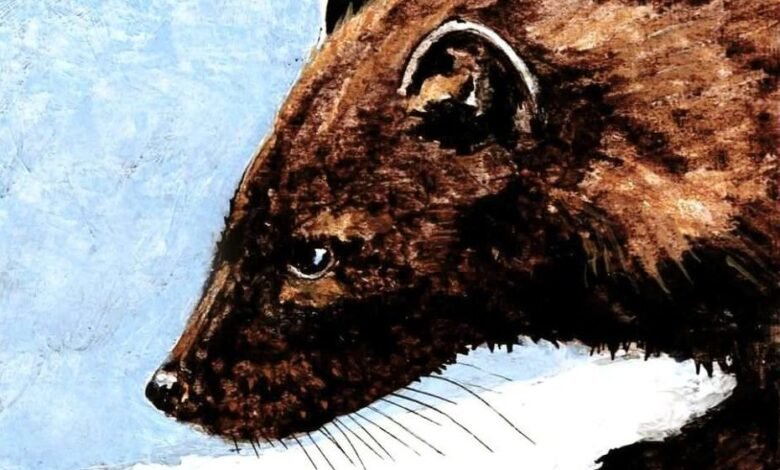
 Fishers (Pekania pennanti) have a reputation as the northern forests’ ultimate misanthropes.
These mesocarnivores are so territorial that within six to eight months after their birth, young fishers are unceremoniously pushed out of their mother’s home range to fend for themselves.
This forced eviction leads to some of the most impressive “marathons” in the animal kingdom. While the average fisher disperses approximately 12 miles from its birthplace by early autumn, University of New Hampshire’s Rem Moll noted that some explorers go much further.
Moll, an associate professor of wildlife ecology and management, has been applying quantitative methods and geospatial modeling to better understand fishers, among other mammals, over the past decade.
“It is remarkable how far they move for a small animal,” Moll said. He recently documented a female that trekked at least 73 miles (straight line) from Durham to Lincoln, New Hampshire, in just two weeks – a long-distance record. Another study in the 1990s recorded a 66-mile movement in Massachusetts.
So, with home ranges that can span up to 30 square miles, fishers rarely cross paths by accident. It takes a specific, biological imperative to bring them together – a moment that arrives in the winter woods of late February and March, in an encounter that is exceedingly brief and unromantic.
“During the breeding season, the males start running around looking for a female,” said Jacob DeBow, a regional wildlife biologist with New Hampshire Fish and Game, who was 15 when he spotted his first fisher and has been spellbound by them ever since. “They spend a short amount of time together. They breed pretty quickly, and then he’s onto the next one. His only job is just to move genetics across the landscape as widely as he possibly can.”
If the male’s contribution is a sprint, the female’s is a marathon of patience, starting with a unique evolutionary strategy called delayed implantation. While a fertilized human egg implants in a mother’s uterus within days, fishers – along with their cousins the black bears – press the pause button.
The fertilized egg, or blastocyst, does not immediately attach to the uterine wall. Instead, it enters diapause, a state of suspended animation where it remains for the next 10 to 11 months.
Thus, for nearly a year, the female carries the spark of life within her, yet she is not “officially” pregnant. As DeBow said, this gives her time to work on “her personal health goals, to fatten up and to get healthy” over the coming spring, summer, and fall – without the nutritional expense of growing an embryo – before heading into the hardest months of winter.
“Then, in January or February of the following year, hormones trigger the blastocyst to attach,” said Kayla Shively, a conservation ecologist with the Wildlife Conservation Society. This hormonal alarm clock kicks off a remarkably swift gestation of roughly 40 to 60 days, ending with the birth of one to four blind and vulnerable kits.
 The sequence creates a critical and rare biological overlap. Because the blastocyst waits so long to wake up, implant, and develop, the female gives birth to one litter just as she is ready to conceive the next.
“Most species don’t ovulate while they’re nursing,” DeBow explained, “but fishers are unique. She’ll have her young in a den and can breed almost immediately, all because of that delayed implantation.”
This grueling schedule is a masterclass in phenological timing. By delaying the “true” pregnancy until late winter, the fisher ensures her kits arrive exactly when the northern forest begins to stir.
As the snow recedes in March and April, the subnivean tunnels of mice and shrews are exposed, and the forest floor becomes a high-energy buffet of emerging shoots, leaves, early berries, insects, and returning birds.
As Moll noted, this process may be regulated by the increase in photoperiod; the lengthening days of late winter signal to the female’s body that the world is waking up. It is a nutritionally rich window that gives the kits a full summer to grow, hone their hunting skills, and prepare for the inevitable lean months of their first winter.
Read more about fishers in New York State.
Jack Beaudoin is a frequent contributor to Northern Woodlands and a Maine Master Naturalist. Illustrations by Adelaide Murphy Tyrol. The Outside Story is assigned and edited by Northern Woodlands magazine and sponsored by the Wellborn Ecology Fund of New Hampshire Charitable Foundation: nhcf.org.
Source link