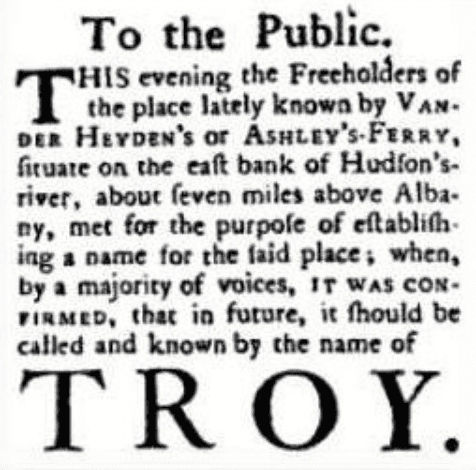
 On January 5th, 1789, a group of colonial settlers living along the east side of the Hudson River north of Albany in an area known as Vanderhyden gathered at a local tavern. Their purpose? To select a new name for their old Dutch community – Troy.
From the Mohican lands were Troy grew, the Hudson River and Atlantic seaboard, the Hoosac River, Lake Champlain, the St. Lawrence River, the Mohawk River, the Great Lakes, and were all within reach – even in prehistoric times.
In 17th and 18th centuries, Manhattan, New England, New France, and the Haudenosaunee (Iroquois) nations became increasingly accessible as New York’s road network spread.
European settlement of the area began across the Hudson ten miles south after the construction of Fort Orange by the Dutch in 1624. Beginning in 1630 land extending more than twenty miles around the fort on both sides of the river was negotiated from Indigenous people for merchant Kiliaen van Rensselaer’s feudal manor, Rensselaerswijck.
Settlers in Rensselaerswijck were lent livestock and a house and barn, but were required to pay rents, keep their homes, barns, and fences in good repair, and fields planted.
Rents might include money, labor, beaver, wampum, or a portion of the farm’s produce. Local mills, owned by the Patroon but operated by others, held a monopoly on milling grains and sawing lumber, two industries that would come to sustain the European immigrants who would arrive.
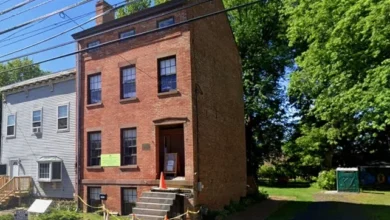
In 1707, the old farm of Pieterse van Woggelum (established in 1671) was conveyed to Dirck Van der Heyden who was then taking over the best lands along the Hudson. Before it took the name Troy the community that stretched from the Poesten Kill north to the Piscawan Kill was known as Vanderheyden, or Ashley’s Ferry for the ferry and inn on the river there.
In 1789, inspired by the legendary Greek city from Homer’s Iliad, new settlers mostly from New England – “locusts of the east” – rejected the old Dutch name and declared in newspapers in Lansingburgh and Albany that they should be called Troy.
The name was part of a contemporary trend of choosing classical names for New York settlements (such as Rome, Syracuse, Ithaca, and many others).
Migrants from along the Hudson River and New England began streaming into Troy and it was made a township two years later in 1791. Troy was became a village in 1801 and was chartered as a city in 1816.
The Erie and Champlain Canals (ca. 1825) boosted Hudson Valley commerce and Troy became a temporary destination for many immigrants moving west.
Industry followed the community’s mercantile roots and by the 1840s Troy was the 16th largest city in America and the 4th wealthiest per capita. The city‘s population reached around 75,000 by 1910, when the community began a long stagnation as its industries moved west as well.
A recent Troy Story podcast covered the history of the founding of naming of Troy in 1789 and more. You can listen here (9 minutes).
Read more about Troy’s history.
Illustration: A newspaper announcement run in Albany and Lansingburgh newspaper’s announcing the renaming of Troy, January 1789.
Source link