 I attended Poughkeepsie’s progressive private school until I was half-way through the third grade. Then our teacher so offended my sensibilities, by not getting angry even though I had thrown a roll of newspapers onto her desk and overturned an inkwell, that when my mother picked me up from school I said, “I want to go to a real school, where the teachers get mad.”
The next day I was enrolled in Poughkeepsie Public School No. 8, Governor George Clinton Elementary School.
Clinton School was everything I had been taught — by such authorities as Mark Twain, the Our gang movies, and the Sunday funnies — to expect of school. The teachers were called Miss This or Mrs. That. (Hearing a teacher’s given name was as disconcerting as seeing her slip showing.)
Their power in the classroom was absolute; a serious infraction of the rules called for a visit to the principal’s office. These were the trappings of authority I had been missing. The fact that the teachers at Clinton, though strict, were kind, and that Dr. Franklin Butts, the principal, seemed to enjoy having friendly chats with the malefactors who visited him, did not offend my sense of propriety.
Compared to the Poughkeepsie Day School, Clinton may have been conservative pedagogically, but it was just as socially progressive and, in its own way, just as eccentric. In an era of conformity when it was a matter of self-preservation for public school educators to fly below the radar of conventionality, the faculty at Clinton School were remarkably willing, at least in their own small domain, to challenge prevailing attitudes.
Pigs and Toll House Cookies
The Poughkeepsie School System at that time required elementary schools to include in their curricula a weekly woodworking class for the boys, called Manual Arts, and a cooking class, Home Economics, for the girls.
When I was in the fifth grade — that would be 1949 — Clinton School instituted two after-school extra-curricular activities: a Home Economics Club for the boys, in which we did nothing, as far as I can remember, but bake batches and batches of Toll House cookies,” and a Manual Arts Club for the girls, in which, I presume, they made cutting boards shaped like pigs to be brought home for Mothers’ Day, just as we boys did during school hours.
I have no idea whether there were any parents who particularly approved or disapproved of these role reversal activities or saw them as significant in any way. To us students, the idea of boys being taught cooking and girls being taught carpentry was comical almost to the level of slapstick, like something out of Abbott and Costello or Laurel and Hardy, and we participated enthusiastically.
Learning to Dance with Kate
Another extra-curricular activity at Clinton School was an evening ballroom dancing class for sixth graders, held in the gymnasium. A local piano teacher, Mrs. Swartz, came once a week with a stack of phonograph records and taught us to recognize a waltz from a fox-trot and shuffle our feet accordingly.
At the end of the school year the entire sixth grade was invited to a dance in the gymnasium, hosted by Mrs. Swartz. There were Toll House cookies and lemonade; folding chairs were lined up against walls, facing each other. Instinctively, the girls occupied one row of chairs and the boys, uncomfortable in ties and jackets, the other.
Before Mrs. Swartz had put on the first record the two classroom teachers, Miss Murphy and Mrs. Dubois, who were acting as chaperones, made their way down the row of boys, engaging each in a brief, earnest conversation. When it was my turn, Miss Murphy and Mrs. Dubois, crouching down to eye level, quietly suggested that I ask Kate Espinosa to dance once or twice.
Kate Espinosa was a quiet girl, smart, pretty and well-liked. Also (thanks to the neighborhood ghettoization which Poughkeepsie shared — and still does — with most cities) she was the only Black student in Clinton’s sixth grade.
As soon as Miss Murphy and Mrs. Dubois made their suggestion, I became aware of my own unconscious, involuntary reticence and of its absurdity. Evidently, I wasn’t the only boy similarly enlightened. Kate Espinosa’s patent leather shoes were trod on that night as often as were Ada Towner’s and Vicky Van Hout’s.
What Mr. Bartlett Taught Us
In preparation for high school, the seventh and eighth grades in the Poughkeepsie school system were departmentalized, meaning that we had a different teacher for each subject.
One notable thing about our history teacher, Mr. Bartlett, was that he was a Mr. — one of only two males on the faculty. But even more notable was that Mr. Bartlett looked and behaved like a college professor (that is, like a college professor as imagined by Hollywood at the time).
Unlike our science teacher, Mr. Dubois, who was sloppy, often unshaven, and seemingly as uncomfortable in a tie and jacket as we were when called upon to “dress up.”
Mr. Bartlett, grey-haired and well groomed, seemed perfectly comfortable in a three-piece suit which — sometimes even with a bowtie — was his every-day attire. It dawned on me many years later that Mr. Bartlett was a political conservative.
Although, like Marx and many historians, both then and now, he believed that history was based on economics. The American Revolution was not about freedom, according to Mr. Bartlett, but
about trade. The Civil War was not about slavery, but about competition between the industrialized North and the agricultural South.
Since these views were different from those of our textbooks, the basic principle that we took away from Mr. Bartlett’s class was not his economics-based conservatism, but a healthy skepticism.
The Messiah and Gov. George Clinton School
Another example of the iconoclastic spirit which was a hallmark of Clinton School seems so archaic, with roots in the Protestant Reformation, that I can’t classify it as either conservative or liberal.
Mrs. Miller was our fifth-grade teacher. I don’t know to what particular evangelical sect she belonged, but she actively proselytized us — in a way she may have thought was subtle — by taking every opportunity, no matter what we were studying at the moment, to mention Jesus.
She was a wonderful teacher, nevertheless. Mrs. Miller was the first teacher I’d encountered who seemed to love books as much as I did. Once a day she would move her chair away from her desk to a sunny spot under the windows and read us a chapter from one of the Anne of Green Gables sequels.
One day around Easter the entire school gathered in The Auditorium to hear Handel’s Messiah – not with live performers, just the record player hooked up to loudspeakers. It started off simply as another Assembly to squirm through, but for Mrs. Miller’s class, at least, it became a most interesting event when, at the start of the “Hallelujah Chorus,” Mrs. Miller alone in the entire auditorium solemnly rose from her seat.
After some hesitation, most of her class also rose to their feet. We Jewish kids – there were seven of us in all – glanced uneasily at each other. As for myself, there was no question about what we should do: I shook my head “no.” In the event, the Jewish girls stood up and the Jewish boys, except one boy considered a class “goody-goody,” who remained seated.
We knew — me, Eddie Horowitz, and Mikey Stern — that our refusal to rise for the Hallelujah Chorus would not be overlooked by Mrs. Miller. If nothing else, it would give her an opportunity to mention Jesus. We weren’t afraid we’d be punished — even at that age we were aware that by constantly harping on Jesus, Mrs. Miller was skating on thin ice — but we did expect to be singled out in some way when we returned to our classroom. And singled-out we were.
“I would like to commend the Hebrew boys who remained seated,” Mrs. Miller said. Since the Hebrews did not accept Jesus as the Messiah, she explained, and were still waiting for their own Messiah to appear (that was news to us, incidentally), by remaining seated we had shown the courage of our convictions.
(We may have called to mind Mrs. Miller’s sectarian forbearers who had gone to the stake for similar acts of nonconformity.)
While it certainly was embarrassing for ten-year-old boys to be praised by their teacher in front of the whole class, Mrs. Miller’s implied rebuke of those annoyingly well-behaved girls who, for once, turned out to have done the wrong thing, and of that the goody-goody, was delicious.
The Germans and George Washington Carver
At another Assembly, the men’s chorus of Germania Hall was brought in to serenade us. Germania Hall was, and still is, Poughkeepsie’s German equivalent of its Italian Center, Hellenic Center and Jewish Center.
Fearing retribution, it had closed its doors during the Second World War. The 1947 performance of the Germania Singing Society at Clinton School was a coming out event for Poughkeepsie’s German-American community.
In fourth grade we were assigned our first full-length books. Although the student body at Clinton was 99% middle-class white, the second book we were given to read, like the fourth
graders at Franklin School and Warring School in the north side ghetto and unlike the fourth graders at Krieger and Smith — was a biography of George Washington Carver.
This was in 1947, mind you. This proclivity to set principle over expediency at Clinton School was not prescribed from above in diktats from Washington, the teachers’ union or the Poughkeepsie Board of Education. The faculty at Governor George Clinton School simply felt that their students deserved as broad an education as possible; if that meant bucking a few trends, so be it.
Although now a self-described “grumpy old guy, still living in the Hudson Valley,” Sanuel Reifler retains says he retains the lessons he learned at Goveror George Clinton Elementary School.
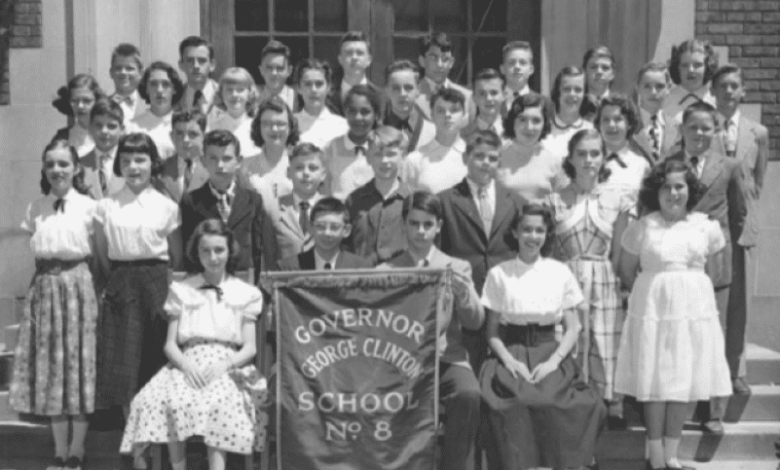
Photo: The graduating eighth grade of Governor George Clinton School. The author (in jacket and tie) is in the second row, third from the right.
Source link