The real estate industry sees the world entirely differently from politicians.
Business people think about economics. Elected officials think about political consequences.
I was reminded of this by a developer’s perfectly reasonable response to my Daily Dirt newsletter about 485x resulting in fewer — and more expensive — apartments:
“If NYC really wanted more housing units, there’s a simple solution — create an incentive structure that rewards higher density. Instead, they’ve done the exact opposite by penalizing higher density.”
Why would government create its own headwinds? Why undermine the objective of your own program?
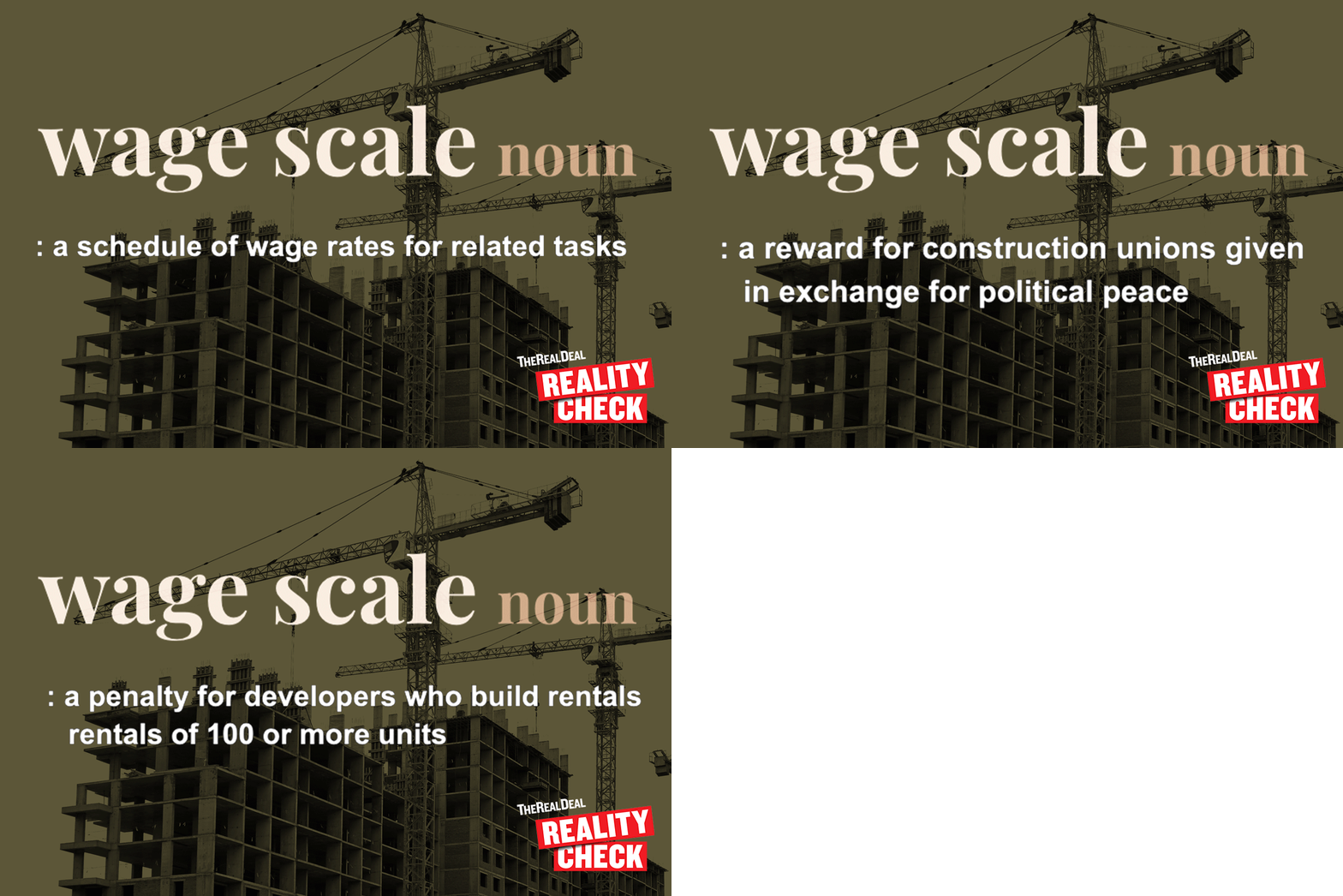
Let’s go back to that word, “penalize.” That’s how I would expect a developer to describe a clause that forces their contractors to pay wages of more than $40 an hour on 485x projects of 100 units or more.
But politicians don’t see higher wages as a penalty. They see them as a reward for a constituency, in this case construction unions.
Which raises the question: Why are these unions — whose members include many Trump voters from the suburbs — so important to elected Democrats in New York City? Why would these unions get priority over the housing shortage?
Elected officials don’t want construction workers protesting outside their office or blasting them at a City Hall rally. Electeds especially don’t want a primary challenge from a union-backed candidate.
All three of those things might have happened if they passed 485x without the wage floors that kick in at 100 and 150 units. Would these actions have cost anyone an election? I doubt it. How many recent elections have been decided by construction unions? Probably none.
They have, in my view, less power than politicians think.
But no legislator wanted that risk or that headache. They knew that if they approved the 485x wage scale, no one would hold a demonstration or stage a primary challenge over something so esoteric. And they were correct.
A few news articles included a single sentence from the Real Estate Board of New York predicting that the new program would create fewer units than the old one, and far less housing than the city needed. Maybe a couple of stories had one critical quote from REBNY’s Jim Whalen, which was of little consequence to state legislators.
The pro-housing movement, for its part, was just happy that a deal got done to replace 421a. It settled for a glass half full. That’s a calculation it might have to revisit.
In New York, the YIMBY group Open New York is growing but still has less political power than construction unions.
What about the real estate industry? It cannot put boots on the ground like unions can. All it can really do to influence election results is fund political action committees, which of late have been entirely ineffective. On occasion it will recruit a candidate.
Real estate people generally spend most freely when trying to defeat socialists. They don’t go after the mainstream Democrats responsible for passing laws, for fear of alienating them. At the risk of repeating myself, that’s a calculation they might have to revisit.
Another factor is that many elected officials likely did not expect the 485x wage floor to cap projects at 99 units. As obvious as that was, most were completely unaware of the possibility. Others assumed developers have such deep pockets or are making such large profits that they would pay higher wages. “Pencil out” is a foreign concept to these officials.
Even for the few electeds who were acutely aware of what they were voting for and its consequences, the $40-an-hour wage for 100 or more units didn’t seem high to them. It’s really not much higher than contractors pay for 99-unit projects.
But just like politicians don’t like to risk getting primaried, developers don’t like to risk penalties or litigation for their contractors’ underpaying. Nor do developers want to hire a third party to handle compliance.
What we have is two sides that don’t speak the same language. They barely understand each other.
Read more

Zero-sum game: 100-unit, mixed-income projects down to nothing

The Daily Dirt: We got 99 problems with 485x

Bad news for developers: Why 485x will remain broken