 On January 4, 1906 The Argus of Albany offered its readers a nugget of political wit. “The insurance office boy who receives your card is likely to reply, nowadays, ‘The boss can’t see nobody. He is busy writing his resignation.’”
New York City lawyer Charles Evans Hughes had just completed his work during the investigation of the life insurance industry on behalf of the state’s legislature (part of the Armstrong Investigation). Hughes, born in Glens Falls, was eager to get as far from the Albany quagmire as possible.
“Charles E. Hughes, counsel to the legislative investigating committee, plans to sail for Europe about Feb. 1,” The Argus reported on Jan. 17. “Mr. Hughes, it is said, intends to rest for a month or more before resuming his law practice.”
There was already speculation that Hughes might run for governor.
“Mr. Hughes, the inquisitor, to whom no witness must talk back, and Mr. Hughes, candidate for Governor, might run somewhat differently in the back districts,” The Argus suggested on Jan. 19.
Over the next few months, reporting in The Argus, a Democratic newspaper, on speculation about the Republican nomination would center primarily on state Sen. Edgar Truman Brackett of Saratoga County and current Gov. Frank Higgins.
Brackett, who announced his candidate on March 19, discounted the potential of a Hughes’ candidacy. “Senator Brackett’s constituents, full of spring water, enthusiasm and buoyancy, repudiate the Hughes claim,” the paper reported on March 21.
On July 4, The Argus said State Senator Alfred R. Page (R-Brooklyn), downplayed published reports that he and Assemblyman Ezra R. Prentice (R-Manhattan) were booming Hughes for governor. “ ‘Nothing to it,’ was the terse comment of Senator Alfred R. Page, who was in Albany yesterday to consult Governor Higgins on a private matter.”
Page had been initiator of a joint Senate and Assembly committee that had hired Hughes to investigate the utilities industry; Prentice had been a member of the committee. Page said that a New York World reporter who contacted him about Hughes misrepresented his response.
“I told the newspaper man that Hughes was all right, that I didn’t know that he was a candidate for the nomination,” Page said, “I didn’t say that I was for Hughes or for anyone else, and I didn’t speak for the Republican organization.”
The Argus continued to occasionally mention the bearded Hughes as a possible novelty candidate. On July 5, the paper suggested, tongue-in-cheek, that Brackett, the state senator from Saratoga Springs, would carry the barbers’ vote if he was the nominee:
“The Saratoga Senator has for years, with devilish ingenuity, kept his countenance smooth shaven. How can ‘His Whiskers,’ the Hon. Charles Evans E. Hughes, reply to an argument like that?”
On July 21, The Argus noted that Higgins and Brackett were the only potential gubernatorial candidates that had delegates lined up for the upcoming nominating convention.
There was still speculation about Hughes, but others doubted it, according to a Utica Press report which The Argus republished: “The Buffalo Commercial … has started a boom for Hughes as our next governor. It hardly seems possible that he could tie up with such men as Platt and Odell, two of the leading Republican bosses.”
The Argus downplayed the chances that Higgins would not run on Aug. 17, by saying “The Batavian News feels that ‘if Gov. Higgins did not desire nomination, he would say so.’ Or whistle, or shake his head, or do something, assuredly.”
The next day it was reported that the Republican leader Timothy Woodruff disputed rumors that Hughes would challenge Higgins for the nomination at the state Republican Convention. “Mr. Hughes will not be a party to any factional strife. He and Gov. Higgins are on terms of highest personal friendship,” Woodruff said.
Gov. Higgins was headed to Lake Placid for a few days of vacation, The Argus reported on Aug. 22. Some still hoped Higgins would run for reelection.
“It is the fervent prayer of the Higgins supporters that he shall come out and declare that he wishes a renomination. They guarantee that if he does so, all the opposition will fade away,” according to The Argus. “Yet the governor hesitates and his enemies laugh and feel assured that he will continue to wabble between doubt and fear till the opportune time has passed for making an effective announcement.”
State Republican Chairman B. B. Odell said he did not know what level of support Hughes might have among delegates to the upcoming convention, paper said on Aug. 24.
“I do not know just how much sentiment there is for the nomination of Mr. Hughes,” Odell was reported to have said, “but I do know that there is a strong sentiment against the nomination of Governor Higgins.”
William Barnes, chairman of the state Republican Executive Committee, announced that he recently met with Higgins and the governor would run for re-election, but did not want to make a fuss about it prior to the convention.
“He never chased after a nomination, and he is not chasing after a renomination,” Barnes told The Argus. “He is a candidate for renomination, but does not demand the hour from the State convention.”
Higgins, still in Lake Placid, would not confirm or discuss his intentions. “I have not directly or indirectly authorized anyone to speak for me as to my future intentions politically,” he said.
There was speculation about whether Hughes would accept the nomination. William C. Warren, state Republican Committee member from Erie County, said he supported either Hughes or state Sen. Frederick W. Stevens of Wyoming County for the nomination, The Argus reported on Aug. 24. Asked if Hughes would accept the nomination, Warren said, “I don’t know anything about that. If it came to him in the right way, I believe he would.”
Some suggested that O’Dell, the state chairman, was touting Hughes as a ruse, in order to keep options open for some other undisclosed candidate. Brackett, the state senator from Saratoga County, still a Republican candidate for governor, contradicted rumors that O’ Dell was pushing his candidacy.
“I am not Mr. O’ Dell’s candidate nor Mr. Anybody Else’s candidate. Whatever support I have is from men who think, or pretend to think, that my candidacy is better than that of the other named,” Brackett said, according to an Aug. 27 report in The Argus.
Charles Evans Hughes would of course go on win election as the governor of New York that fall in a close race against William Randolph Hearst. He enjoyed the backing of then President Theodore Roosevelt.
In 1910, President William Howard Taft appointed him associate justice of the Supreme Court of the United States.
Read more about Charles Evans Hughes.
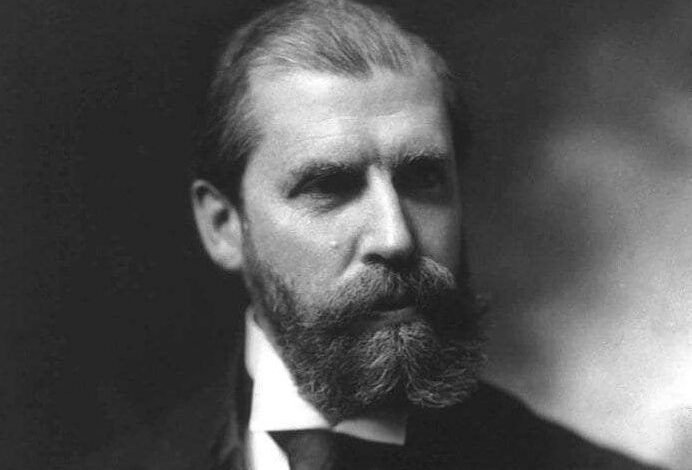
Illustration: Charles Evans Hughes as Governor.
Source link