When it comes to finding the best gifts for three-year-olds it’s all about selecting educational toys that mascarade as good old fashion fun.
“Three-year-olds are pretty smart human beings who are defined by curiosity,” Kathy Hirsh-Pasek, PhD, a psychology professor at Temple University and senior fellow at the Brookings Institution — whose research centers on the development of early language and literacy, as well as the role of play in learning — told the New York Post. “They have mastered language skills to determine how the world works and, while we’re not interested in the slugs, bugs and worms that make up the ground, they are. They’re naturalists.”
Because kids are filled with energy and have short attention spans, toys that keep them engaged while fostering core learning skills are best. We reached out to a variety of child experts, plus members of our team to learn what gifts fit the bill and if we say so ourselves, our list is pretty rad.
Whether you’re shopping for a 3-year-old who loves realistic toy trucks or dress-up, there’s something for every kid on your list.
Click to jump to a specific section:
Meet the experts
Alice Cady, EdM, classroom teacher for 2- and 3-year-olds for 8+ years
“Cube puzzles are a fun way to address in-hand manipulation and fine motor skills as well as problem-solving and visual skills,” Sanschagrin said. “The borders along the outside of the puzzle can help give spatial reference while in the process of building the puzzle.”
To better help your 3-year-old learn about common farm animals they’ll find in preschool and kindergarten, we approve of this affordable toy that’ll keep your little one engaged for hours, too.
“A durable tricycle that will last for several years and can even be passed down to another child is my recommendation,” Pruneda-Hernandez said. “For children just turning three, parents or caregivers should be able to push the child when taking the child out for walks.”
However, the push handle should easily come off when children no longer need that support. Tricycles build children’s gross motor skills, too, according to our expert.
While your little one may be too young to have a social account, they’re not too young to enjoy photography. The durable GoFunly Kids’ Selfie Camera offers various filter settings, a preview screen, and even games to entertain them. A sneaky way to teach finger and hand skills, the device will keep them engaged for hours.
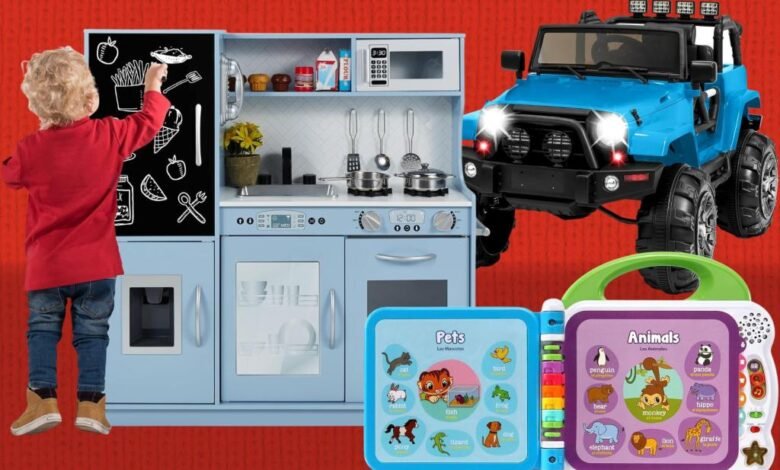
If you’re looking for awesome gifts for 3-year-olds, this pick is worth the money. The best Choice Products Kids Ride on Truck is like a real-life jeep, armed with working LED headlights and fully functioning wheels. Don’t worry about safety. The luxury gift for kids includes a parental remote control, so you’ll be the one truly behind the wheel.
Over a dozen double-sided flash cards give kids a clever introduction to letters, letter sounds, words and sentences — all the essential language building blocks. The device also makes music and has sound effects to accompany the cards, which helps to keep children engaged.
“These electronic flash cards teach kids the underlying concepts of reading,” said Wilmot. By prompting kids to use their fingers to follow the information on each card, Wilmot said this toy also “reinforces letter sounds and vocabulary.”
Colorful and made with silicone, these stackable blocks will delight any child. The building possibilities are endless and they’re great for hand-eye coordination development.
This is the kind of toy that kids intuitively understand better than adults. Each piece is made from a firm foam and can be stacked to create chairs or steps, or used outside to play in the pool or at the beach. They encourage open-ended play and are great to use indoors and outdoors.
“These lightweight, colorful pieces can be used creatively in so many ways to help kids get sensory input that improves their developmental skills,” Wilmot explains. “Scatter them to use like stepping stones, stack them up to serve as a chair or use them for sensory play in the sandbox or the bathtub.”
“Play kitchens ignite children’s imagination and are such a great way to encourage unstructured, pretend play,” said Claire Diamonstein, child therapist and parent coach. “Adding play food to the set opens up even more opportunities for increased fun and creativity.”
Made from non-toxic materials that are easy to clean and easy to assemble, this kitchen set will delight any kid with hours of pretend play opportunities.
Help your child develop a love of learning by treating it like a game. Lingokids The Playlearning App has more than 1,000 fun and interactive activities to help them read, learn math, music, and other useful skills like routines and mindfulness. Voted the number one learning app for kids, you’ll actually feel good about giving your little one extra screen time with this download in your parenting arsenal, and they’ll enjoy learning something new each day.
Kids practice all the fundamentals of setting up and playing games with this car-themed shape and color matching board game. It includes 15 puzzle cards of easy, medium and hard difficulties, so kids won’t outgrow this toy right away.
“This brain teaser for young kids helps them to learn about following instructions even just by setting the game up,” said Wilmot. “Activities like this one include cards that are graded, where kids can experience success and build to more challenging problems by starting off simple and getting more complex.”
Thousands of parents love the play kits from Lovevery which blend learning with fun. The Storyteller Play Kit is a favorite of ours, coming with an assortment of toys for a realistic make believe session. There’s an easy to connect fort set, puppets, plus a theater for them to perform in. Games that allow 3-year-olds to “explore” and “use their imagination” are always a winner, per Pruneda-Hernandez.
Coloring may not seem like a fancy, educational activity but the fun pastime boosts cognitive and motor skills. Bluey continues to be a kids’ favorite character, plus the coloring book comes with five non-toxic coloring markers.
It’s hard to go wrong with a Montessori Toy. This busy board is a small but fun sensory toy that fosters problem-solving, recognition ability and includes lots of flippable switches and lights to keep your 3-year-old occupied.
This award-winning game will be a hit at the next playdate you host. It centers around teamwork, so there are no losers — only winners!
Designed for up to four players, children take turns spinning the spinner and then use counting skills to move around the board to collect chicks. Along with teaching collective decision-making, the fun board game shows mathematics and problem solving.
“I love to read and credit that to my parents who read to me every night when I was a kid,” said Updates Editor, Holly J Coley. “Humans have always relied on stories to teach morals and values, and I’m guessing that’s what my parents were trying to do when they read me books like this. The stories are short, making them ideal for little ones with low attention spans. Also, the illustrations in the book are so gorgeous.”
Practical gifts, like kids’ clothing are great but not very exciting. This 38-piece play set includes a plethora of pretend tools, costumes and a convenient storage box that let kids play doctor for hours on end. It also has specialized dentist equipment, as well as a large set of plastic teeth to brush and clean.
“Role play, or sociodramatic play as it is sometimes called, is perfect for developing empathy and understanding the perspectives of other people,” Harding said. “Imaginative play with super-fun toys like a medical set does wonders for confidence and self-esteem.”
“A variety of musical toys such as the kit above allows children to develop their fine motor skills and their hand-eye coordination,” Pruneda-Hernandez explains. “Kits such as the one above can also grow with the child.”
Whereas a 3-year old may enjoy using the maracas, a four-or five- year-old may be more interested in the xylophone or rhythm sticks. “The kit also allows for more than one child or for an adult to be involved in the musical play with a child,” she adds.
Right on the money, Cady also recommends this play bundle for musical fun.
When it comes to young children, it’s all about making the learning experience fun. These alphabet-inspired blocks morph into robot toys that a child can fidget with while you’re driving or making dinner. Durable and made with non-toxic material, the economy-size pack also teaches sequencing skills.
Young children may not be able to handle a 100-piece plus puzzle but they can handle a 24-piece — especially if the pieces are large enough to hold with two hands. Made with recyclable material and veggie ink, this motor skill building activity will delight your 3-year-old with its bright colors.
Filled with space rocks, foam planets and sparkly poms, there are more than a few items to keep your toddler curious. They can play within the self-contained box for an easier clean-up for you or items can be spread out on the table. The affordable toy for 3-year-olds is not only assists with sensory skills but motor skills while encouraging imaginative place.
This 100 Words Book from LeapFrog makes a fun toy to tuck into your bag. It gives — you guessed it, 100 words for kids to learn, plus offers a variety of categories, ranging from mealtime to opposites to teaching recognition and memorization. The book’s audio allows children to connect certain images to their appropriate names, and it can even speak to them in Spanish. More than 46,000 folks have purchased the best gift for 3-year-olds and rave about its educational value.
Great for encouraging creativity and motor skills, Play-Doh is a childhood classic that any kid would like. We like the idea of buying it in bulk, especially for under $20.
Many children want to cook and bake with their parents. Although 3-year-olds are too young to truly get their hands dirty in the kitchen, a hyper-realistic culinary toy is the next best thing. The pieces of the wooden Make Me A Pizza Toy are smooth and large enough to prevent them from being accidentally swallowed. Play helps kids “flex” their imagination, explains Mierzejewski, so toys where they can engage in active storytelling while working on coordination and organization are a win.
Okay, this gift for toddlers doesn’t include the alphabet, blocks or anything we’ve come to think of as a quality but educational toy. However, playing is educational, especially if it encourages the use of imagination. The Starry Night Air Fort is easy to set up (less than 1 minute) and has a ceiling full of glow-in-the-dark stars for your child to gaze at. If you’re looking for another hot Christmas toy with more of a princess feel, check out the Play Vibe Princess Tent, too ($40).
“This math activity set not only has the educational benefits of a learning toy, but also the developmental benefits of tactile play, so it’s a true two-for-one,” Mierzejewski adds. “It’s packed with tons of activities and facts for kids to learn about turtles, but also provides the tools for open-ended play as well.”
This STEM-based toy includes turtles of three different sizes, six colors, six shell textures and six belly shapes, adding to how it’s a wonderful sensory toy in addition to a learning-development aide.
This game may say it’s for ages nine and up but a Post staffer swears it’s a great gift for 3-year-olds like his nephew, who have a touch of mathematical genius.
“My nephew is a bit of a math whiz,” they say. “Every time he calls, we go over multiplication and long division rather than the latest episode of Bluey. That’s why I’m getting him Proof! A ‘faced game of mental math magic.’ His mom thought it would be perfect for him and I couldn’t agree more based on our brainy conversations.”
Kids can not only build with their favorite Sesame Street character, but they can also color with this set!
“Since there are multiple activities, kids will stay busy for awhile,” Mierzejewski said. “The kid-safe magnetic building pieces are fun for kids to construct with, helping them to hone their spatial awareness, motor skills and more.”
Children’s blocks that allow for a variety of uses in play make great toys, and this Melissa & Doug Standard Unit Solid-Wood Building Blocks is recommended by our expert.
“Blocks should not just be squares but come in a variety of shapes to include spheres, rectangles, triangles and squares so children can build in many different ways.” Pruneda-Hernandez recommends. “Blocks not only provide children the opportunity to enhance their fine motor skills and eye-hand coordination but allows them to problem solve and begin to use their critical thinking while building.”
“Social-emotional learning is so important for 3-year-olds, and this adorable pineapple is great for helping kids identify, recognize, and communicate their emotions,” Mierzejewski notes.
Aside from being adorable and unique, this toy helps develop important coping habits and communication skills that will serve as an important foundation for mental health, too, according to Mierzejewski.
“Crayola’s Color Wonder line is a great gift for kids, not only because of its affordable price point, but because it is a perfect, no-mess, creative art line,” Ali Mierzejewski, editor-in-chief at “The Toy Insider” and childhood play expert, told The Post.
The Color Wonder markers only show on the special Color Wonder paper, so it’s great for traveling on airplanes, roadside restaurant stops, or for kids’ independent playtime as well.
“The Melissa & Doug Mix ‘n Match Wooden Bear Family Dress-Up Puzzle is great for three-year-olds,” Cady recommends. Not to mention, we recommend nearly any toy from the brand as they’re (1) adorable and (2) always a hit with our nieces.
“This puzzle sorter helps build upon self-help skills and pushes toward dramatic play,” she adds.
“The Melissa & Doug Primary Lacing Beads Educational Toy is wonderful for three-year-olds and older,” Cady shares. “It helps develop fine motor skills, patterning, counting and sorting.
For less than $20, you won’t find a more interactive or colorful toy, either. With an included play box, it’s especially perfect for neatly storing in your playroom.
Feed your child’s love of Disney Pixar without sitting them in front of the tablet. The audible download has 17 retellings, each filled with stories of friendship, love, and the importance of perseverance.
The pins and ball in this kid-safe bowling set are made from a soft material that won’t scratch floors or cause any injuries — and because the pins are numbered 1 through 10, they double as a counting and number ordering exercise for children.
Dr. Jacqueline Harding, a child development expert and author, recommended this toy for hours of indoor fun. “When you are three years old, getting moving is one of the main activities on your mind,” said Harding. “There is hardly any time to sit still when there is a big world to investigate! This bowling set is simply great fun and offers a chance to recognize and name numbers and colors.”
“Musical sets are a great way to facilitate those fine motor and bilateral coordination skills,” Sanschagrin notes. “You can practice different rhythms and see if your kiddo can imitate and join in!”
The Stoie’s International Wooden Music Set is less than $40 on Amazon, one that our expert recommends and is backed by more than 5,000 rave reviews. Plus, it includes a tambourine, a castanet, a hand drum, two hand bells, a maraca, a flute, a wooden block with a stick, a wood sounder with a stick and a chime bar with a stick.
Squishmallows can also offer a safe sensory experience, plus they’re very cute.
“The texture often encourages squeezing of the toy which can also offer similar deep pressure benefits as the weighted animals,” Sanschagrin adds. “They make for great comfort items and sleeping companions.”
These colorful toy houses may seem simple, but they’re quite innovative way for children to intuitively practice both counting and identifying and matching colors. Kids can add and remove color-coordinated figures into their respective houses, engage in pretend play and even recreate their own family size by organizing a number of figures to match the number of people in their household.
Rachel Ritlop, a mom and toy review expert, recommended this toys for 3-year-olds. “Kids can use these with a train set, magnetic blocks or other building toys to create a little neighborhood in open-ended play,” she said. “Or you can work on color matching and counting.”
Give kids a screen-free listening experience that sparks their imagination and offers them a wide selection of music and stories. “By placing different collectible characters from their favorite shows and books on top of the Toniebox,” Wilmot said, “kids will love being in control of choosing the songs and stories they listen to.”
This device can be a great way for kids to wind down before bedtime, and its built-in interactivity keeps kids feeling engaged. Plus, once you buy this, you can pick up additional Tonie figurines to give as gifts for future holidays. The starter set, shown here, includes a Playtime Puppy Tonie with 52 minutes of popular children’s songs.
Infinitely reusable and entertaining, these colorful bendy sticks let kids build characters, animals, plants and anything they can imagine, then take pride in their creations.
Diamonstein said these are a favorite at her office. “They offer endless possibilities for creative fun,” she said. “There are a million different ways to use WikkiStix. You can use them for crafting, in imaginative play, as a fine motor activity and even as a fidget tool.”
“Disney toys are always wildly popular, but they are this year, especially with the Disney100 anniversary celebrations,” Mierzejewski adds. “Classic fashion dolls allow kids to engage in creative storytelling and imaginative, open-ended play, and these allow kids to do so with their favorite Disney characters!”
At a great value, kids can build up a whole Disney squad to create their own adventures.
This puppet creation kit includes fuzzy socks, finger puppets and self-adhesive felt patches that bring characters from the classic children’s book to life — and let kids take a turn at telling their own stories.
Yesim Kunter, an independent play consultant who has worked as a designer for LEGO, Hasbro and Toys “R” Us, recommended this kit for 3-year-olds. “Storytelling tools like puppets are great for enhancing children’s imagination and creative thinking, and developing their language skills and future thinking,” she said.
“This delightful toy ismade of wood and is wonderfully calming,” said Harding. “As parents, it is exciting to discover that playing imaginatively has an impressive brain-building result for our children. The brain relishes the opportunity to be creative with play activities like this!”
The set includes an array of ice cream flavors and toppings that kids will enjoy combining (with the option to pile all the scoops together into one mega cone). The pretend dollar bills and menu also give kids the opportunity to role play with their friends, parents or siblings.
“With summer fast approaching, I would recommend gardening and insect catcher toys that parents can easily purchase at dollar stores, Walmart, or Target,” Sonia Pruneda-Hernandez, PhD, acting dean of education and social sciences at Montgomery College —and doctorate of education with a concentration in early childhood education and higher education — told The Post.
She recommended items like a bucket, shovel, trowel and watering can. Specifically, the Play22 12-Piece Kids Gardening Tool Set is one she brought to our attention for fun outdoor play.
This interactive dashboard from Melissa & Doug provides ton of tactile and imaginative play for preschoolers.
“They’ll love to pretend to drive as they move the steering wheel and engage with all of the other interactive features,” Mierzejewski adds. “Plus, it’s PAW Patrol, so it’s a guaranteed hit for your little one.”
This book offers kids an introductory cooking lesson without any mess in the kitchen. The thick pages have hidden pull-tabs and moveable parts that kids can move around as you read to them, imitating the actual motions of measuring ingredients, mixing food and cooking dishes. Other books in the series include pizza, cookies and other recipes.
“The ‘Cook In A Book’ board books have great interactive recipes where kids can lift, turn and shift the pages to ‘cook’ in the book,” said Ritlop. “It also doubles as a real recipe, so when your three-year-old is ready to bring the fun out of the page and into the kitchen, they can follow along.”
An FAQ on the 3-year-old age group, from experts
iStock
Ahead, our team of child development experts provide insight into the 3-year-old age group and what defines playtime at this stage.
What child development skills come to light among 3-year-olds?
Three-year-olds are like 2-year-olds in the sense that they’re moving, but they’re noticing more, according to Hirsh-Pasek. Ahead, she details all of the wonderful learning stages three-year-olds — generally — are up to in age.
They can tell a story well and can run pretty fast (though skipping is far away).
They are much more coordinated, with their body proportions more formed.
They are very conversational and particular. If a three-year-old boy wants milk out of a dinosaur cup, he’s usually referring to a specific cup that you should know about.
They can live in fantasy worlds they create, as well as line up toys and tell a story with them.
They’re “not bad” toward the end of the third year but “great” as they move toward year four.
They are glued to characters like Elmo who serve as conversational agents for them.
They’re pretty dexterous and can put small pieces into large puzzles.
They’re interested in putting crayons on paper.
They like when you read stories to them and can talk about the characters in a book in finer detail.
Their scribbles are becoming more sophisticated and symbolic. To them, things stand for something else: the rocks symbolize the tower they want to build; the drawings begin to turn into family portraits. They start to symbolically represent, and that’s one of the best human development skills — the move toward language and symbolism.
What are the best toys for 3-year-olds?
Of course, every 3-year-old has a different imagination and a different view of play. However, it’s most important to find a toy that suits their needs as they’re becoming more curious by the day.
“I highly recommend toys that allow children to explore, use their imagination and will enable them to hold or use their hands easily,” Pruneda-Hernandez said. “Children should not become frustrated with toys that may not be age-appropriate such as providing a 3-year-old with a fifty-piece puzzle.”
What’s more, parents, teachers and caregivers should always review the manufactures age range for a toy. “Three-year-olds may put toys or items in their mouths, so toys with small pieces that children may swallow are inappropriate,” she adds.
There’s a multitude of evidence recognizing the importance of play in children. According to Sanschagrin, at age three, one of their primary occupations is play which is a massive facilitator of their learning.
“Toddlers are much more likely to absorb new information when using the modality of play. Play is also a great way to process emotions that they might be unable to express or even understand. It encourages creativity and even problem solving!”
Caitlin Sanschagrin, an occupational therapist specializing in pediatrics — specifically, feeding, sensory processing and regulation and neurodivergent-affirming care
Overall, staple toys for the 3-year-old age group would include building toys (like Magna-Tiles and LEGO), shape sorters, drawing and coloring toys (like MagnaDoodle), and open ended pretend play toys (like Little People sets), per Sanschagrin.
How do toys facilitate learning in the 3-year-old age group?
“Toys introduce kids to the foundations of storytelling, coding, creativity, dexterity and more thorough fun and engaging play patterns, so they spark curiosity for a future love of learning,” Mierzejewski explains. “Through play, 3-year-olds can develop their motor skills, start to learn the basic concepts of STEM skills, flex their imaginations, and start to role-play what they see adults doing through pretend play.”
During this age, kids can also start to establish physically active and social-emotional habits early that they will carry with them as they grow.