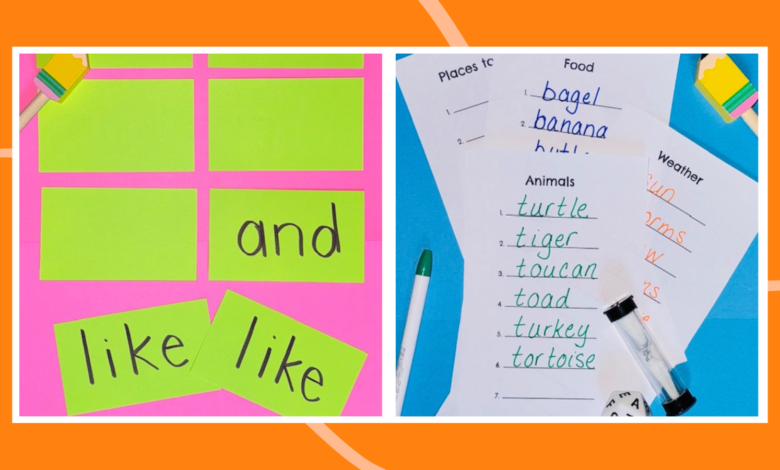
The classroom games you choose to play with students may become their favorite memories. (I still remember playing Heads Up, Seven Up in Mrs. Merar’s 1st grade class!) Classroom games are a great way to build collaboration and community and practice important skills. Plus, they’re fun!
Jump to:
Why play classroom games?
Classroom games capture what kids are naturally good at—playing—to improve other skills. Games support kids’ executive functioning skills. Things like planning, organization, turn-taking, and problem-solving are all skills that students need to be successful. Playing games, from Memory to Monopoly, gives kids experience in focus and concentration, working memory, and flexibility in safe spaces where they can grow and stretch these skills. Plus, they’re a fun way to learn more about how your students think and work together.
Cabrina LaFonte, a veteran special education teacher who loves engaging her students in play, uses games as a routine to wrap up the week. When it’s Fun Phonics Friday, students put the phonics skills they’ve learned all week to use while playing games like Squishyland, a favorite for practicing word reading.
In addition to all the classroom games listed below, check out our lists of most loved educational board games and best board games for 6-to-12-year-olds.
Top 5 Classroom Games
Below are Cabrina’s favorite classroom games. For more great ideas from Cabrina, be sure to follow her on Instagram at @cabrinascreativeclassroom.
1. Reading Jenga
Participants: 2 or more
Time: 10 minutes
Objective: Build the tallest tower you can without letting it fall!
How to play: Jenga is a versatile classroom game. Have students read decodable words, solve a mental math problem, or tell you a history fact before pulling a Jenga block. Or have them write sight words or questions onto the blocks themselves, and when students pull a block, they have to read the word or answer the question.
Why we love it: Kids love playing Jenga, and when you ask the question before each turn, you can differentiate what each student answers.
Buy it: Jenga at Amazon
2. Uno
Participants: 2 or more
Time: 10 minutes
Objective: Read words while playing Uno.
How to play: Put tape in the middle of a standard Uno deck so students read the words as they play.
Why we love it: Uno is a fast-paced game, so adding word reading in builds automaticity.
Buy it: Uno at Amazon
3. UFLI Phonics Games
Participants: 2 or more
Time: 10 minutes
Objective: Read decodable words to advance in the board game.
How to play: Read a word and move forward on a game board, or roll dice to read a word.
Why we love it: If you use UFLI or another phonics curriculum, games are a great way to practice word-reading skills beyond decodables and word lists. The UFLI games app uses game formats (think online board games) to reinforce phonics skills.
4. Sight Word Pop
Participants: 2 or more
Time: 10 minutes
Objective: Read as many sight words correctly as you can.
How to play: Students read sight words and pop bubbles on their fidgets when they read the words correctly.
Why we love it: You can play whole-class or in small groups. Purchase the official game or make your own with a set of high-frequency-word cards and a bunch of Pop-It fidgets.
Buy it: The Fidget Game, Rainbow fidgets, and sight words cards at Amazon
5. Math Tug
Participants: 1 or more
Objective: Solve as many math problems as you can to win Math Tug, an online game of tug-of-war.
How to play: Students complete math problems to compete as teams in a tug-of-war or against the computer. The team with the most correct answers tugs the rope to their side and wins.
Why we love it: It’s a fun way to practice math (there are multiple levels online), and you can set up brackets so students can compete against one another until you have a math tug champion.
Games for Practicing Academics
Classroom games can help students practice things that they need to know—like multiplication tables, vocabulary words, and science facts. They’re great ways to do a quick review or practice for a quiz.
We Are Teachers Game Hub
Participants: 1–30
Time: 10 minutes
Objective: Choose a game to practice language, math, and more.
Our game hub has daily word challenges, math games, and even an AI animal shelter. Use them for quick brain breaks, morning meetings, or early finishers.
Why we love it: We’ve pulled together games that we know students and teachers will love into one fun hub.
Try it: We Are Teachers Game Hub
Math Dash
Participants: From 4 to the whole class
Time: 10 minutes
How to play: Place a grid of numbers on the floor using painter’s tape. Call a prompt—for example, “find a number divisible by 5” or “find a number that is prime.” Students race to stand on the correct answer or answers.
Why we love it: You can practice almost any math numeracy skill just by changing the prompts.
Math (or Fact) Baseball
Participants: 10 minimum
Time: 15 minutes
Objective: Practice math fact fluency by answering “at bat” questions correctly.
How to play: Divide the class into two teams. One team is “at bat” and scores runs by answering questions that are worth one, two, or three bases. You “pitch” the questions using flash cards. If the at-bat team answers correctly, they move around the baseball field and rack up runs. If the at-bat team does not answer correctly, the defending team can respond correctly to earn an out. Once the at-bat team has three outs, they switch.
You can also have students work in pairs and have them play a partner version.
Why we love it: This game is great for upper elementary students who are able to follow the game and will love the strategy of earning runs.
Try it: Math Facts Baseball on YouTube
Beach Ball Toss
Participants: 5 or more
Time: 5 minutes or more
Objective: Solve the problem or answer the question when it’s your turn with the ball.
How to play: Write questions on the sides of a plastic beach ball. You can write questions about a story (plot, theme, setting, characters, structure), about math (write numbers 1 through 6 on the beach ball, and students have to select a math problem based on the number they choose), or silly questions that students can answer. As students catch the ball, they answer the question. When they’ve answered, they throw the ball to the next player. If you’re working with material that may be new for some kids, you can give each kid one “pass” and they can share the problem-solving with another student.
Why we love it: It’s flexible and works with students’ hand-eye coordination.
Pictionary
Participants: 4 or more
Time: 20 minutes or more
Objective: Identify the concept, idea, or person that your team is drawing.
How to play: Create a list of topics that students can visualize (think science concepts, vocabulary words). Students work either in two teams for the entire class or in small groups that are divided into two. One student selects a card and has to draw an image that the other team uses to guess the word. The rest of the group guesses the term that’s being drawn. Add a timer for an added challenge. Provide additional differentiation by allowing students to provide one, two, or more letters in the word as well.
Why we love it: Kids who have strengths in drawing and thinking outside the box can really shine.
Simon Says
Participants: 2 or more
Time: 10 minutes or more
Objective: Solve the problem, define the word, or spell a word, but only when Simon says!
How to play: There’s the Simon Says you know from the playground and the Simon Says classroom game. In this Simon Says, tell students to do something that lets them show off what they’ve learned or practices a skill. So you might say “Simon says spell ‘conundrum.’” Or “Simon says solve this equation.” Play either as a whole class with you as Simon or in small groups with cards of prompts that students can use when they take turns being Simon.
Why we love it: In addition to practicing skills, students also practice listening and impulse control.
Mad Libs
Participants: 1 or more
Time: 5 minutes or more
Objective: Provide parts of speech to make silly stories.
How to play: Who doesn’t remember Mad Libs from their elementary school days? Practice nouns, adjectives, verbs, and more with the fill-in-the-blank word game.
Why we love it: It’s a timeless word game that hooks kids on grammar, vocabulary, and reading.
Buy it: Get started with Mad Libs from Amazon.
20 Questions
Participants: 4 or more
Time: 10 minutes
Objective: Ask yes or no questions to identify the topic.
How to play: Prepare cards with related words or topics. Group students into teams of two to four students. One at a time, students choose a card and the others have to try to guess what the card is by asking questions that can only be answered with a yes or no. Keep track of how many questions are asked, because you’re only allowed 20 questions to get to the answer. Have students put aside the cards they didn’t get for review. Tip: Guess in 10, which you can buy on Amazon, has ready-made card packs for states, cities, countries, and animals.
Why we love it: Students practice working memory as they add new information to what they already know.
Memory
Participants: 2 or more
Time: 10 minutes
Objective: Find pairs of matching cards.
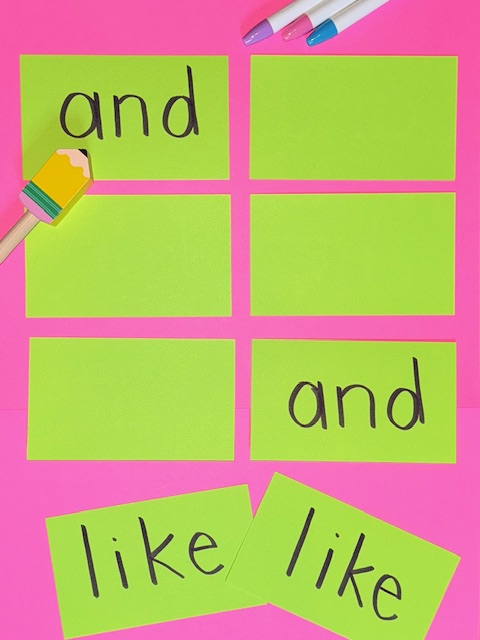
How to play: Memory is a game that students can do with any content—vocabulary words paired with their definitions, chemistry terms paired with images that depict them, or text structures paired with graphic organizers. First, have students create card pairs. Shuffle the cards and put them on the table. Take turns flipping cards over and finding the matching pairs.
Why we love it: Memory is so versatile you can use this game with anything from procedures to vocabulary to history facts.
Bananagrams
Participants: 2 or more
Time: 10 minutes
Objective: Build words quickly.
How to play: Use word tiles to create words and build off of words that others create. The trick: Students have to think fast to build words or they become the “bad banana.”
Why we love it: It’s fast-paced and great for students who are learning and mastering spelling concepts.
Buy it: Bananagrams game at Amazon
Anomia
Participants: 4 or more
Time: Varies
Objective: Name items in a category.
Anomia is a game of naming categories. Each person puts down a category card, and the players with the same image on their card compete to name an item in the other players’ category first. Check out the actual board game, and make your own over the year with categories you’ve taught.
Why we love it: It’s a fast-paced knowledge game that students will want to play again and again.
Buy it: Anomia at Amazon
Charades
Participants: 4 or more
Time: 15 minutes
Objective: Guess the topic, vocabulary, or person that your team is acting out.
How to play: In charades, students choose a card and act out the information on the card. For a unit on weather, you may have the words cloud, tornado, or hurricane, for example. Scaffold this game with three rounds. In the first round, students can explain the topics using a few words. Then, in the second round, they can only use one word to describe what they are acting out. And in the third round, they have to be completely silent, using only their bodies to act out each word.
Why we love it: This game gets students up and moving around and thinking creatively about how to show what they know.
Make Your Own Board Games
Participants: 2 or more
Time: 15 minutes
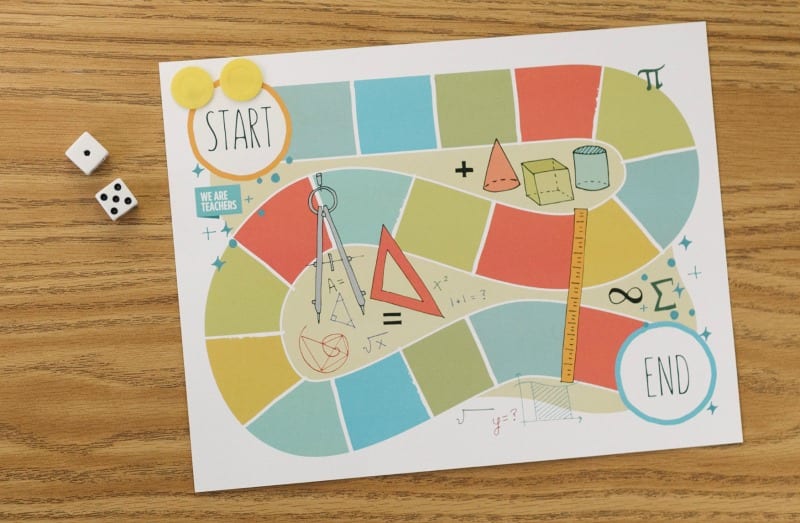
How to do it: Use a board game template to create a board game that matches what your students have been learning. Studying math facts? Fill in each square with a math fact to solve. Working on states and capitals? Write a state in each box and players say the capital as they pass.
Why we love it: Playing games is a great way to review, and when students play together, they can learn from one another.
Printable Game Boards
Print these game boards and personalize them for each unit you teach.
Hot Seat
Participants: 5 or more
Time: 15 minutes
Objective: Answer the most questions while sitting in the hot seat.
How to play: Put students in the hot seat to review the plot points of a story, practice answering questions, or review for a science test. First, choose vocabulary to review. Then, select a student to sit in the hot seat. The other students ask questions about the topic or information. The student in the hot seat must answer as quickly as possible. If their answer is correct, they stay in the hot seat. If they get a wrong answer, they can pass the seat to someone else. (You can take the pressure out of this game, which can make some students nervous, by removing the timed aspect.)
Why we love it: Hot Seat is a great way to get students to practice information they need to have right at the tip of their tongue.
Try it: Hot Seat on YouTube
Scattergories
Participants: 3 or more
Time: 15 minutes
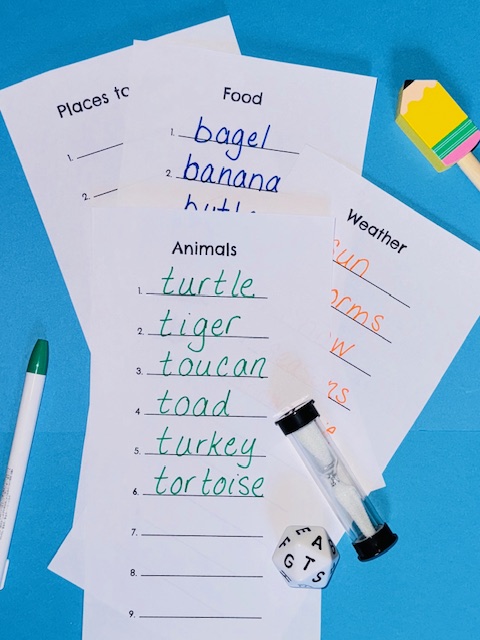
Objective: Come up with words for each combination of category and letter.
How to play: Scattergories can be played for academics or for fun. It also helps students improve their creative thinking. You’ll need a list of at least 10 categories—mix serious topics with silly ones. Then, select a letter of the alphabet. Have students brainstorm words to go with each category that starts with that letter. So, if the categories you have are Weather, Bees, and Favorite Places, and the letter is H, students might write: hurricane, hive, and Hawaii. Give a set amount of time for students to complete their own brainstorm, then share out. Students can rack up points for the number of categories that they complete. And sharing out helps them connect their brainstorming with everyone else’s.
Why we love it: The boundaries that kids have to work in when playing Scattergories are ideal for inspiring creativity.
Fix It Relay Race
Participants: 8 or more
Time: 15 minutes
Objective: Fix all the errors in a sentence before the other team.
How to play: Divide the class into teams of four to six students, and prepare sentences that each have an error—it could be a factual error for content classes or grammar or spelling mistakes for language classes. Arrange students in a line, standing a few feet apart. The first student in each team must correct one mistake in the sentence they are given. Then, they pass the card to the next teammate. The next student corrects another mistake. This continues until each team member has seen the card and they think all the errors are corrected. Then they run the card to the front to complete the relay.
Why we love it: Teams work together to complete each task.
Word Scramble
Participants: 4 or more
Time: 5 minutes
Objective: Use knowledge of words to find as many words as you can in a given word.
How to play: Each student or group has a word. The goal is to pull as many words out of the original word as possible within the time limit.
Why we love it: Word Scramble encourages flexibility, and students may be surprised at what they see in each game.
Try it: Word Scramble on YouTube
Who Am I?
Participants: 5 or more
Time: 10 minutes
Objective: Ask questions to figure out which topic or person you are.
How to play: This is another classic game that can be adapted to any academic context. Each student gets a card that is taped to their back or forehead. The card has the name of a person or a topic you’re studying written on it. Then, the students circulate and ask questions of one another to try to figure out who or what is taped to them.
Why we love it: This game is easily differentiated by providing students with personalities that you know they are familiar with, and by providing them with questions to ask or a checklist of personalities that they can be thinking about as they figure out who everyone is.
Stickyball Bingo
Participants: 4 or more
Time: 15 minutes
Objective: Get bingo by reading words, defining vocabulary, or solving math problems.
How to play: Create a bingo board on your whiteboard with the words that you want students to work with or the math problems you want them to do. Then, have students throw a sticky ball at the board. They must read the word the ball lands on, or solve the math problem, to get the space.
Why we love it: When their aim is poor, students may have to answer questions that push them out of their comfort zone.
Try it: Stickyball Bingo on YouTube
Musical Chairs
Participants: 5 or more
Time: 10 minutes
Objective: Find a chair and work with a peer to answer a question.
How to play: Prepare a list of discussion questions or prompts. Students choose a card, then walk around the room while music plays. When the music stops, they find a partner and work on the questions they see on the card. You can prepare cards with math or science problems, questions from social studies, getting-to-know-you questions, or silly questions. Changing the type of questions that students are working with keeps this game fresh.
Why we love it: Musical chairs really gets students up and moving, and if you remove the loss of a chair each time, all students can stay in the game.
Learn more: School-appropriate songs kids love and Trivia Questions for Kids
Tens and Hundreds Game
Participants: 1 or 2
Time: 10 minutes
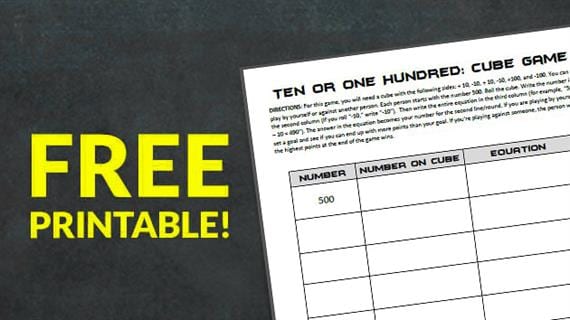
Objective: Add and subtract until you reach a goal number.
How to play: Students roll a cube and add or subtract 10 or 100 depending on the result. The goal is to reach a certain number.
Why we love it: It’s fast-paced math practice and never the same game twice.
Flash Card Duel
Participants: 2 or more
Time: 15 minutes
Objective: Gain all the cards in a deck by solving problems or answering questions.
How to play: Students each have a set of flash cards and use them to “duel.” In pairs, students show each other a flash card one at a time. If they answer the card right, they get to keep the card. If they don’t, their partner keeps the card.
Why we love it: It’s fast-paced and easy for students to pick up and play during a few minutes of downtime.
Try it: Flash Card Duel on YouTube
Boggle
Participants: 1 or more
Time: 10 minutes
Objective: Find as many words as you can using the letters in a grid.
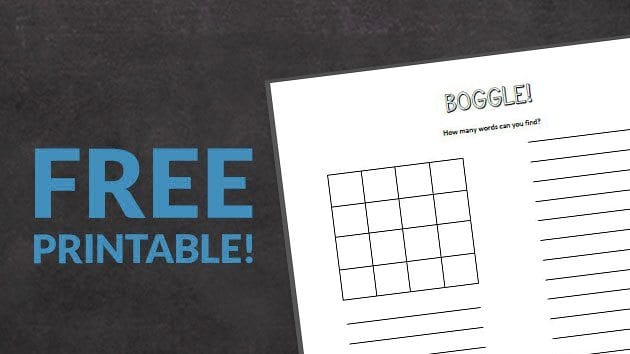
How to play: Provide students with a printed Boggle sheet or the Boggle game. Students write down as many words as they can find using the letters in the grid.
Why we love it: Boggle is a classic game that flexes kids’ language abilities.
Buy it: Boggle at Amazon
Boggle Printable
Print out this Boggle page, fill in the grid, and let students play!
Bozo Buckets
Participants: 4 or more
Time: 10 minutes
Objective: Toss the balls into all the Bozo Buckets.
How to play: Put questions about what you’re working on in class in the bottom of buckets. Have students toss a ball or beanbag into the buckets. When they get a ball or beanbag in, they answer the question in the bucket.
Why we love it: Bozo Buckets gets kids moving around and encourages them to cheer each other on.
Penny Pitch
Participants: 2 or more
Time: 10 minutes
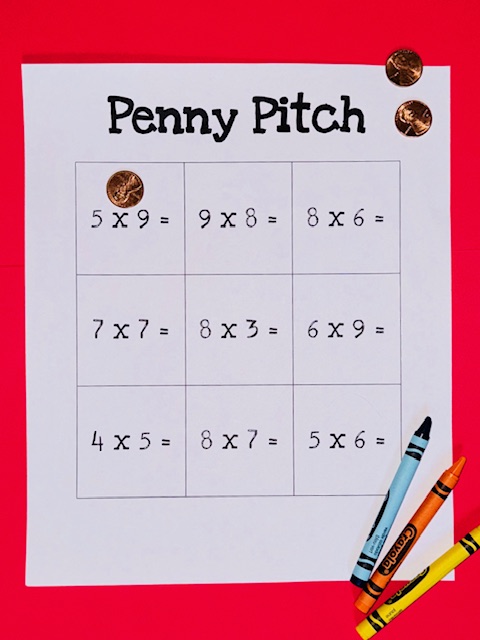
Objective: Toss pennies and get 3 in a row or cover all the spaces in your card.
How to play: Set up a paper divided into spaces with a question or math problem on each space. Students sit or stand away from the paper and toss pennies onto the paper. Then, they answer each question their penny lands on.
Why we love it: Depending on the size of the paper, you can create desk-sized Penny Pitch games for small groups or a large board for the entire class.
Kahoot!
Participants: 2 or more
Time: 10 minutes
Objective: Score the most points in multiple-choice trivia games.
How to play: With Kahoot, you can create games related to any topic you are working on. Create multiple-choice, Jeopardy-esque games, and students compete to earn the most points. It’s engaging, fun, and fast-paced. You should know, however, that Kahoot isn’t the only option for online games. Check out these Kahoot alternatives.
Why we love it: Kids love playing on interactive online interfaces, and we love that we can find or create an interactive game for any lesson.
Learn more: Fun Kahoot Ideas, Tips, Topics, and Games
Battleship
Participants: 2
Time: 20 minutes
Objective: Sink the other player’s ship.
How to play: Two players place their battleships on the grid. Then, they try to sink each other’s ships by guessing where each one is. The trick is they have to use coordinate planes to do it. You can buy the game or use grid paper to have students create their own.
Buy it: Battleship at Amazon
Tic-Tac-Toe
Participants: 2 or more
Time: 5 minutes
Objective: Get 3 Xs or Os in a row.
How to play: Divide students into teams. Have students complete math problems or answer questions. When they get a question correct, they can add an X or O to the tic-tac-toe board.
Why we love it: It’s a simple game so students can play many rounds, which maintains momentum as you review material.
I Spy
Participants: 3 or more
Time: 5 minutes
Objective: Name the item that your teammate has spotted.
How to play: Put images from your last unit up around your classroom and have students guess based on clues you give. For example, “I spy an invertebrate …”
Why we love it: It’s a classic game that can be adapted to any subject, and there are lots of opportunities for students to ask questions.
Proof!
Participants: 2 or more
Time: 10 minutes
Objective: Use the cards available to create and solve math equations.
How to play: In this math game, students put down cards and find the ways to use the numbers to create equations. For example, if you see a 4, 5, and 20, you can take all three with the equation 4 x 5 = 20. The goal is to create as many equations and get as many cards as possible.
Why we love it: This is a more open-ended game to practice math facts, so it’s naturally differentiated.
Buy it: Proof! at Amazon
Duck, Duck, Goose
Participants: 4 or more
Time: 10 minutes
Objective: When you are chosen, quickly race and catch the “goose.”
How to play: This game is a good way to get students up and moving, but give it an educational spin by changing the duck-duck-goose to words from a topic you’ve been studying (e.g., earth-earth-moon) or by having students move when they hear a term with a certain characteristic, like a prime number (2, 4, 7).
Why we love it: Get students up and moving and really paying attention as they listen for “goose.”
Hangman
Participants: 3 or more
Time: 10 minutes
Objective: Guess letters to guess the word before the hangman is complete.
How to play: This is a game that every teacher should have on their go-to list. You draw a spot for a “hangman” and add spaces to represent the letters of a particular phrase or word. Whoever guesses the word or phrase first wins, but every wrong answer means that a body part is added to the hangman. If the hangman is completed first, then the leader wins. Create a list of words and phrases that have to do with what you’re teaching and use a round of hangman as a review.
Why we love it: It’s a game that every student can play—even if they don’t guess the final phrase, they can definitely contribute letters.
Hot Potato
Participants: 5 or more
Time: 5 minutes
Objective: Don’t be the one holding the potato!
How to play: Students sit in a circle and pass the “potato” (a beanbag or ball) around and, as they do, they say a pronoun, or count by 5s, or practice another skill you’ve been working on. They only have until the timer goes off or the music stops. The person holding the potato moves out of the circle when the music stops.
Classroom Games for Communication
Games to play in class that require students to talk and listen to one another are great ways to encourage communication.
Yes, No, Stand Up
Participants: 4 or more
Time: 10 minutes
Objective: Listen to a sentence. Stand up if you say “yes.”
How to play: Have a list of sentences prepared. When you read a sentence, students stand if their response is yes and stay seated if it’s no.
Why we love it: Students practice listening skills and inhibition by standing or not standing in response to your questions.
Try it: Yes, No, Stand Up on YouTube
Blind Square
Participants: 4 or more
Time: 10 minutes
Objective: Work together to place a square of rope on the ground.
How to play: Use a long rope and blindfolds. Have students stand in groups of four, then put the blindfolds on and hold the rope between them so it creates a square. They have to work together to put the rope down on the floor in front of them.
Why we love it: This game is great for middle schoolers to learn to work together.
Try it: Blind Square on YouTube
Odd One Out
Participants: 4 or more
Time: 10 minutes
Objective: Categorize words and find the word that is the odd one out.
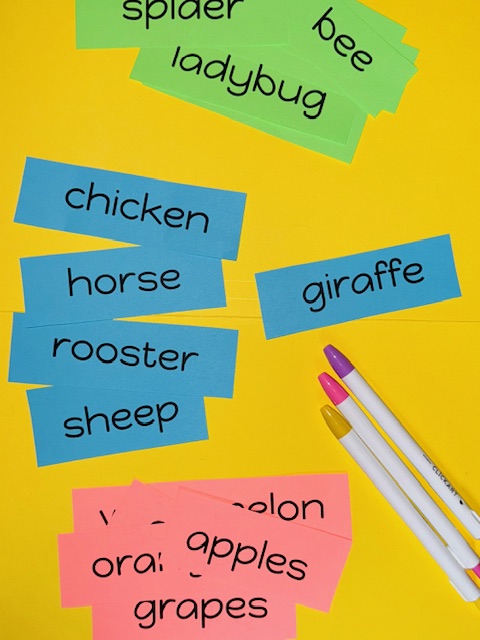
How to play: Prepare this game with a set of words or phrases written on slips of paper. Have students work in pairs or small groups to categorize the words or phrases as they relate to one another. Students have completed the game when they find the odd one out. So, students may have a group of four people from the Revolutionary War but only three who were presidents, so the one who is not a president is the odd one out.
Why we love it: Odd One Out requires students to use critical thinking and working memory as they come to each answer.
Can You Hear Me Now?
Participants: 2 or more
Time: 5 minutes
Objective: Communicate directions for a drawing.
How to play: This is a fun warm-up or cool-down for the day. It’s also a great classroom game to play if you’re teaching virtually. Play as a class or in groups. Each student takes a turn describing an item for the others to draw one step at a time. For example, if the object were “cat,” the description might be: “Draw a circle. Draw two triangles on top of the circle …,” and so on until a cat is drawn. It’ll surprise students how their directions are interpreted and how hard it is to get people to follow their directions.
Why we love it: This is a humorous way to reinforce that students need to be clear in their directions and listen to yours.
Check out: 20 Classroom Zoom Games and Directed Drawing Activities
Find Four
Participants: 1 or more
Time: 5 minutes
Objective: Find which 4 cards fit together.
How to play: Present students with 16 cards that can be grouped into 4 categories with 4 words each. Students work together to figure out how the words fit together. The trick is to create groups that go beyond the obvious. Make this activity more challenging by putting a time limit on it or creating banks of words that are more advanced.
The Rule Game
Participants: 10 or more
Time: 10 minutes
Objective: Guess the rule!
How to play: Send one student into the hallway. The rest of the class creates a rule for that student to guess, such as “only people wearing red can talk.” Then, the student comes back in and tries to figure out the rule with their classmates’ guidance.
Collaboration and Team-Building Classroom Games
Games that require teamwork are ideal for helping kids practice collaboration in short bursts and around a common, if silly, goal.
Minute To Win It
Participants: 5 or more
Time: 1 minute
Objective: Complete the challenge in a minute or less!
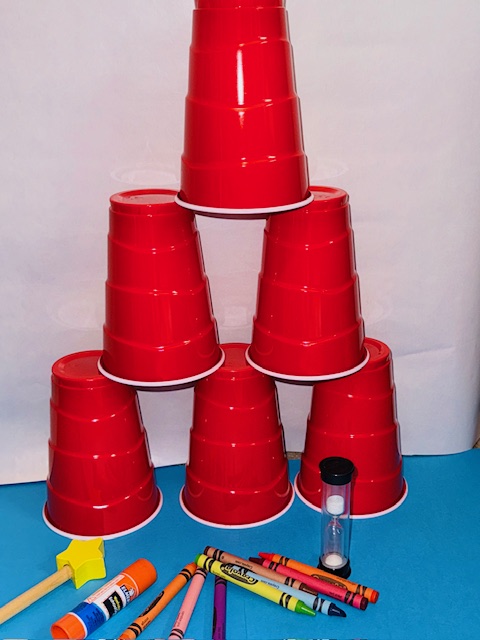
How to play: Challenge your class to compete in tasks that can take under a minute. You could:
- Speed-stack paper cups.
- Roll a coin between fork tongs.
- Transfer pom-poms with chopsticks.
- Build a tower out of marshmallows and toothpicks.
- Pass a balloon from one person to another without using your hands.
- Put together a puzzle.
Why we love it: It’s a quick way to engage students and shift students into a positive frame of mind.
Learn more: Fun and Easy Minute To Win It Games
Over the Electric Fence
Participants: 4 or more
Time: 10 minutes
Objective: Work together to cross the “electric fence” without touching it.
How to play: Put two chairs next to each other, and tell students that they are connected by a wire that is 3 feet high. Even better, string a rope 3 feet high. Students have to imagine that this is an electric fence and if they touch it, they are dead. They’ll help everyone get over the fence and work together to do so. Make it even more challenging by telling students that they have to hold hands while moving everyone from one side of the fence to the other.
Why we love it: Students will have to slow down and figure out exactly how to solve the problem.
Try it: Over the Electric Fence on YouTube
Minefield
Participants: 4 or more
Time: 10 minutes
Objective: Lead your partner through the minefield safely.
How to play: Create a square in your classroom using tape. Then, place plastic cups or cones around the inside of the square. This area is the minefield. Break students into pairs. One student is blindfolded and the other leads them. The students have to cross the minefield without touching or knocking down the plastic cups. The non-blindfolded student gives directions and the blindfolded student must follow them to cross the minefield without blowing up a “mine” or knocking over a cone.
Why we love it: Students will get out of their comfort level while playing this game.
Try it: Minefield on YouTube
Freeze Theater
Participants: 10 or more
Time: 10 minutes
Objective: Keep the scene going, no matter what!
How to play: Start with general everyday scenes (eating dinner, brushing teeth). Have two people act out a scene while everyone else watches. After a predetermined time, stop the scene and have someone swap out for a new player. Then, they have to change how the scene is being done. They could, for example, turn eating dinner into taking care of a pet. Once students are familiar with the game, make it more challenging with prompts from the book you’re reading or history scenarios (e.g., Washington crossing the Delaware turns into the French Revolution).
Why we love it: This game gives older students the opportunity to work with a variety of people and get creative connecting scene to scene.
Check out more team-building activities for kids and cooperative games for kids.
Classroom Games Just for Fun
Sometimes you need classroom games that simply let students have fun and blow off steam!
Go on a Hike
Participants: Whole class
Time: 10 minutes
Objective: To find partners and complete the actions as instructed.
How to play: To play this game, you say “go for a hike.” When they hear that prompt, students walk around the classroom. Then, you will give them one of four commands in a random order. When you say “bonfire,” students get into groups of two and pretend to be sitting by a fire. When you say “build a tent,” they get into groups of three and create a “tent” with their arms. When you say “s’mores,” they get into groups of four, line up, and smoosh together. In between, when you say “go for a hike,” they will keep walking. The goal is to find partners and complete the action. If they don’t find a partner they are out.
Why we love it: It’s a creative way to get kids moving around and working with people they may not usually work with.
Categories
Participants: Whole class
Time: 10 minutes
Objective: Find an item to go with each category.
How to play: Students stand in a circle. Name a category (pets, pizza toppings, etc). One student starts by saying an item that fits into the category. Then, one at a time, each student provides an item that hasn’t been said yet. The goal is to go all the way around the circle without repeating an item.
Why we love it: It gets kids’ brains turned on for listening and thinking.
Silent Ball
Participants: 5 or more
Time: 5 minutes
Objective: Pass the ball without dropping it OR talking.
How to play: The main rule is that students can’t talk. And if you drop the ball, you’re out.
Why we love it: Silent ball is a great transition game. Once students learn the rules, they can play this game at the drop of a hat.
Try it: Silent Ball
Freeze Dance
Participants: 5 or more
Time: 5 minutes
Objective: Dance when the music starts, freeze when it stops.
How to play: This is a great brain break. Put on music and dance (challenge kids to a Floss-off or the Macarena to get everyone moving). Then, pause the music, and any student who unfreezes before the music starts again is out.
Why we love it: You’ll see some students come out of their shells once the music starts.
Heads Up, Seven Up
Participants: 14 or more
Time: 10 minutes
Objective: Guess who “picked” you, or pick someone without them knowing it was you.
How to play: Choose seven students to be “pickers.” Everyone else puts their heads on their desks with their thumb up. Each picker chooses one person by pressing their thumb down. When everyone has chosen a person, say “heads up, 7 up.” Anyone who was tapped has one guess at who chose them. If they are right, the “picker” sits down and the person they chose is a new picker. Play as many rounds as you can in the time you have.
Why we love it: This is a classroom game we remember from our elementary school years, and now we’re passing it along!
Try it: Heads Up, Seven Up on YouTube
Tic-Tac-Toe
Participants: 2 or more
Time: 5 minutes
Objective: Get 3 in a row!
How to play: There are lots of versions of tic-tac-toe, from drawing Xs and Os to tossing beanbags into spaces. Use a version of tic-tac-toe during the dreaded indoor recess or as a brain break.
Why we love it: It doesn’t matter which of these classroom games you choose, tic-tac-toe is a quick game that’s always a winner.
Try it: Hula-Hoop Tic Tac Toe on YouTube
20 Objects
Participants: 2 or more
Time: 10 minutes
Objective: Memorize as many objects as you can in 1 minute.
How to play: Place a number of objects (up to 20) on a table (or post on a slide with 20 words or pictures) and have students take one minute to try to memorize as many as they can. Then, cover the objects or hide the slides and have students write down as many as they can remember. Play this game once a week or so and see how students improve their memory strategies.
Why we love it: Students will sharpen their focus and memory skills trying to remember as many objects as possible.
Try it: 20 Objects on YouTube
For more articles like this, be sure to subscribe to our newsletters to find out when they’re posted!
Plus, check out these top online educational games.